

Preparation method and application of immobilized Brevundimonas naejangsanensis bacteria highly efficient in degrading Dimetachlone
A high-efficiency technology for degrading bacteria and single cells, which is applied in the field of biotechnology to degrade pesticide residues and achieves remarkable effects, good lasting effect, and environmental friendliness.
- Summary
- Abstract
- Description
- Claims
- Application Information
AI Technical Summary
Problems solved by technology
Method used
Image

Examples
Embodiment 1
[0018] 1. Screening of immobilized carrier:
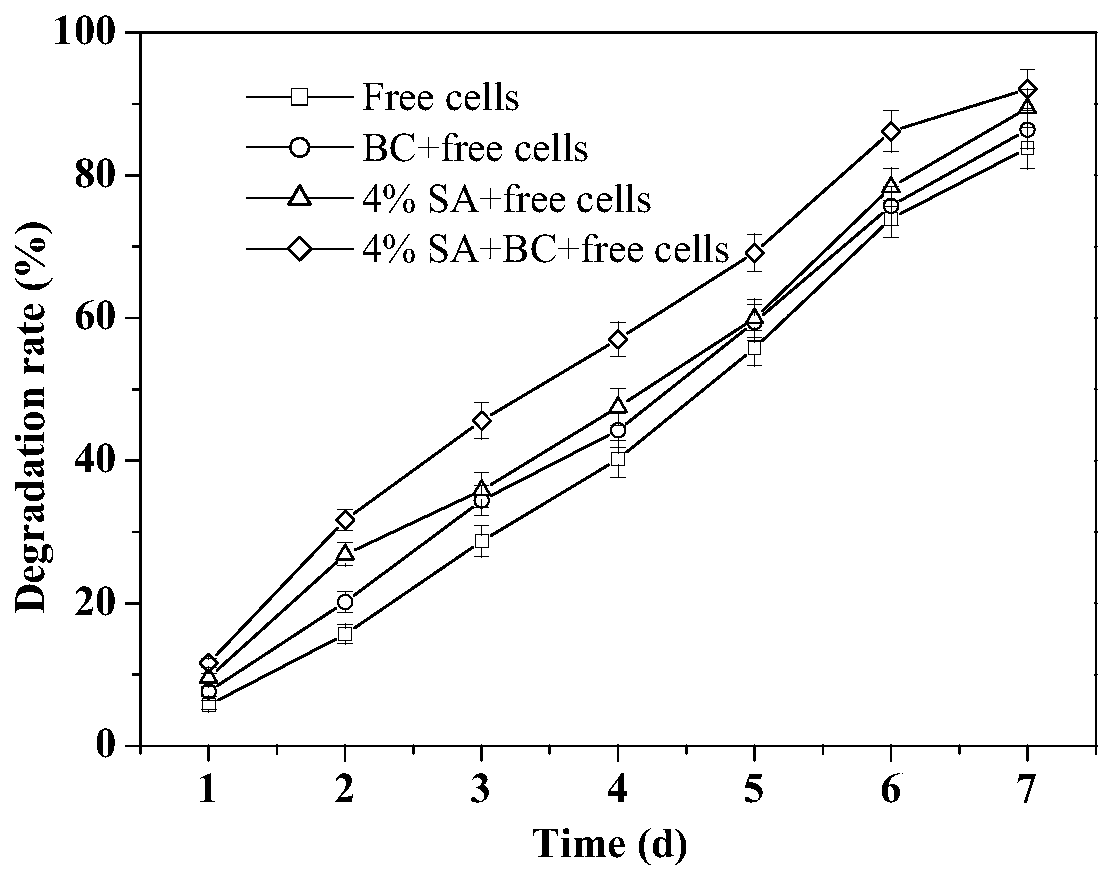
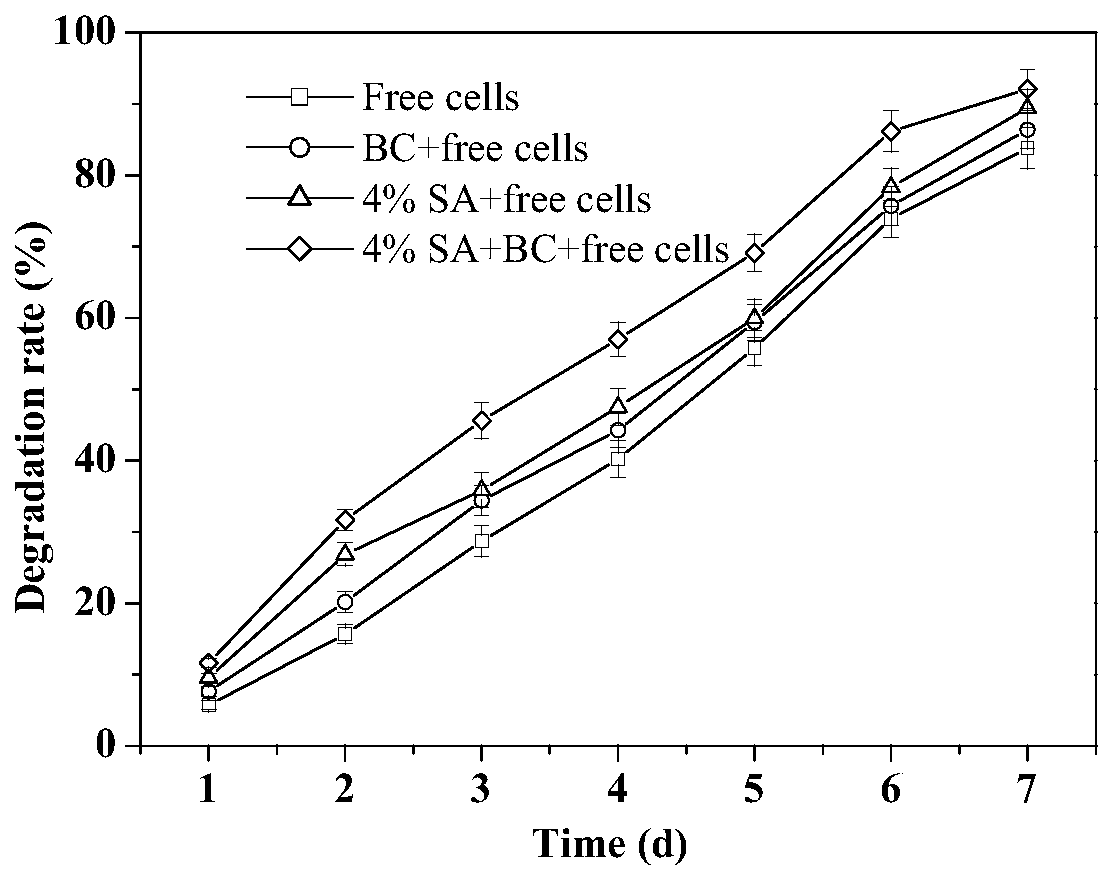
[0019] Preliminary experiments showed that in 1%, 2%, 3%, 4%, 5% sodium alginate (SA) immobilized and suspended free cells, 4% SA showed a better effect. Furthermore, the experiment measured the degradation effect of free cells, bamboo charcoal (BC) + free cells, 4% SA + free cells, 4% SA + bamboo charcoal (BC) + free cells on 75 mg / L of Sclerotium. The results are shown in figure 1 .
[0020] 2. Preparation of immobilized bacteria:
[0021] 1) Preparation of bacterial suspension: under aseptic conditions, add 2 mL of sterile phosphate buffer to the culture dish for 48 hours of culture and shake in parallel, and gently scrape off the colonies on the surface of the medium with an inoculating loop to form a crude bacterial suspension Transfer it to a liquid fermentation medium (maltose 7g / L, yeast extract 6g / L, NaCl 3g / L), and culture for 48-56h at a pH of 7.5-8, 30-35°C and 150-200rpm. The removed fermentation broth was immediately centr...
PUM
| Property | Measurement | Unit |
|---|---|---|
| diameter | aaaaa | aaaaa |
| particle diameter | aaaaa | aaaaa |
| diameter | aaaaa | aaaaa |
Abstract
Description
Claims
Application Information
 Login to View More