Supercharge Your Innovation With Domain-Expert AI Agents!

A kind of method for collecting cellulose-degrading bacteria cells

A technology of cellulose-degrading bacteria and cellulase, applied in the field of environmental microorganisms, can solve the problems of unfavorable collection of bacteria, difficulty in reflecting enzyme activity, unfavorable bacterial proliferation, etc.

Active Publication Date: 2022-07-08
FUJIAN AGRI & FORESTRY UNIV
View PDF0 Cites 0 Cited by
  • Summary
  • Abstract
  • Description
  • Claims
  • Application Information

AI Technical Summary

Problems solved by technology

[0004] 1. When using a solid culture plate to collect samples, repeated washing and centrifugation with sterile water are required, so that it takes about 5 minutes to collect a sample, which makes it difficult for the results of enzyme activity characterization to reflect the enzyme activity under actual culture conditions;
[0005] 2. When using liquid CMC medium to collect samples, due to the high viscosity of CMC liquid medium, it is not conducive to the proliferation of bacteria, and it is also not conducive to collecting bacteria by centrifugation

Method used

the structure of the environmentally friendly knitted fabric provided by the present invention; figure 2 Flow chart of the yarn wrapping machine for environmentally friendly knitted fabrics and storage devices; image 3 Is the parameter map of the yarn covering machine
View more

Image

Smart Image Click on the blue labels to locate them in the text.
Viewing Examples
Smart Image
  • A kind of method for collecting cellulose-degrading bacteria cells
  • A kind of method for collecting cellulose-degrading bacteria cells
  • A kind of method for collecting cellulose-degrading bacteria cells

Examples

Experimental program
Comparison scheme
Effect test

Embodiment 1

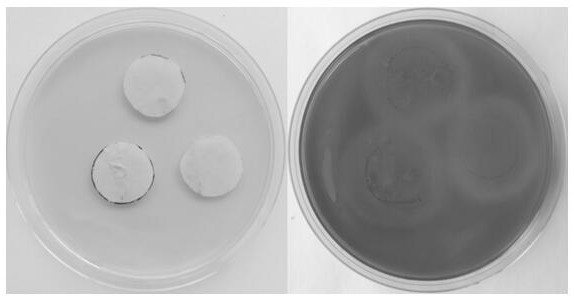
[0029] Example 1: Characterization of the cellulose degrading ability of the bacteria according to the present invention

[0030] 1. The CMC medium used in the embodiment is composed of: CMC-Na 15 g, NH 4 NO 3 1 g, yeast extract 1 g, MgSO 4 ·7H 2 O 0.5 g, KH 2 PO 4 1 g, 15 g agar, dilute to 1 L with distilled water, sterilize at 121°C for 20 min by autoclaving;

[0031] 2. The concentration of Congo red dye solution used in this example is 1 mg / ml, and the concentration of NaCl solution is 1 mol / L;

[0032] 3. The cellulose degrading bacteria used in this example are Bacillus subtilis (the deposit number is CGMCC No. 18089) and Bacillus alpine (the deposit number is CGMCC No. 17046).

[0033] 4. The cells were expanded and cultured in LB liquid medium, shaking at 37 °C and 150 rpm for 12 h.

[0034] 5. Collect the bacterial liquid cultured overnight into a 10 ml sterilized centrifuge tube, centrifuge at 6000 rpm for 5 min at room temperature, collect the bacterial pre...

Embodiment 2

[0041] Example 2: Characterization of cellulase activity of bacterial cells according to the present invention

[0042] On the CMC solid plate, use the method in Example 1 to cultivate cellulose-degrading bacteria for 72 h, quickly clip the filter paper with sterile tweezers, put it into a sterilized centrifuge tube, and use the DNS method to determine the bacterial fiber enzyme activity.

[0043] 1, the CMC medium used in the embodiment is formed with embodiment 1;

[0044] 2. The cellulose degrading bacteria used in this example are the same as those in Example 1;

[0045] 3. In this example, an ultraviolet spectrophotometer (UV) was used to measure the absorbance of the treated sample;

[0046] 3. The absorbance and cellulase activity measured in this example are as follows:

[0047] Table 1 Enzyme activity detection results

[0048]

[0049] The above proves that the bacteria collected by the method of the present invention can be quantitatively detected by cellulas...

Embodiment 3

[0050] Example 3: The samples collected by the method of the present invention are used for DNA extraction

[0051] On the CMC solid plate, use the method of Example 1 to cultivate cellulose-degrading bacteria for 72 h, quickly clip out the filter paper with sterile tweezers, put it into a sterilized centrifuge tube, and extract the filter paper with phenol chloroform. bacterial DNA.

[0052] 1, the CMC medium used in the embodiment is formed with embodiment 1;

[0053] 2. In this example, Nanodrop 2000 was used to measure the DNA content;

[0054] 3. The cellulose degrading bacteria used in this example are the same as in Example 1;

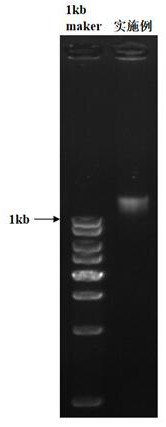
[0055] 4. In the examples, 1% agarose gel electrophoresis was used to obtain clear and bright DNA bands ( figure 2 );

[0056]5. Compared with the traditional method of collecting bacteria (coating method), the method of filter paper can stably extract DNA and perform subsequent PCR experiments.

[0057] Table 2 Nanodrop 2000 test results ...

the structure of the environmentally friendly knitted fabric provided by the present invention; figure 2 Flow chart of the yarn wrapping machine for environmentally friendly knitted fabrics and storage devices; image 3 Is the parameter map of the yarn covering machine
Login to View More

PUM

No PUM Login to View More

Abstract

The invention provides a method for collecting cellulose-degrading bacterial cells, which belongs to the technical field of environmental microorganisms. The specific steps are: first use LB liquid medium to expand the culture of cellulose-degrading bacteria; remove the medium by centrifugation, blow and suck the bacteria evenly with sterile water and use it as an inoculum; sterile filter paper dips the bacteria liquid and spreads it on the CMC solid culture plates were cultured at 37°C for 72 h; the samples needed to detect the activity of cellulose-degrading bacterial cellulase were obtained by collecting filter paper. The method is simple in operation, stable, time-saving and reliable in results, and has extensive application value in the characterization of cellulase activity of cellulose-degrading bacteria.

Description

technical field [0001] The invention relates to the field of environmental microorganisms, in particular to a method for rapidly collecting cellulose-degrading bacteria cells. Background technique [0002] Cellulose-degrading bacteria refer to bacteria that can degrade cellulose. Through the action of cellulase produced in the bacteria, the difficult-to-degrade cellulose is decomposed into cellobiose, which is further decomposed into glucose which is easily decomposed and utilized. Cellulose-degrading bacteria are widely distributed in humus and the intestinal tract of herbivorous animals, and can be divided into aerobic degrading bacteria and anaerobic degrading bacteria. There are many cellulose resources on the earth, more than half of which are not used, resulting in waste of resources and environmental pollution. The degradation of cellulose in nature is mainly through biodegradation, so screening high-efficiency cellulose-degrading bacteria plays an important role in ...

Claims

the structure of the environmentally friendly knitted fabric provided by the present invention; figure 2 Flow chart of the yarn wrapping machine for environmentally friendly knitted fabrics and storage devices; image 3 Is the parameter map of the yarn covering machine
Login to View More

Application Information

Patent Timeline
no application Login to View More
Patent Type & Authority Patents(China)
IPC IPC(8): C12N1/20C12N9/42C12Q1/34C12R1/125C12R1/07
CPCC12N1/20C12N9/2437C12Q1/34Y02W30/40
Inventor 石振华张琪周顺桂
Owner FUJIAN AGRI & FORESTRY UNIV
Features
  • R&D
  • Intellectual Property
  • Life Sciences
  • Materials
  • Tech Scout
Why Patsnap Eureka
  • Unparalleled Data Quality
  • Higher Quality Content
  • 60% Fewer Hallucinations
Social media
Patsnap Eureka Blog
Learn More