
A kind of rare earth Y-type molecular sieve and preparation method thereof
A molecular sieve and rare earth technology, which is applied in molecular sieve catalysts, chemical instruments and methods, physical/chemical process catalysts, etc., can solve problems such as complex processes, and achieve simple and easy operation, reduced coke selectivity, and high cracking activity and stability. Effect
- Summary
- Abstract
- Description
- Claims
- Application Information
AI Technical Summary
Problems solved by technology
Method used
Image

Examples
Embodiment 1
[0026] Take 100g NaY molecular sieve (Changling Branch of Sinopec Catalyst Company, 74.1% by weight on ignition, 89.3% crystallinity, the same below) and 1800g deionized water to mix and beat, add 20ml of concentration to 357gRE 2 O 3 / L rare earth chloride salt solution and 2g ammonium chloride solid, stir evenly, heat up to 70°C, adjust the pH value of the slurry to 4.5 with dilute hydrochloric acid, and stir at constant temperature for 1h. After filtration, washing and drying, external pressure was applied and water was added to make it calcined at 500°C, apparent pressure 0.3Mpa, and 100% water vapor atmosphere for 2h to obtain the product, which is denoted as PAY-1.
[0027] In the chemical composition of PAY-1, rare earth oxide is 10.1% by weight.
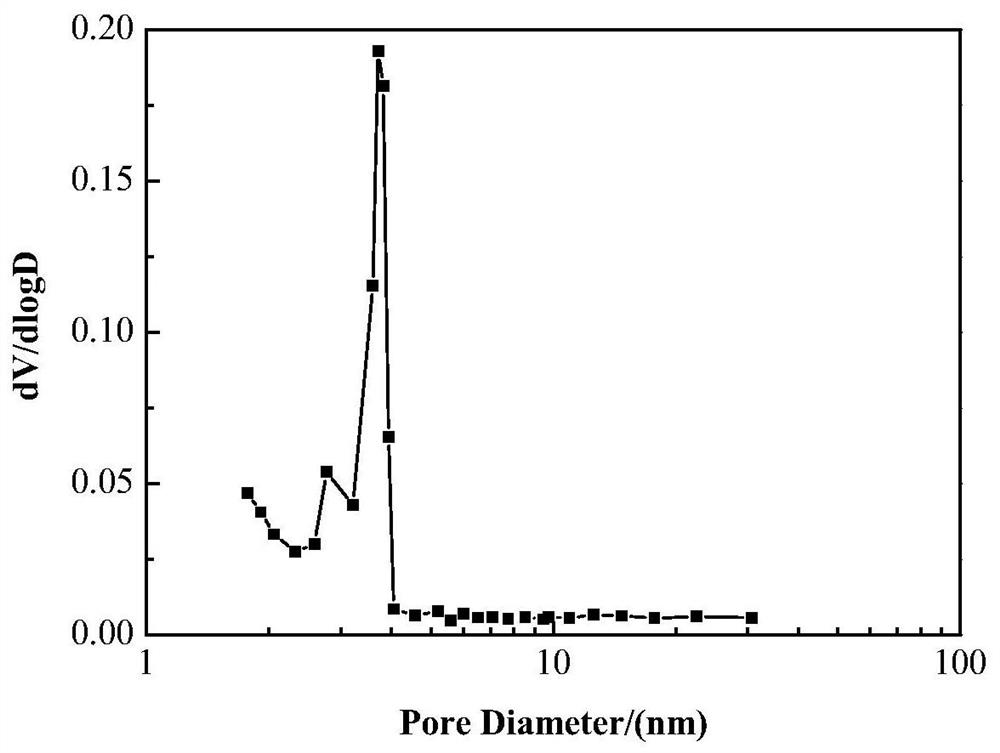
[0028] figure 1 The pore size distribution curve calculated according to the BJH model for PAY-1. from figure 1 It can be seen that there are at least two kinds of mesopore size distributions, which are at 2-3 nm and 3-4 nm...
Embodiment 2
[0040] Take 100g NaY molecular sieve and 1000g deionized water, mix and beat, add 16ml concentration to 357gRE 2 O 3 / L rare earth chloride salt solution and 8g ammonium chloride solid, stir evenly, heat up to 60°C, adjust the pH value of the slurry to 4.0 with dilute hydrochloric acid, and stir at constant temperature for 1.5h. After filtration, washing and drying, external pressure was applied and water was added to make the sample hydrothermally calcined at 430°C, apparent pressure 0.8Mpa, and 50% water vapor for 0.5h to obtain a sample, which was designated as PAY-2.
[0041] In the chemical composition of the PAY-2 molecular sieve, the rare earth oxide is 8.2% by weight.
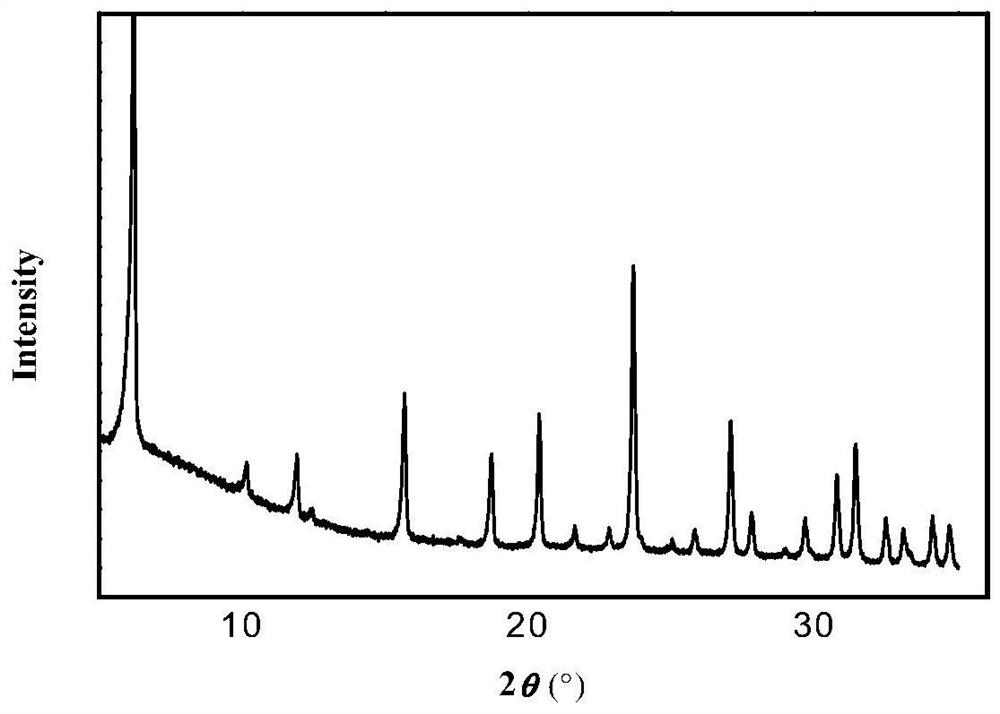
[0042] The BJH pore size distribution curve and XRD pattern of PAY-2 are the same as figure 1 , 2 Characteristics.
[0043] In the BJH pore size distribution curve, the ratio of the peak area of the 2-3 nm pore size distribution to the peak area of the 3-4 nm pore size distribution is 0.3.
[0...
Embodiment 3
[0046] Take 100g of NaY molecular sieve and 2200g of deionized water to mix and beat, add 24ml of concentration to 357gRE 2 O 3 / L rare earth chloride salt solution, stir evenly, heat up to 70 °C, adjust the pH value of the slurry to 3.5 with dilute hydrochloric acid, and stir at constant temperature for 1 h. After filtration, washing and drying, external pressure was applied and water was added to make it hydrothermally calcined at 520°C, apparent pressure 0.4Mpa, and 100% steam atmosphere for 1.5h to obtain the product, denoted as PAY-3.
[0047] In the chemical composition of PAY-3, rare earth oxide is 11.4% by weight.
[0048] The BJH pore size distribution curve and XRD pattern of PAY-3 are the same as figure 1 , 2 Characteristics.
[0049] In the BJH pore size distribution curve, the ratio of the peak area of the 2-3 nm pore size distribution to the peak area of the 3-4 nm pore size distribution is 0.25.
[0050] XRD spectrum test the intensity I of its 2θ=11.8±...
PUM
| Property | Measurement | Unit |
|---|---|---|
| crystallinity | aaaaa | aaaaa |
Abstract
Description
Claims
Application Information
 Login to View More