Check patentability & draft patents in minutes with Patsnap Eureka AI!

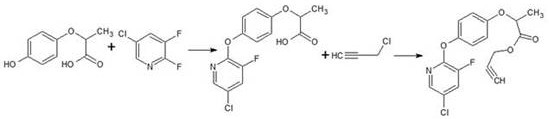
Synthesis method of clodinafop-propargyl

A synthetic method, the technology of clodinafop-propargyl, which is applied in the field of synthesis of clodinafop-propargyl, can solve the problems of affecting the quality of clodinafop-propargyl products, low synthesis efficiency, cumbersome synthesis steps, etc.

Inactive Publication Date: 2021-01-22
甘肃联凯生物科技有限公司
View PDF5 Cites 0 Cited by
  • Summary
  • Abstract
  • Description
  • Claims
  • Application Information

AI Technical Summary

Problems solved by technology

[0002] The content of 2,3-difluoro-5-chloropyridine currently available on the market is basically about 96%, of which 3% (area normalization method) isomers, in the synthesis process of clodinafop-propargyl Among them, the above-mentioned 3% (area normalization method) isomers will eventually form about 3% (area normalization method) isomers of clodinafop-propargyl as the reaction proceeds, which will affect the final clodinafop-propargyl product quality
[0003] In order to improve the purity of the clodinafop-propargyl product, there are generally purification steps in the currently disclosed synthetic route of clodinafop-propargyl, which makes the synthesis steps more cumbersome and the synthesis efficiency is low

Method used

the structure of the environmentally friendly knitted fabric provided by the present invention; figure 2 Flow chart of the yarn wrapping machine for environmentally friendly knitted fabrics and storage devices; image 3 Is the parameter map of the yarn covering machine
View more

Image

Smart Image Click on the blue labels to locate them in the text.
Viewing Examples
Smart Image
  • Synthesis method of clodinafop-propargyl

Examples

Experimental program
Comparison scheme
Effect test

Embodiment approach 1

[0018] Dissolve 72.9g (0.4mol) DHPPA in 200g acetonitrile, stir and heat up, add 0.3g sodium sulfite and 55g (0.97mol) KOH at 50°C, and start adding 66g of 2,3-difluoro-5-chloropyridine dropwise when the temperature rises to 60°C (0.44mol), after the dropwise addition, the temperature was raised to 70°C for 5 hours. After the heat preservation, remove acetonitrile under reduced pressure, add 200g of water after removing acetonitrile, add dropwise hydrochloric acid with a mass fraction of 30% to adjust pH = 1, cool and precipitate, filter, and wash with water to obtain a dry etherified product: 124.6g.

[0019] Feed 62.3g (about 0.2mol) of ether compound and 82g of DMF into a 500mL four-necked bottle and heat up until the material is completely dissolved. Add 30g (0.22mol) of potassium carbonate and heat up to 60°C. Add 20g (0.27mol) of propyne chloride dropwise. Finish at 65°C for 4 hours. Heat preservation finishes adding water 100g, toluene 130g, stirring and dissolving, st...

Embodiment approach 2

[0021] Dissolve 72.9g (0.4mol) of DHPPA in 200g of acetonitrile, stir and heat up, add 0.3g of sodium sulfite and 53.3g (0.95mol) of KOH at 50°C, and start adding 2,3-difluoro-5-chloropyridine dropwise when the temperature rises to 60°C 66g (0.44mol), the dropwise addition was completed and the temperature was raised to 70°C for 5 hours. After the heat preservation is over, remove acetonitrile under reduced pressure, add 200 g of water after removing the acetonitrile, add dropwise hydrochloric acid with a mass fraction of 30% to adjust pH = 1, cool and precipitate, filter, and wash with water to obtain a dry etherified product: 124 g.

[0022] Feed 62g (about 0.2mol) of ether compound and 82g of DMF into a 500mL four-necked bottle and heat up until the material is completely dissolved. Add 30g (0.2mol) of potassium carbonate and heat up to 60°C. Add 20g (0.27mol) of propyne chloride dropwise, and the addition is completed Incubate at 65°C for 4 hours. Heat preservation finish...

Embodiment approach 3

[0024] Dissolve 72.9g (0.4mol) of DHPPA in 200g of acetonitrile, stir and raise the temperature, add 0.3g of sodium sulfite and 56.1g (1mol) of KOH at 50°C, and start adding 2,3-difluoro-5-chloropyridine 74.7 dropwise at 60°C g (0.5mol), after the dropwise addition, the temperature was raised to 70°C for 6 hours. After the heat preservation is over, remove acetonitrile under reduced pressure, add 200 g of water after removing the acetonitrile, add dropwise hydrochloric acid with a mass fraction of 30% to adjust the pH to 1, cool and precipitate, filter, and wash with water to obtain a dry etherified product: 130 g.

[0025] Feed 65g (about 0.2mol) of ether compound and 82g of DMF into a 500mL four-necked bottle and heat up until the material is completely dissolved. Add 30g (0.22mol) of potassium carbonate and heat up to 60°C. Add 20g (0.27mol) of propyne chloride dropwise, and the addition is completed Incubate at 65°C for 4 hours. Heat preservation finishes adding water 100...

the structure of the environmentally friendly knitted fabric provided by the present invention; figure 2 Flow chart of the yarn wrapping machine for environmentally friendly knitted fabrics and storage devices; image 3 Is the parameter map of the yarn covering machine
Login to View More

PUM

No PUM Login to View More

Abstract

The invention relates to the field of chemical engineering, and discloses a synthesis method of clodinafop-propargyl. The method comprises the following steps of: dissolving DHPPA in an organic solvent, heating to a temperature of 50 DEG C, adding an antioxidant and potassium hydroxide, heating to a temperature of 60 DEG C, starting to dropwise add 2, 3-difluoro-5-chloropyridine, heating to a temperature of 70 DEG C after completing the dropwise addition; removing the organic solvent under reduced pressure after heat preservation is finished, adding water after the organic solvent is completely removed, adjusting the pH value to be 1-2, cooling and separation are carried out, performing filtering, performing washing with water to obtain etherate; dissolving the etherate in DMF, heating until the etherate is completely dissolved, adding potassium carbonate, heating to 60 DEG C, dropwise adding propargyl chloride, and keeping the temperature at 60-70 DEG C after after completing the dropwise addition; after completing heat preservation, adding water and methylbenzene, stirring for dissolving, performing still standing for layering, and washing; and decolorizing an organic layer, performing filtering, desolventizing a filtrate with water vapor, and performing slicing to obtain the clodinafop-propargyl finished product. According to the synthesis method, on the premise that a purification step is omitted, the isomeride in the clodinafop-propargyl product is controlled to be about 1% (area content).

Description

technical field [0001] The invention relates to the field of chemical industry, in particular to a method for synthesizing clodinafop-propargyl. Background technique [0002] The content of 2,3-difluoro-5-chloropyridine currently available on the market is basically about 96%, of which 3% (area normalization method) isomers, in the synthesis process of clodinafop-propargyl Among them, the above-mentioned 3% (area normalization method) isomers will eventually form about 3% (area normalization method) isomers of clodinafop-propargyl as the reaction proceeds, which will affect the final clodinafop-propargyl product quality. [0003] In order to improve the purity of the clodinafop-propargyl product, the currently disclosed synthetic route of clodinafop-propargyl generally has a purification step, which makes the synthetic steps more cumbersome and the synthesis efficiency is low. Contents of the invention [0004] Purpose of the invention: Aiming at the problems existing in...

Claims

the structure of the environmentally friendly knitted fabric provided by the present invention; figure 2 Flow chart of the yarn wrapping machine for environmentally friendly knitted fabrics and storage devices; image 3 Is the parameter map of the yarn covering machine
Login to View More

Application Information

Patent Timeline
no application Login to View More
Patent Type & Authority Applications(China)
IPC IPC(8): C07D213/643
CPCC07D213/643
Inventor 赵飞四覃能东任永辉蒋云翔
Owner 甘肃联凯生物科技有限公司
Features
  • R&D
  • Intellectual Property
  • Life Sciences
  • Materials
  • Tech Scout
Why Patsnap Eureka
  • Unparalleled Data Quality
  • Higher Quality Content
  • 60% Fewer Hallucinations
Social media
Patsnap Eureka Blog
Learn More