

Preparation method of self-repairing material and application of self-repairing material
A technology of self-healing materials and oligomers, applied in the direction of friction generators, etc., can solve the problems of low tensile properties, long repair time of self-healing materials, low repair efficiency, etc., and achieve high tensile properties and excellent self-healing properties Effect
- Summary
- Abstract
- Description
- Claims
- Application Information
AI Technical Summary
Problems solved by technology
Method used
Image

Examples
Embodiment Construction
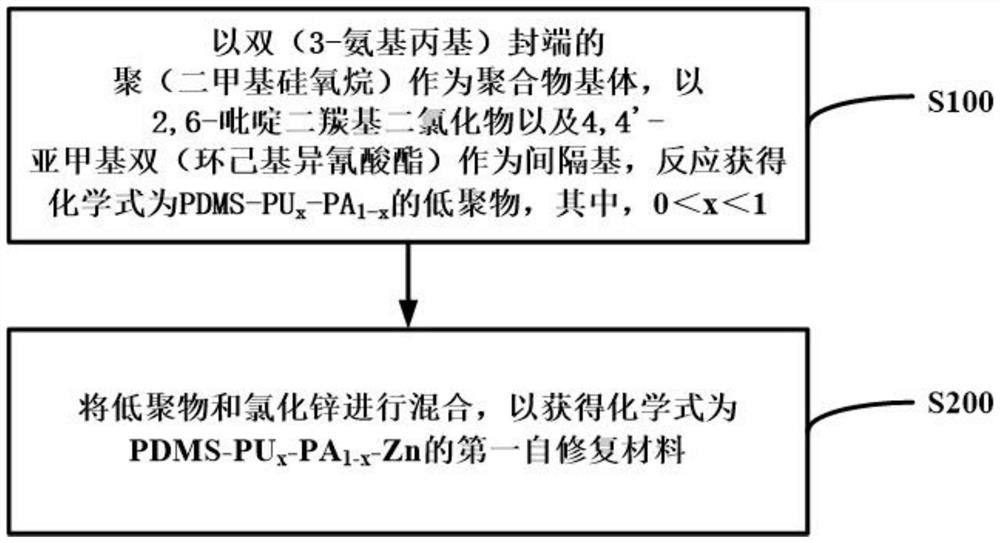
[0045] figure 1 A schematic structural view showing a method for preparing a self-healing material according to an embodiment of the present invention. Such as figure 1 Shown, this preparation method comprises:
[0046]Step S100, using bis(3-aminopropyl)-terminated poly(dimethylsiloxane) as a polymer matrix, and 2,6-pyridinedicarbonyl dichloride and 4,4'-methylenebis( Cyclohexyl isocyanate) as a spacer, the reaction obtained chemical formula is PDMS-PU x -PA 1-x The oligomer of , wherein, 0<x<1;
[0047] Step S200, mixing the oligomer and zinc chloride to obtain the chemical formula PDMS-PU x -PA 1-x - The first self-healing material of Zn.
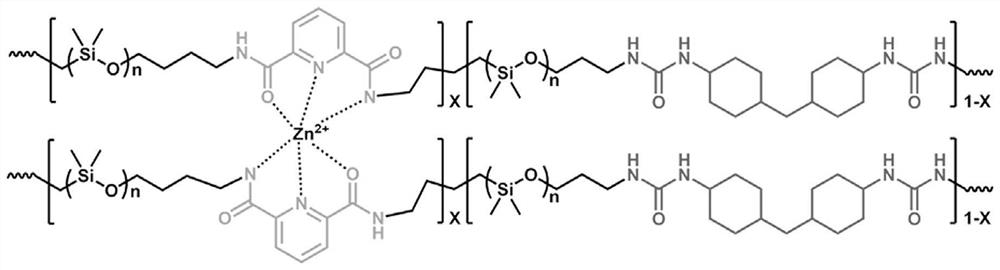
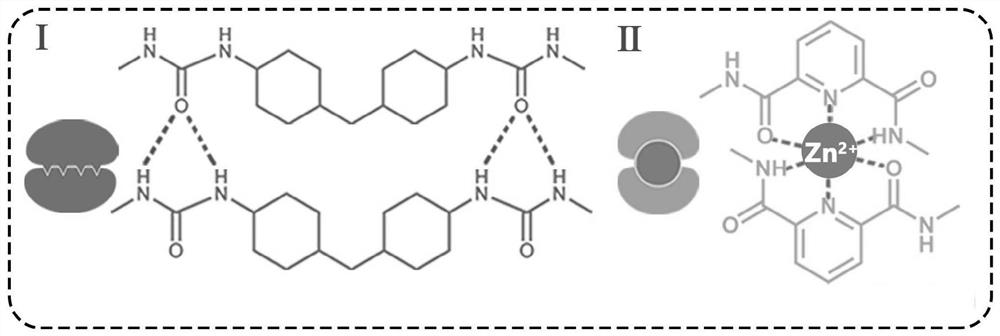
[0048] figure 2 A molecular formula structure diagram of the first self-healing material according to an embodiment of the present invention is shown. image 3 A molecular formula structure diagram of part of the first self-healing material according to an embodiment of the present invention is shown. Depend on figure 2 with ...
PUM
 Login to View More
 Abstract
Description
Claims
Application Information
 Login to View More