
Gamma'phase pre-adjusting plasticizing production process of high-performance high-temperature alloy
A high-temperature alloy and production process technology, applied in the field of material processing, can solve problems such as reducing high-temperature plasticity, and achieve the effects of reducing forging times, increasing high-temperature plasticity, and high yield.
- Summary
- Abstract
- Description
- Claims
- Application Information
AI Technical Summary
Problems solved by technology
Method used
Image

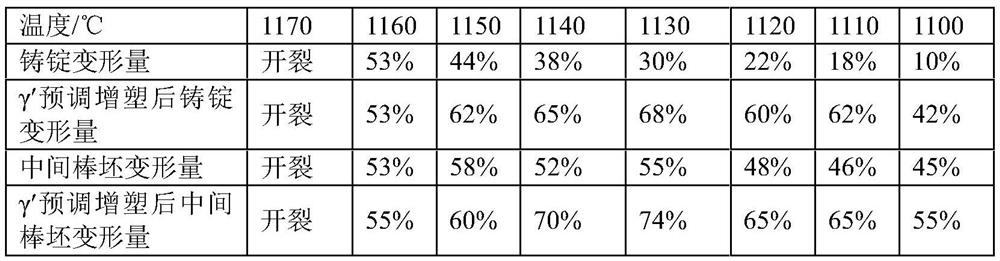
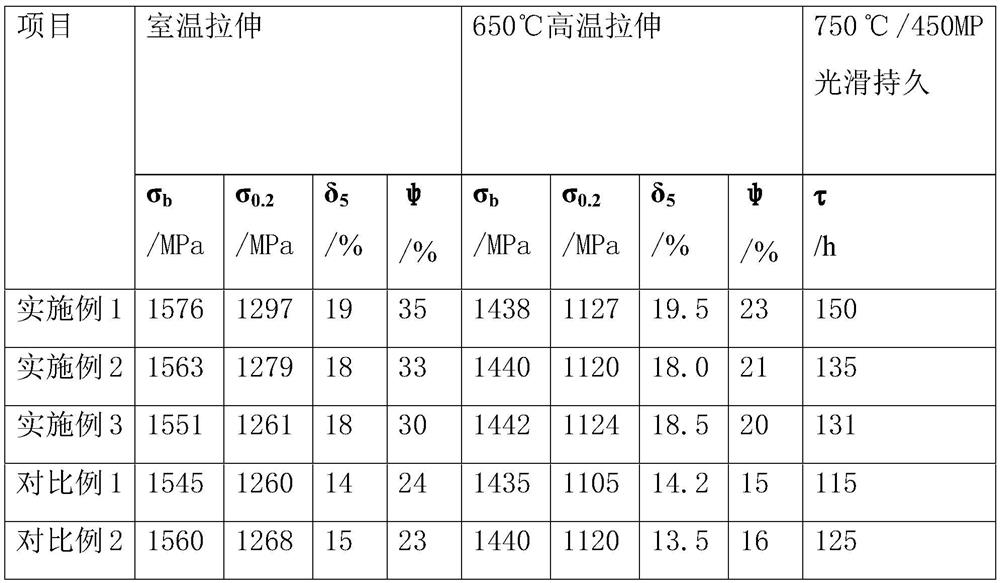
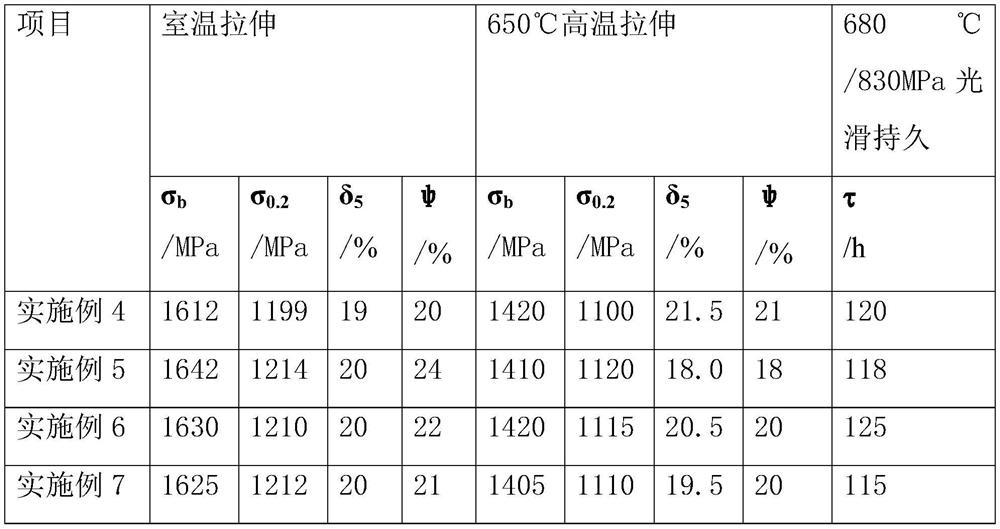
Examples
Embodiment 1
[0037] GH4730 alloy is a wrought superalloy with a mass fraction of γ' phase as high as 42%, and the complete melting temperature of γ' phase is 1090°C.
[0038] Step 1. The GH4730 alloy consumable ingot smelted by vacuum induction melting, electroslag remelting and vacuum consumable remelting process is subjected to two times of upsetting and two times of elongating forging in the single-phase region (1110°C) to obtain Φ480mm bar;
[0039] Step 2. Lower the temperature of the forging heat treatment furnace to 1070°C, and return the Φ480mm bar forged in step 1 to the forging heat treatment furnace. After holding it for 2 hours, cool it down to 900°C at a cooling rate of 20°C / h and keep it for 3 hours;
[0040] Step 3. The bar processed in step 2 is heated up to 1070°C at 10°C / min. After holding for 2 hours, it is taken out of the furnace and enters the forging heat treatment furnace for forging. After forging, return to the forging heat treatment furnace for 2 hours of heat pr...
Embodiment 2
[0043] GH4730 alloy is a wrought superalloy with a mass fraction of γ' phase as high as 42%, and the complete melting temperature of γ' phase is 1090°C.
[0044] Step 1. The GH4730 alloy consumable ingot smelted by vacuum induction melting, electroslag remelting and vacuum consumable remelting is subjected to two upsetting and elongating forging treatments in the single-phase region (1110°C) to obtain a Φ480mm rod material;
[0045] Step 2. Lower the temperature of the forging heat treatment furnace to 1050°C, and return the Φ480mm bar forged in step 1 to the forging heat treatment furnace. After holding it for 2 hours, cool it down to 800°C at a cooling rate of 50°C / h and keep it for 6 hours;
[0046] Step 3. The bar processed in step 2 is heated up to 1050°C at 5°C / min. After holding for 3 hours, it is taken out of the furnace and enters the forging heat treatment furnace for forging. After forging, return to the forging heat treatment furnace for 2 hours of heat preservatio...
Embodiment 3
[0049] GH4730 alloy is a wrought superalloy with a mass fraction of γ' phase as high as 42%, and the complete melting temperature of γ' phase is 1090°C.
[0050] Step 1. The GH4730 alloy consumable ingot smelted by vacuum induction melting, electroslag remelting and vacuum consumable remelting is subjected to two upsetting and elongating forging treatments in the single-phase region (1110°C) to obtain a Φ480mm rod material;
[0051] Step 2. Lower the temperature of the forging heat treatment furnace to 1060°C, and return the Φ480mm bar forged in step 1 to the forging heat treatment furnace. After holding it for 2 hours, cool it down to 1000°C at a cooling rate of 50°C / h and keep it for 5 hours;
[0052] Step 3. The bar processed in step 2 is heated up to 1050°C at 2°C / min. After holding for 4 hours, it is taken out of the furnace and enters the forging heat treatment furnace for forging. After forging, return to the forging heat treatment furnace for 2 hours of heat preservati...
PUM
| Property | Measurement | Unit |
|---|---|---|
| crystal size | aaaaa | aaaaa |
| crystal size | aaaaa | aaaaa |
| crystal size | aaaaa | aaaaa |
Abstract
Description
Claims
Application Information
 Login to View More