

Method for realizing beam-to-ground coverage through low-orbit satellite beam position design
A technology for low-orbit satellites and communication satellites, applied in the field of satellite communications, to achieve the effect of optimizing the number of beams and reducing the overlap rate
- Summary
- Abstract
- Description
- Claims
- Application Information
AI Technical Summary
Problems solved by technology
Method used
Image

Examples
no. 1 example
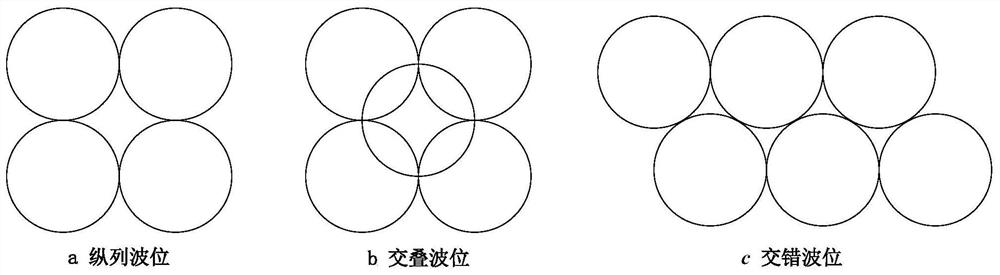
[0072] figure 1 It shows a schematic diagram of three traditional wave position arrangements, namely: tandem wave position a, overlapping wave position b and staggered wave position c.
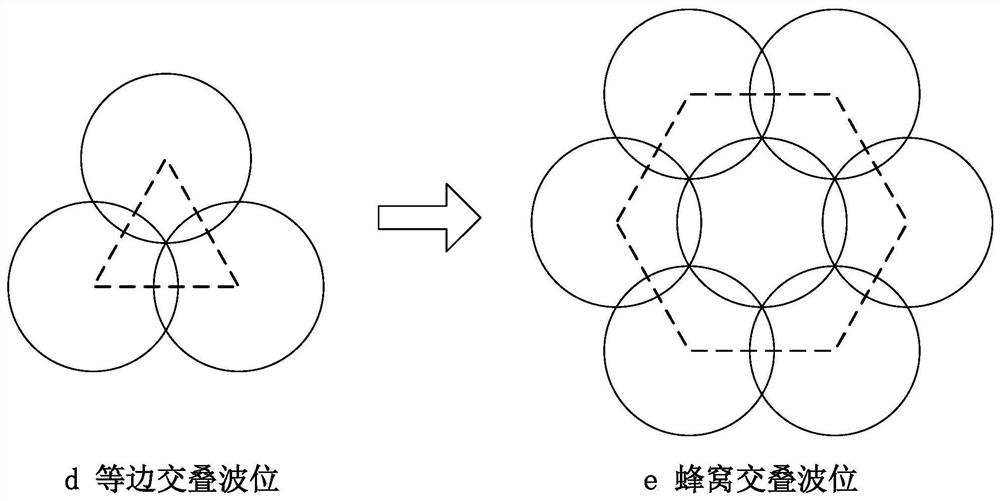
[0073] figure 2 The schematic diagrams of the two wave position arrangement styles proposed in this embodiment are given, wherein d is a schematic diagram of the equilateral overlapping wave position arrangement style, which is composed of three spot beam positions, and the centers of the three spot beam positions form an equilateral Triangle, the side length of the equilateral triangle is the radius of the spot beam beam (the spot beam beam is the circle projected by the spot beam to the ground) times. e is a schematic diagram of the cellular overlapping wave position arrangement pattern evolved on the basis of the equilateral overlapping wave position arrangement pattern, which is composed of a central point beam position and six surrounding spot beam positions, and six surrounding point...
no. 2 example
[0150] Figure 7 A schematic structural diagram of a computer device provided by another embodiment of the present application is shown. Figure 7 The computer device 50 shown is only an example, and should not impose any limitation on the functions and scope of use of the embodiments of the present application. Such as Figure 7 As shown, computer device 50 takes the form of a general-purpose computing device. Components of computer device 50 may include, but are not limited to: one or more processors or processing units 500 , system memory 516 , bus 501 connecting various system components including system memory 516 and processing unit 500 .
[0151] Bus 501 represents one or more of several types of bus structures, including a memory bus or memory controller, a peripheral bus, an accelerated graphics port, a processor, or a local bus using any of a variety of bus structures. These architectures include, by way of example, but are not limited to Industry Standard Archite...
no. 3 example
[0159] Another embodiment of the present application provides a computer-readable storage medium, on which a computer program is stored, and when the program is executed by a processor, the method provided in the first embodiment above is implemented. In practical applications, the computer-readable storage medium may use any combination of one or more computer-readable media. The computer readable medium may be a computer readable signal medium or a computer readable storage medium.
[0160] A computer-readable storage medium may be, for example, but not limited to, an electrical, magnetic, optical, electromagnetic, infrared, or semiconductor system, device, or device, or any combination thereof. More specific examples (non-exhaustive list) of computer readable storage media include: electrical connections with one or more leads, portable computer disks, hard disks, random access memory (RAM), read only memory (ROM), Erasable programmable read-only memory (EPROM or flash mem...
PUM
 Login to View More
 Abstract
Description
Claims
Application Information
 Login to View More