
Production process of chloropinacolone
A production process, pinatonone technology, applied in the field of monochloropinatone production process, can solve the problems of long reaction time, low production yield, high viscosity, etc., reduce production equipment and production consumption, and reduce production raw material consumption , The effect of reducing the chlorine content
- Summary
- Abstract
- Description
- Claims
- Application Information
AI Technical Summary
Problems solved by technology
Method used
Image

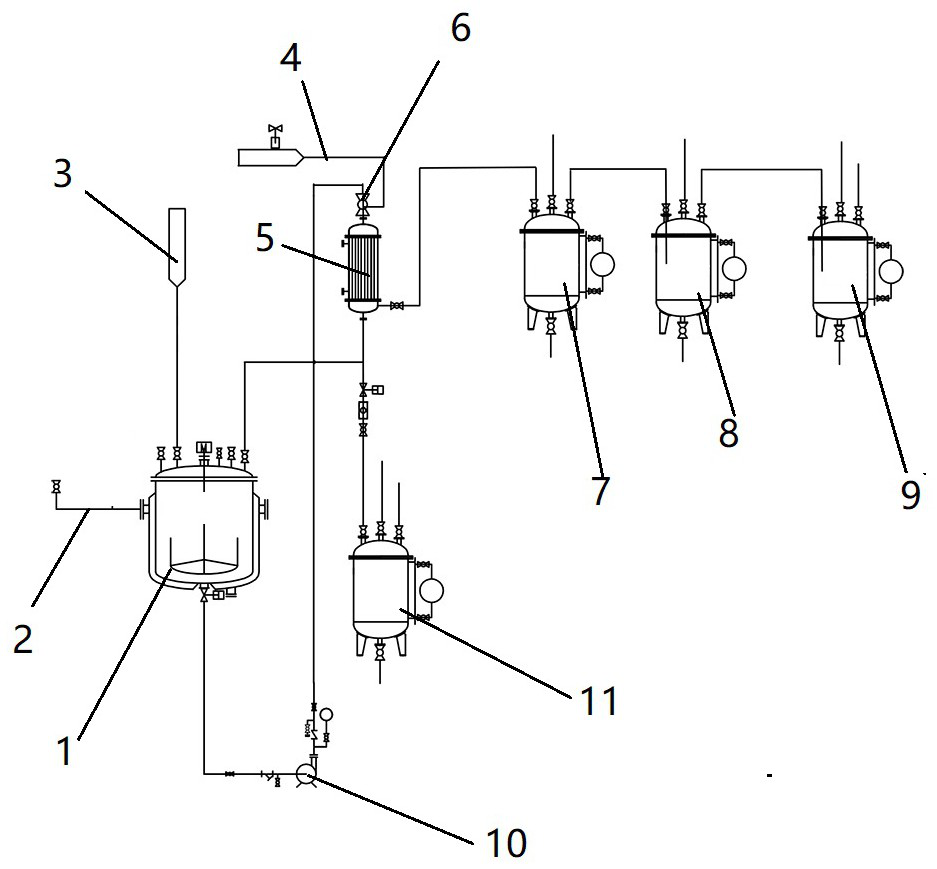
Examples
Embodiment
[0010] Embodiment: drop into 100kg pinacolone and 200kg methyl alcohol in the mixing kettle 3, after mixing evenly, pinacolone-methanol is dropped in the reactor 1, the stirring of opening reactor and the brine cooling pipeline 2, in the reactor The temperature of the pinacolone-methanol mother liquor drops below 0°C; the circulating pump 10 is turned on, and the pinacolone-methanol solution is repeatedly circulated from the reactor circulation outlet to the feed inlet, and a cooling heat exchanger 5 is arranged on the circulation pipeline. Keep the temperature of the circulating mother liquid below 0°C, install a Venturi mixer 6 at the inlet of the cooling heat exchanger, connect the gas inlet of the Venturi mixer to the chlorine gas pipeline 4, and add chlorine gas at a rate of 0.5-1.0kg / min, repeat the cycle After the addition of chlorine gas, keep it for 30 minutes. After the reaction is completed, stop the circulation, open the inlet valve of the precipitation kettle, pour...
PUM
 Login to View More
 Abstract
Description
Claims
Application Information
 Login to View More