Unlock instant, AI-driven research and patent intelligence for your innovation.

Write-in method of flash memory array

A flash memory array, column-oriented technology, applied in the field of flash memory array writing, can solve the problems of unfavorable memory reliability, increase the vertical height of the gate structure, unfavorable, etc., to improve the data write throughput rate, overcome slow write, reduce The effect of power consumption

Pending Publication Date: 2021-11-16
BEIJING PANXIN MICROELECTRONICS TECH CO LTD
View PDF0 Cites 2 Cited by
  • Summary
  • Abstract
  • Description
  • Claims
  • Application Information

AI Technical Summary

Problems solved by technology

[0004] However, the floating gate flash memory has the following disadvantages: the process is relatively complicated; the vertical height of the gate structure is increased due to the existence of the floating gate structure in the flash memory unit, which is not conducive to scaling down the process size and cell area; Conductivity, the stored charge can move freely in the floating gate, which is not conducive to improving the reliability of the memory
However, the source lines of existing flash memory arrays are formed in the active area, and the sheet resistance of the active area is much higher than that of metal
Therefore, in order to reduce the series resistance of the source lines, it is necessary to short-circuit the source lines in the active area through metal common source lines every few rows or columns in the row or column direction, resulting in an increase in the area overhead of the flash memory array.

Method used

the structure of the environmentally friendly knitted fabric provided by the present invention; figure 2 Flow chart of the yarn wrapping machine for environmentally friendly knitted fabrics and storage devices; image 3 Is the parameter map of the yarn covering machine
View more

Image

Smart Image Click on the blue labels to locate them in the text.
Viewing Examples
Smart Image
  • Write-in method of flash memory array
  • Write-in method of flash memory array
  • Write-in method of flash memory array

Examples

Experimental program
Comparison scheme
Effect test

Embodiment Construction

[0023] In the following description, for purposes of explanation, numerous specific details are set forth in order to provide a thorough understanding of various exemplary embodiments or implementations of the invention. As used herein, "implementation" and "implementation" are interchangeable words that are non-limiting examples of devices or methods that employ one or more of the inventive concepts disclosed herein. It is evident, however, that the exemplary embodiments may be practiced without these specific details, or with one or more equivalent arrangements. In other instances, well-known structures and devices are shown in block diagram form in order to avoid unnecessarily obscuring the exemplary embodiments. Furthermore, each exemplary embodiment may be different, but is not necessarily exclusive. For example, the specific shapes, configurations and characteristics of the exemplary embodiments can be used or implemented in other exemplary embodiments without departing...

the structure of the environmentally friendly knitted fabric provided by the present invention; figure 2 Flow chart of the yarn wrapping machine for environmentally friendly knitted fabrics and storage devices; image 3 Is the parameter map of the yarn covering machine
Login to View More

PUM

No PUM Login to View More

Abstract

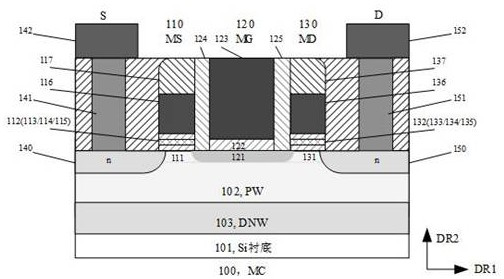
The invention provides a write-in method of a flash memory array. The flash memory array comprises: a plurality of flash memory units arranged along a row direction and a column direction; a plurality of word line groups extending in a row direction; and a plurality of bit line groups extending in the column direction. A flash memory unit pair is arranged at the intersection point of the word line group and the bit line group and comprises a first flash memory unit and a second flash memory unit which are adjacent in the row direction and share the same bit line group. The write-in method includes applying each writing voltage to a first electrode and a second electrode of a selected flash memory cell and a gate electrode of a memory transistor, wherein the writing voltage applied to an electrode connected to the written memory transistor is higher than an electron barrier height at an interface between the substrate and a gate dielectric stack of the memory transistor. The write-in method of the flash memory array has the advantages of being low in operation power consumption and high in programming speed, and the number of flash memory units written in parallel is increased, so the data writing throughput rate of the memory is increased.

Description

technical field [0001] The present disclosure relates to the field of semiconductor technology, and in particular, the present disclosure relates to a writing method of a flash memory array. Background technique [0002] Flash memory, referred to as flash memory, is a non-volatile memory, that is, the stored data will not be lost even if the power is cut off, and it is especially suitable for mobile communication and computer storage components and other fields. In addition, some flash memories also have high-density storage capabilities, and are suitable for applications such as large-capacity mobile storage media. [0003] Conventional flash memory adopts a floating gate cell structure. The floating gate non-volatile memory originated from the MIMIS (Metal-Insulator-Metal-Insulator-Semiconductor: Metal-Insulator-Metal-Insulator-Semiconductor) structure proposed by D.Kahng and S.Sze in 1967. This structure adds a metal floating gate and an ultra-thin tunnel oxide layer on...

Claims

the structure of the environmentally friendly knitted fabric provided by the present invention; figure 2 Flow chart of the yarn wrapping machine for environmentally friendly knitted fabrics and storage devices; image 3 Is the parameter map of the yarn covering machine
Login to View More

Application Information

Patent Timeline
no application Login to View More
IPC IPC(8): G11C7/12G11C8/08
CPCG11C7/12G11C8/08
Inventor 蒋家勇石振东
Owner BEIJING PANXIN MICROELECTRONICS TECH CO LTD
Features
  • R&D
  • Intellectual Property
  • Life Sciences
  • Materials
  • Tech Scout
Why Patsnap Eureka
  • Unparalleled Data Quality
  • Higher Quality Content
  • 60% Fewer Hallucinations
Social media
Patsnap Eureka Blog
Learn More