Friction nano-generator driven sensing system and method for bacterial detection
A nanogenerator and bacteria detection technology, applied in the field of microbial detection, can solve the problems of large environmental influence factors, environmental and industrial hazards, long detection time, etc. Effect
- Summary
- Abstract
- Description
- Claims
- Application Information
AI Technical Summary
Problems solved by technology
Method used
Image

Examples
Embodiment 1
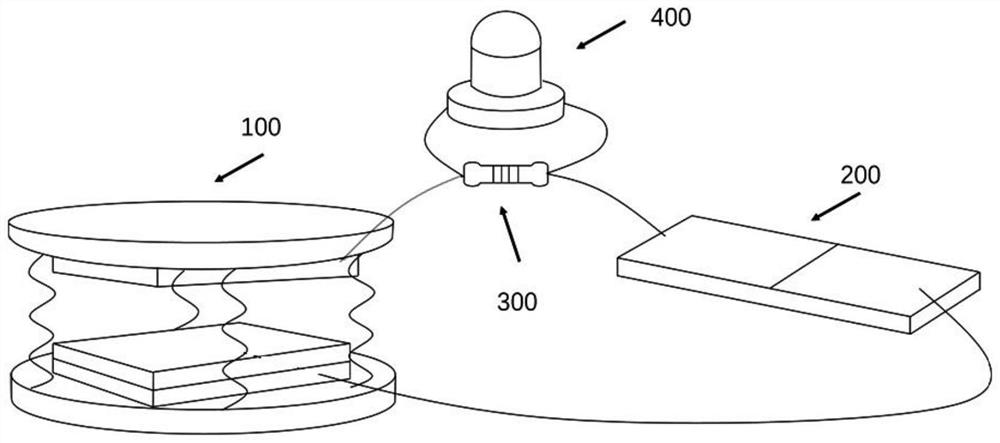
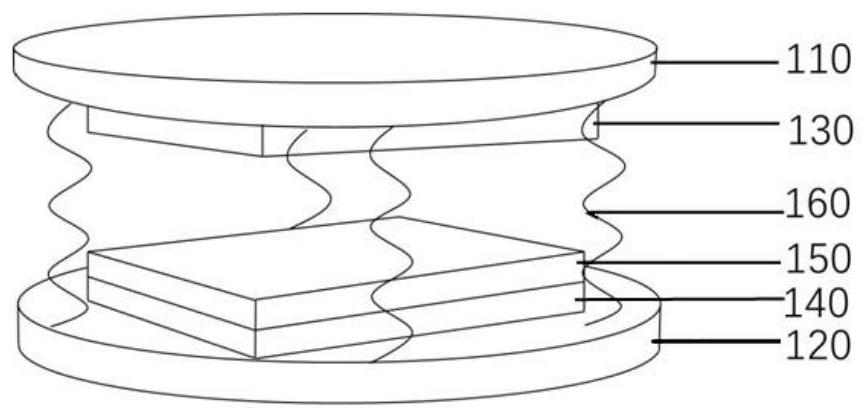
[0035] Embodiment 1 This embodiment provides a sensor system for bacteria detection driven by a triboelectric nanogenerator, figure 1 The structure of the system is shown. Such as figure 1 As shown, the triboelectric nanogenerator-driven sensing system for bacteria detection of the present invention includes a triboelectric nanogenerator 100 , a resistive biosensor 200 , a variable resistor 300 and an LED lamp 400 . The triboelectric nanogenerator 100 is used to convert external mechanical energy into electrical energy to output electrical signals to an external circuit. The resistive biosensor 200 is electrically connected with the triboelectric nanogenerator 100, so that the triboelectric nanogenerator 100 supplies power to the resistive biosensor 200 for detecting sensing signals. The variable resistor 300 is connected in series with the resistive biosensor 200 to obtain a part of the voltage. The LED lamp 400 is connected to both ends of the variable resistor 300 in pa...
Embodiment 2
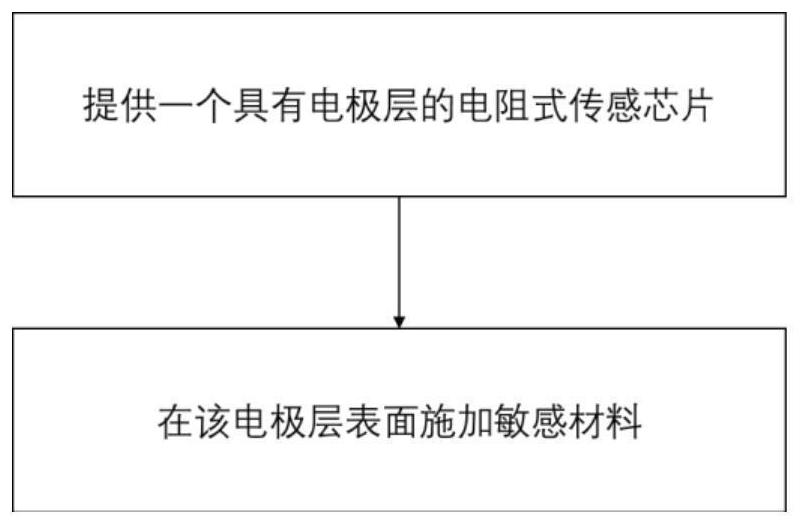
[0056] Embodiment 2 This embodiment provides a method for detecting bacteria using the sensor system for bacteria detection driven by the above-mentioned frictional nanogenerator. The method takes the detection of sulfate-reducing bacteria as an example. The process is as follows Figure 4 As shown, the specific steps are as follows:
[0057] (1) Soak the resistive biosensor in a series of known concentrations of SRB bacteria solution and incubate for 2 hours;
[0058] (2) Take out the above sensor, soak it in a solution of carbon nanotubes modified with concanavalin at a concentration of 0.15 mg / mL, and react for 2 hours;
[0059] (3) Take out the above sensor, gently rinse off the unconnected carbon nanotubes with deionized water, gently wipe off the water on the surface, and let it dry naturally;
[0060] (4) Connect the circuit, drive it with a triboelectric nanogenerator, and test the voltage value at both ends of the resistive biosensor; Figure 5 The relationship betw...
PUM
| Property | Measurement | Unit |
|---|---|---|
| Thickness | aaaaa | aaaaa |
| Thickness | aaaaa | aaaaa |
| Thickness | aaaaa | aaaaa |
Abstract
Description
Claims
Application Information
 Login to View More
 - R&D
- Intellectual Property
- Life Sciences
- Materials
- Tech Scout
- Unparalleled Data Quality
- Higher Quality Content
- 60% Fewer Hallucinations
Browse by: Latest US Patents, China's latest patents, Technical Efficacy Thesaurus, Application Domain, Technology Topic, Popular Technical Reports.
© 2025 PatSnap. All rights reserved.Legal|Privacy policy|Modern Slavery Act Transparency Statement|Sitemap|About US| Contact US: help@patsnap.com