

Catalyst for olefin polymerization or copolymerization at high temperature
A technology for olefin polymerization and copolymerization, which is applied in the field of catalysts and can solve the problems of complex catalyst preparation and poor control.
- Summary
- Abstract
- Description
- Claims
- Application Information
AI Technical Summary
Problems solved by technology
Method used
Image

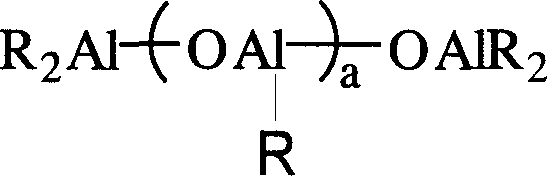
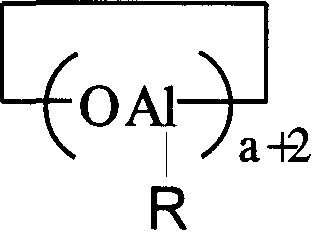
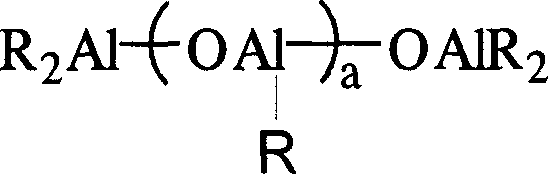
Examples
Embodiment 1
[0032] The preparation of catalyst component A:
[0033] In the high-purity N 2 In the fully replaced reactor, sequentially add 0.05mol anhydrous MgCl 2 , 75ml of toluene, 0.1mol of epichlorohydrin, 0.03mol of tributyl phosphate, heated to 50°C with stirring, and maintained for 2 hours, the solids were completely dissolved, added 0.008mol of phthalic anhydride, and maintained for 1 hour. The solution was cooled to -25°C, 55ml of titanium tetrachloride was added dropwise within 1 hour, and then the temperature was slowly raised to 80°C. During the heating process, solids were gradually precipitated. Add 0.0125 mol of diisobutyl phthalate, maintain at 80° C. for 1 hour, filter and wash twice with 100 ml of toluene to obtain a brownish yellow solid precipitate. Add 60ml of toluene and 40ml of titanium tetrachloride, process at 90°C for two hours, filter, repeat the above operation once more, wash with toluene once after filtration, wash with hexane four times, and dry in vacuo ...
Embodiment 2
[0039] The preparation of catalyst component A and cocatalyst MMAO: with embodiment 1.
[0040] High temperature polymerization of propylene: add 30mg of catalyst component A, catalyst component B 0.32mmol of MMAO and 0.32mmol of Et 3 Al, the CHMMS of catalyst component C 0.032mmol, all the other are with embodiment 1. 6.4 g of polypropylene was obtained with an isotacticity of 95%. The polymerization results are shown in Table 1.
PUM
 Login to View More
 Abstract
Description
Claims
Application Information
 Login to View More