Self adaptive imaging algorithm for archaeological isotope density scan
A self-adaptive algorithm, isotope technology, applied in computing, special data processing applications, material analysis using wave/particle radiation, etc., can solve problems such as difficulty in determining μ parameters
- Summary
- Abstract
- Description
- Claims
- Application Information
AI Technical Summary
Problems solved by technology
Method used
Image


Examples
Embodiment Construction
[0024] The working method of the isotope density imager for archaeology is to place the excitation source at a certain depth underground through a source guide pipe, and use detectors to conduct intensive detection on the surface, mainly detecting the rays emitted by the excitation source through the underground medium. Intensity attenuation, so as to determine the density distribution of the underground medium.
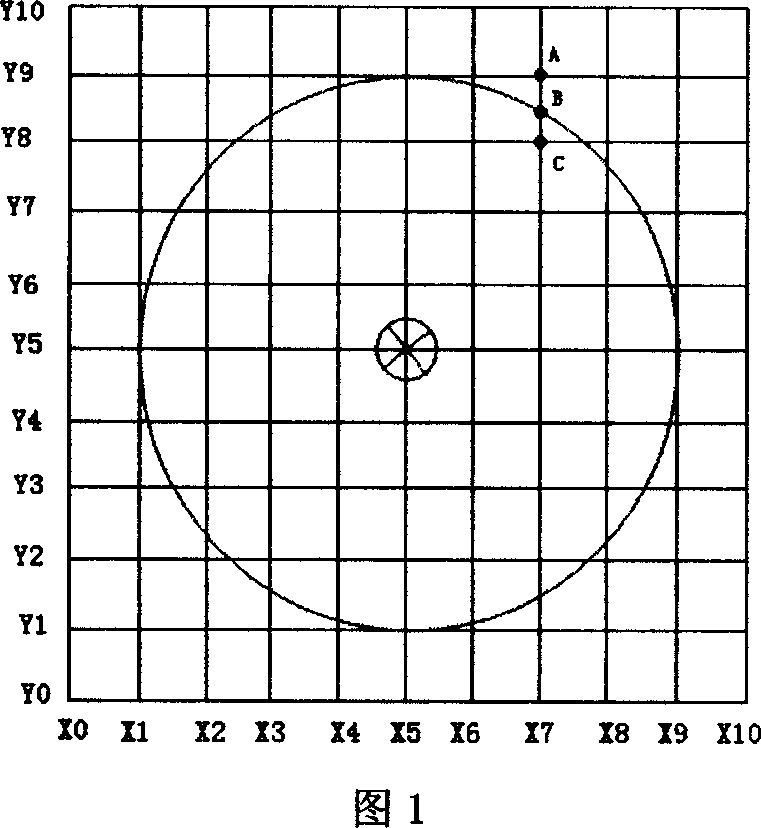
[0025] The present invention is as shown in Figure 1, assumes in the XY coordinate system of 10 * 10, with (X 5 , Y 5 ) as the center of the circle, put the excitation source underground at a depth of h, and measure at the intersection of the X-axis and Y-axis. In order to avoid different parameters at each measurement point and cannot be compared, all the original data are converted into The radius r is the coordinate in the coordinate system.
[0026] 1. Calculation of γ-ray intensity from isotope source and equidistant point
[0027] The distance from each poin...
PUM
 Login to View More
 Abstract
Description
Claims
Application Information
 Login to View More
 - R&D
- Intellectual Property
- Life Sciences
- Materials
- Tech Scout
- Unparalleled Data Quality
- Higher Quality Content
- 60% Fewer Hallucinations
Browse by: Latest US Patents, China's latest patents, Technical Efficacy Thesaurus, Application Domain, Technology Topic, Popular Technical Reports.
© 2025 PatSnap. All rights reserved.Legal|Privacy policy|Modern Slavery Act Transparency Statement|Sitemap|About US| Contact US: help@patsnap.com