

Memory system, storage device, and method for controlling memory system
a memory system and storage device technology, applied in the field of memory system, can solve problems such as errors in data written to non-volatile memory, and achieve the effect of suppressing the degradation of memory cells of non-volatile memory and excellent
- Summary
- Abstract
- Description
- Claims
- Application Information
AI Technical Summary
Benefits of technology
Problems solved by technology
Method used
Image



Examples
first embodiment
[Example of Configuration of Memory System]
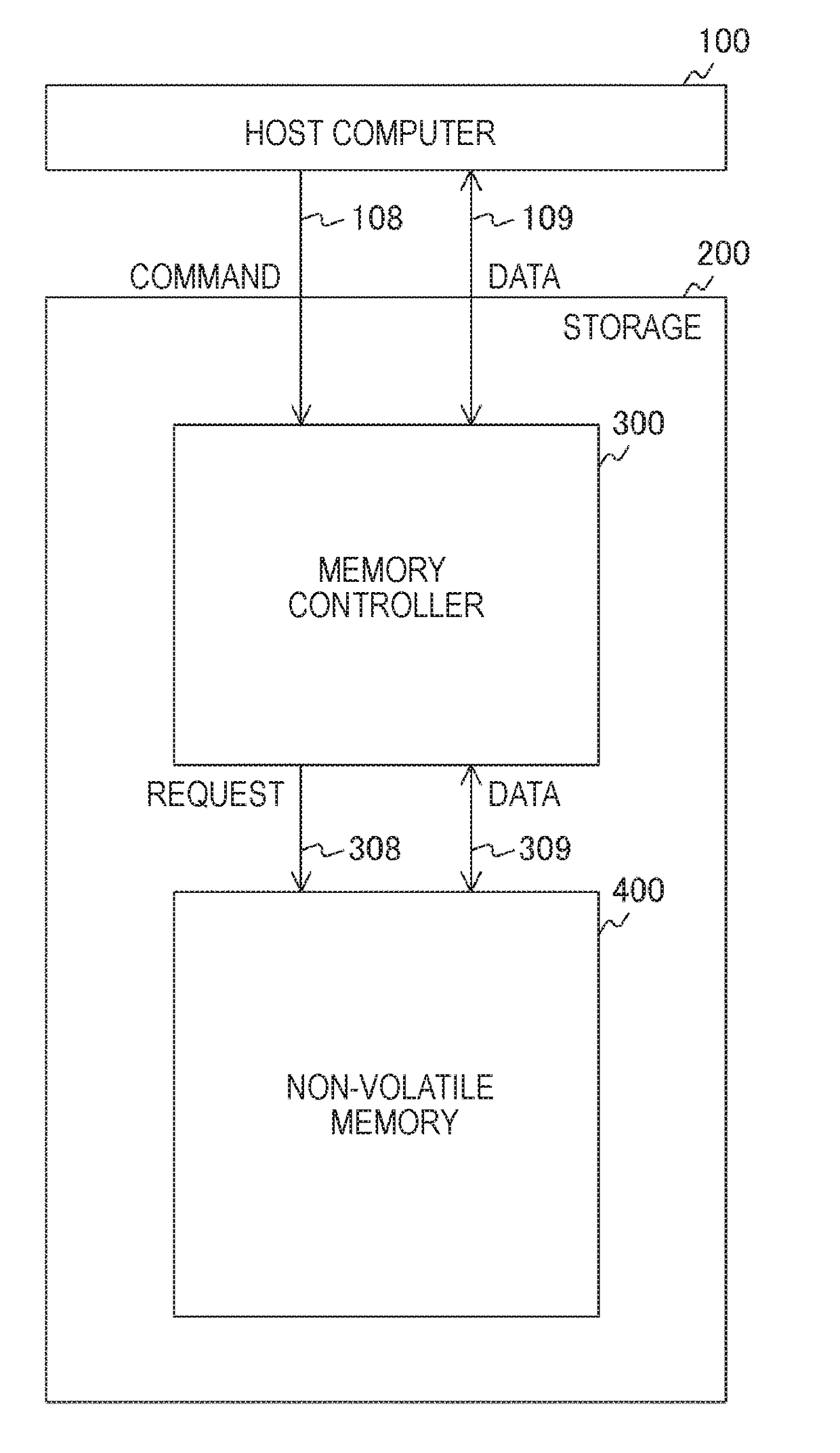
[0052]FIG. 1 is a block diagram illustrating an example of a configuration of a memory system according to a first embodiment. The memory system includes a host computer 100 and a storage 200.
[0053]The host computer 100 controls an overall memory system. Specifically, the host computer 100 generates commands and data and supplies them to the storage 200 via signal lines 108 and 109. In addition, the host computer 100 receives read data from the storage 200 via the signal line 109. Here, the commands are for controlling the storage 200 and include, for example, a write command instructing writing of data and a read command instructing reading of data.
[0054]The storage 200 includes a memory controller 300 and a non-volatile memory 400. The memory controller 300 controls the non-volatile memory 400. When a write command and data are received from the host computer 100, the memory controller 300 generates an error detection and correction code ...
second embodiment
[0118]In the first embodiment described above, the memory controller 300 performs a refresh for an address each time the number of errors, which have occurred during a read process of the address, has become equal to or greater than a predetermined allowable value. However, performing a refresh process each time an error is detected may cause a reduction in the access speed since the non-volatile memory 400 cannot perform other request operations during a refresh process. Therefore, it is preferable that the memory controller 300 suppress issuance of a refresh request until a predetermined condition is satisfied and issue a write request or a read request in priority to the refresh request. Examples of the predetermined condition include that the host computer 100 has instructed that a refresh be performed or that the number of addresses to be refreshed has exceeded a predetermined number. The memory controller 300 of this second embodiment differs from that of the first embodiment ...
third embodiment
[0134]In the first embodiment described above, the memory controller 300 performs a refresh for an address at each reading when the number of errors of read data of the address is equal to or greater than a predetermined allowable value. However, collectively performing a refresh when the access frequency for reading or writing has been reduced, rather than performing a refresh at each reading in accordance with the number of errors, can increase the access efficiency. For example, it is possible to employ a configuration wherein the host computer 100 sets a refresh mode when the access frequency has been reduced and the memory controller 300 performs a refresh when in the refresh mode. The memory system of this third embodiment differs from that of the first embodiment in that the memory controller 300 performs a refresh when the access frequency has been reduced such that the refresh mode is set.
[0135]FIG. 19 is a block diagram illustrating an example of a functional configuration...
PUM
 Login to View More
 Abstract
Description
Claims
Application Information
 Login to View More