Check patentability & draft patents in minutes with Patsnap Eureka AI!

Antibody and aptamer ensemble for cell isolation and enrichment

an antibody and aptamer technology, applied in the field of antibody and aptamer ensemble for cell isolation and enrichment, can solve the problems of insufficient capture efficiency, complex multi-step technology, and significant technological challenge in isolation of these cells, and achieve the effect of facilitating interaction and captur

Inactive Publication Date: 2019-11-05
UNIV OF FLORIDA RES FOUNDATION INC
View PDF14 Cites 0 Cited by
  • Summary
  • Abstract
  • Description
  • Claims
  • Application Information

AI Technical Summary

Benefits of technology

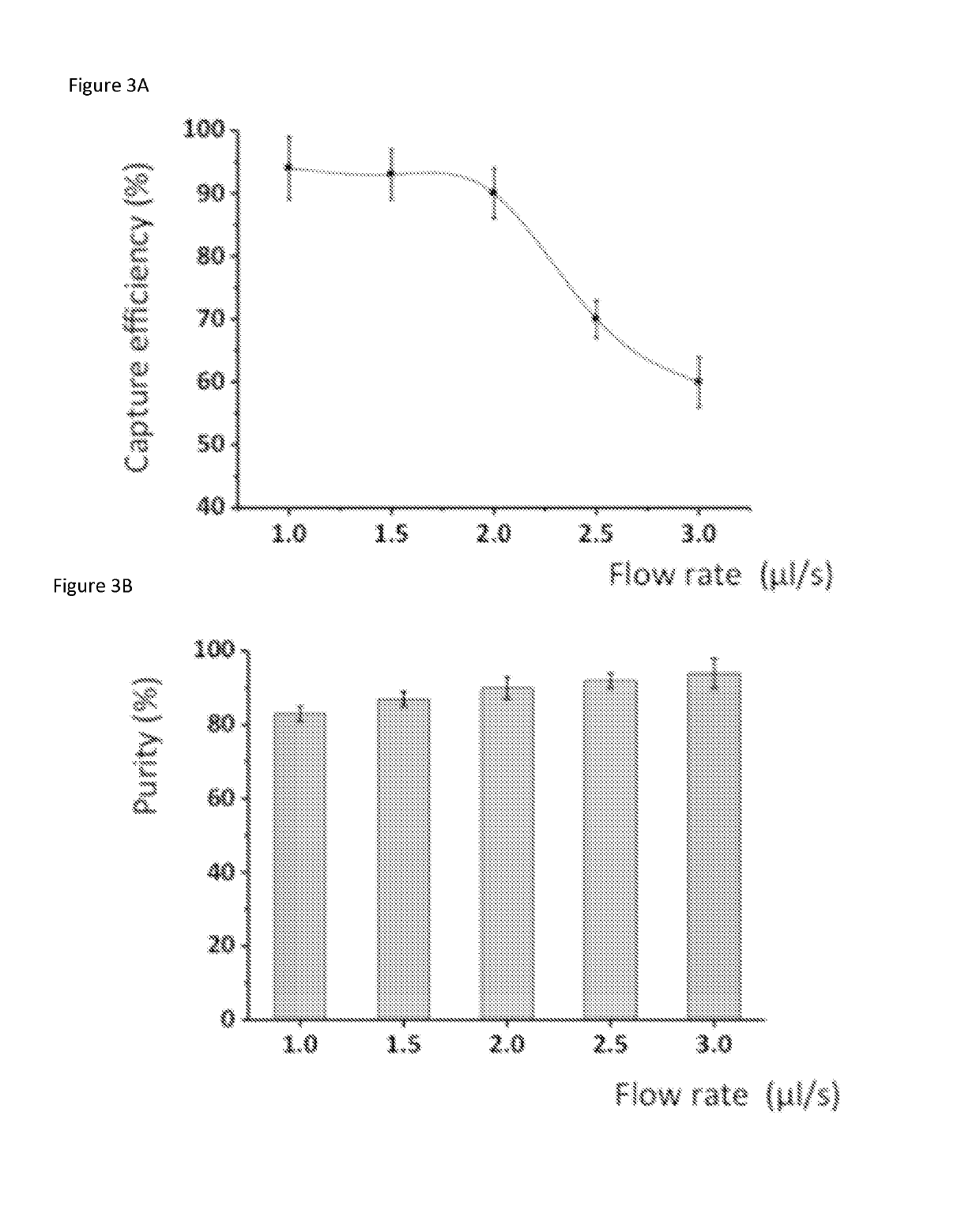
The combination of aptamers and antibodies in microfluidic devices achieves high capture efficiency (up to 99%) and purity (up to 95%) of CTCs, allowing for rapid processing of large blood samples without the need for complex channel geometries, thus overcoming the limitations of existing technologies.

Problems solved by technology

However, isolation of these cells is a significant technological challenge due to their rare numbers and their low recovery rate following traditional batch purification techniques.
There are a variety of conventional technologies, such as immuno-magnetic enrichment, flow cytometric cell sorting or polymerase chain reactions (PCR)-based methodology,[2, 5-8] but these are multistep technologies which are complex and have insufficient capture efficiency.
Recent microfluidic CTC devices using monovalent capture agents, including antibodies[9-11] and nucleic acid aptamers[12-13] represent a promising approach to capture cancer cells with highly efficient processing of complex cellular fluids,[14-15] greater simplicity, sensitivity[16-17] and throughput.[10, 18-19] However, monovalent adhesion ligands have difficulties in capturing large-sized entities, such as cells under high shear stress; a flow rate with low shear stress will render the assay time-consuming to process large volumes of blood samples.

Method used

the structure of the environmentally friendly knitted fabric provided by the present invention; figure 2 Flow chart of the yarn wrapping machine for environmentally friendly knitted fabrics and storage devices; image 3 Is the parameter map of the yarn covering machine
View more

Image

Smart Image Click on the blue labels to locate them in the text.
Viewing Examples
Smart Image
  • Antibody and aptamer ensemble for cell isolation and enrichment
  • Antibody and aptamer ensemble for cell isolation and enrichment
  • Antibody and aptamer ensemble for cell isolation and enrichment

Examples

Experimental program
Comparison scheme
Effect test

example 1

of Human Leukemia Cells (CCRF-CEM) Using SGC8 Aptamers and Anti-PTK7 Antibodies

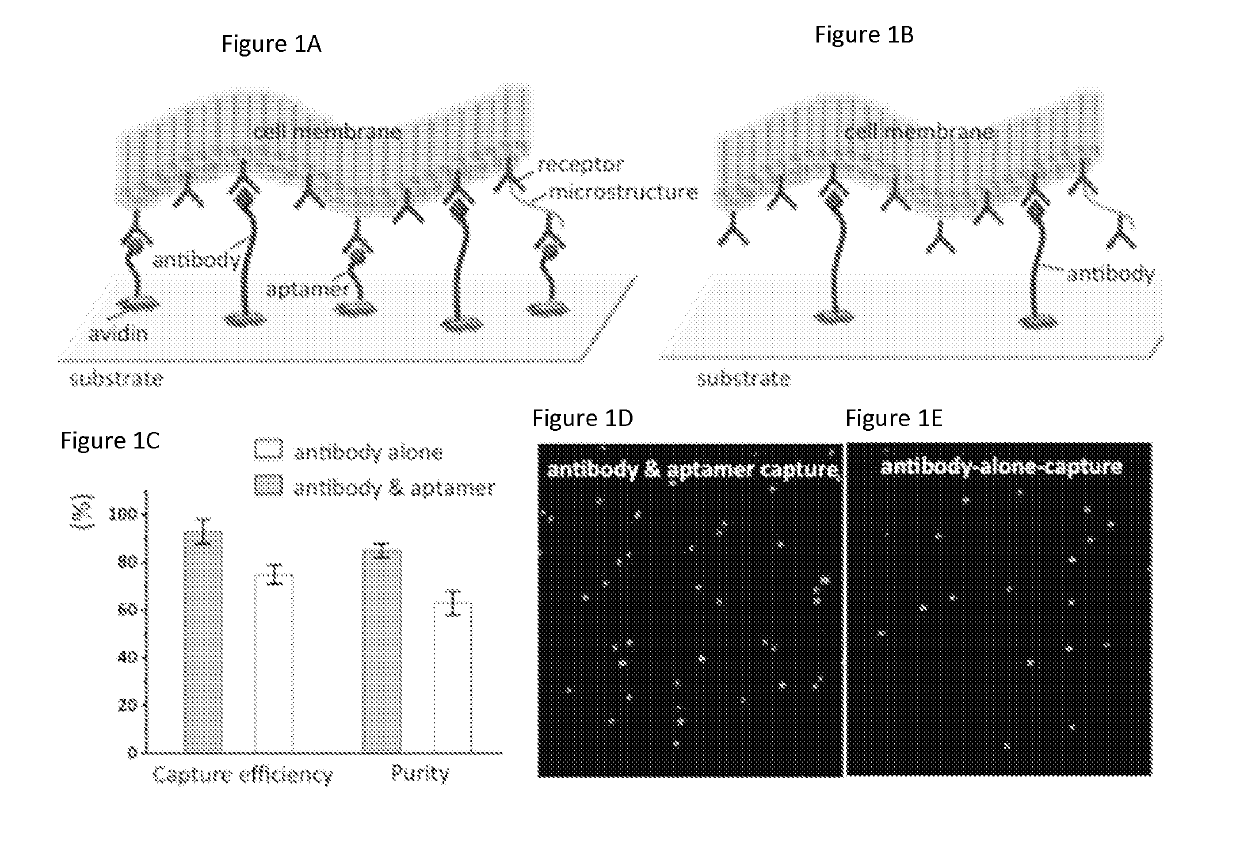
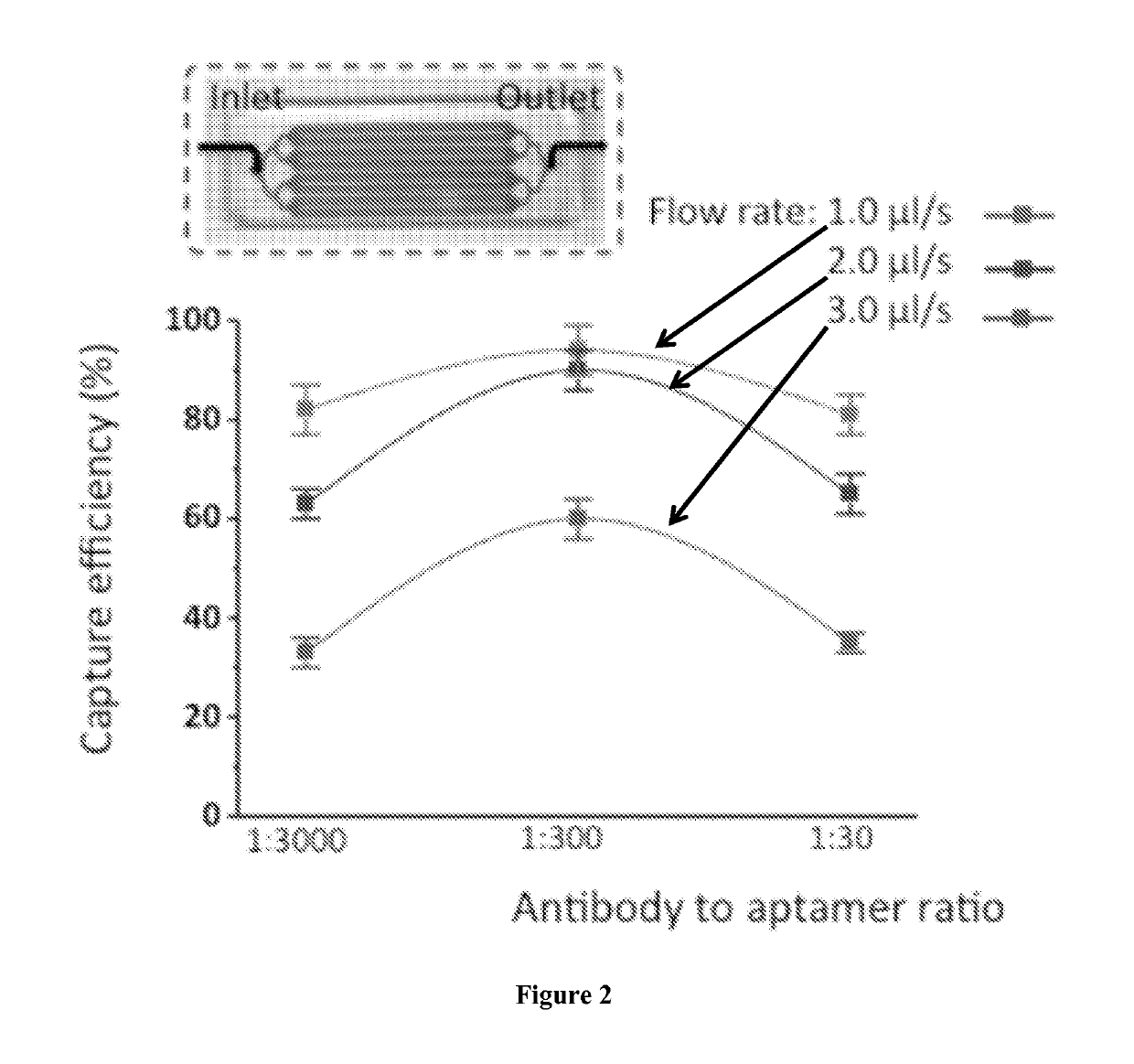
[0093]A microfluidic device to isolate human leukemia cells (CCRF-CEM) using a combination of sgc8 aptamers and anti-PTK7 (protein tyrosine kinase-7) antibodies is provided. These aptamers and antibodies exhibit strong binding to receptor PTK7 which is over expressed on many human cancer cells (including CCRF-CEM cells).[25] The average recovery is above 90% at various cell concentrations. In addition, this method can be used for other types of cell isolation and subsequent molecular analysis, which can facilitate developing effective chemotherapeutic drugs.

[0094]Antibodies and aptamers are assembled together onto microfluidic channel surface to form a surface having aptamers and antibodies providing multivalent binding. The affinity surface inside the microfluidic device was prepared using established method of avidin and biotin reactions.[13] We strategically mixed biotinylated anti-PTK7 antibodies (Mil...

example 2

xperiments for “An Ensemble of Aptamers and Antibodies for Multivalent Capture of Cancer Cells”

[0101]TDO5 is the aptamer that has specific bind with Ramos cells. This aptamer was used as negative control aptamers for CEM capture using antibody-aptamer ensemble. The binding properties of TDO5 to CEM and Ramos were studied[14]. Studies also indicated that CEM cells do not bind with EpCAM.[33] This antibody was used as negative control antibodies for CEM capture using antibody-aptamer ensemble.

[0102]Cell Capture with Ensemble of Anti-PTK7 and TDO5

[0103]For CEM cells, the capturing reagent is anti-PTK7, while TDO5 was a negative control aptamer; for Ramos cells, TDO5 was the capturing reagent, and anti-PTK7 was the negative control. The capture efficiency of both CEM cells and Ramos cells were about 60% at flow rate of 1 μL / s (FIGS. 9A and 9B).

[0104]Cell capture with ensemble of anti-EpCAM and sgc8.

[0105]For CEM cells, the capturing reagent is sgc8, while EpCAM was a negative control an...

the structure of the environmentally friendly knitted fabric provided by the present invention; figure 2 Flow chart of the yarn wrapping machine for environmentally friendly knitted fabrics and storage devices; image 3 Is the parameter map of the yarn covering machine
Login to View More

PUM

PropertyMeasurementUnit
molecular weightsaaaaaaaaaa
flow rateaaaaaaaaaa
Login to View More

Abstract

The subject invention pertains to devices and methods of isolating target cells from a population of cells. The devices comprise of microfluidic channels and aptamers and antibodies attached to the inner surface of the microfluidic channels, wherein the aptamers and the antibodies are capable of specific binding to one or more biomolecules present on the surface of the target cell. The methods of the current invention comprise passing the population of cells through the microfluidic channels to facilitate interaction and capture of the target cells by the aptamers and the antibodies attached to the inner surface of the microfluidic channels, washing to microfluidic channels by a washing solution to remove the cells non-specifically bound to the aptamers and the antibodies attached to the inner surface of the microfluidic channels, releasing the captured target cells from the microfluidic channels, and collecting the released target cells.

Description

CROSS-REFERENCE TO RELATED APPLICATIONS[0001]This application is in the U.S. national stage application of International Patent Application No. PCT / US2014 / 066590, filed Nov. 20, 2014, which claims the benefit of U.S. Provisional Application Ser. No. 61 / 906,526, filed Nov. 20, 2013, the disclosures of which are hereby incorporated by reference in their entirety, including all figures, tables and amino acid or nucleic acid sequences.[0002]This invention was made with government support under K25CA149080 awarded by National Institutes of Health. The government has certain rights in the invention.[0003]The Sequence Listing for this application is labeled “Seq-List.txt” which was created on Nov. 20, 2014 and is 6 KB. The entire contents of the sequence listing is incorporated herein by reference in its entirety.BACKGROUND OF THE INVENTION[0004]The enrichment and capture of target cells, for example, cancer cells, bacteria, viruses and other pathogens, from peripheral blood are of great i...

Claims

the structure of the environmentally friendly knitted fabric provided by the present invention; figure 2 Flow chart of the yarn wrapping machine for environmentally friendly knitted fabrics and storage devices; image 3 Is the parameter map of the yarn covering machine
Login to View More

Application Information

Patent Timeline
no application Login to View More
Patent Type & Authority Patents(United States)
IPC IPC(8): G01N33/543G01N33/574B01L3/00
CPCG01N33/57426G01N33/54366B01L3/502753B01L2300/12B01L2200/0668G01N2333/91205B01L2300/16
Inventor FAN, ZHONGHUI HUGHZHANG, JINLING
Owner UNIV OF FLORIDA RES FOUNDATION INC
Features
  • R&D
  • Intellectual Property
  • Life Sciences
  • Materials
  • Tech Scout
Why Patsnap Eureka
  • Unparalleled Data Quality
  • Higher Quality Content
  • 60% Fewer Hallucinations
Social media
Patsnap Eureka Blog
Learn More