
Ammonium sulfate nitrate
- Summary
- Abstract
- Description
- Claims
- Application Information
AI Technical Summary
Problems solved by technology
Method used
Image

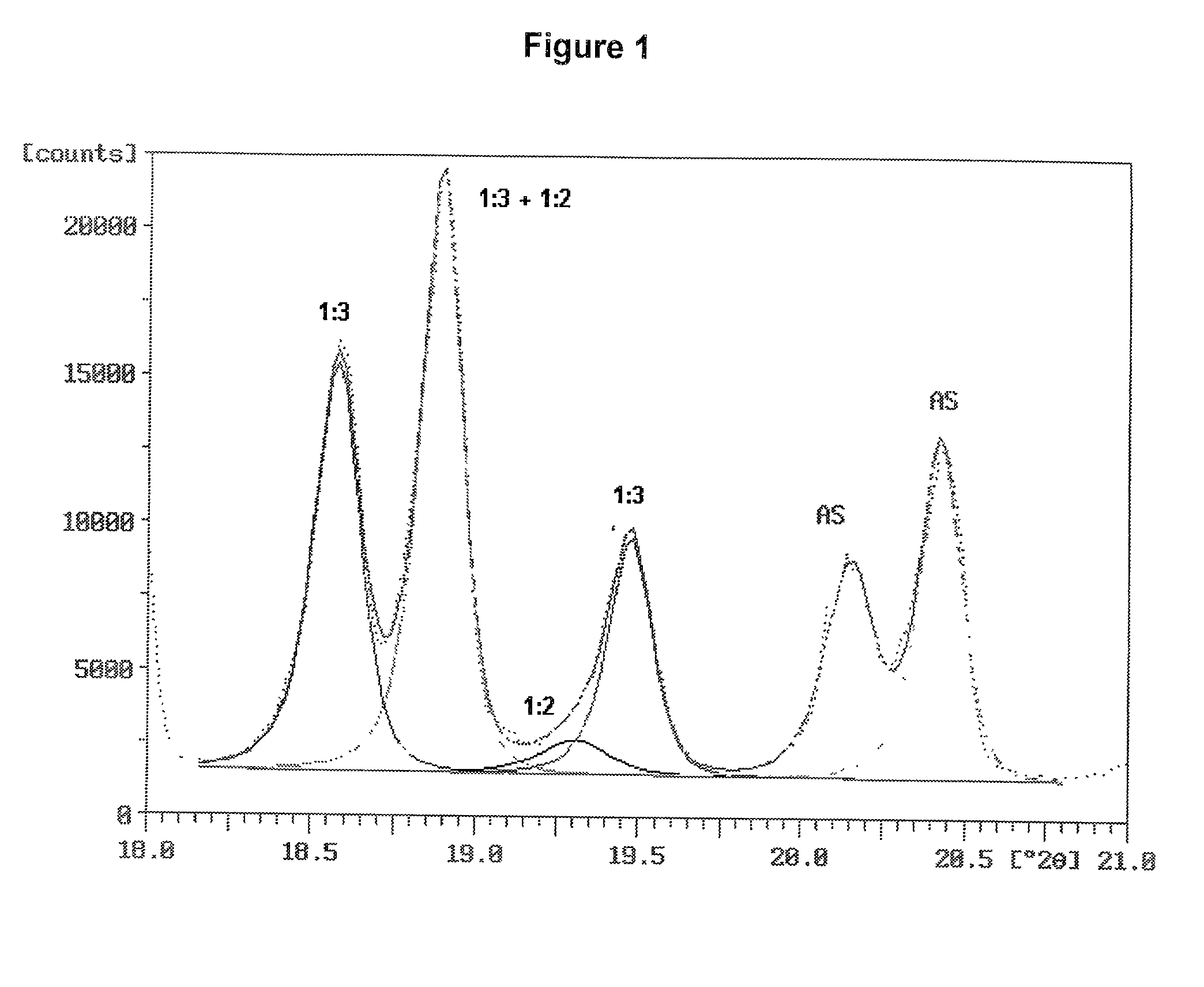
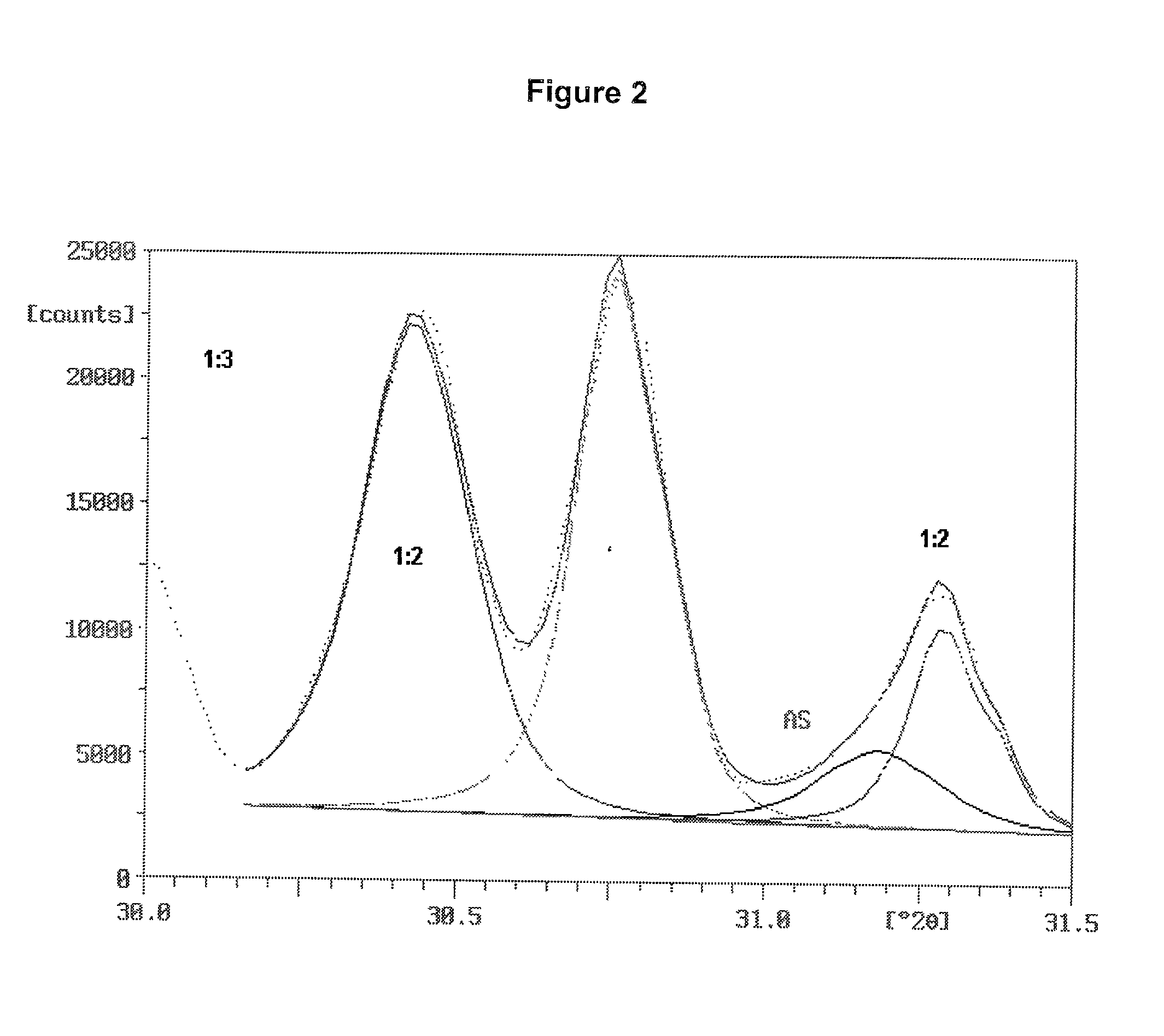
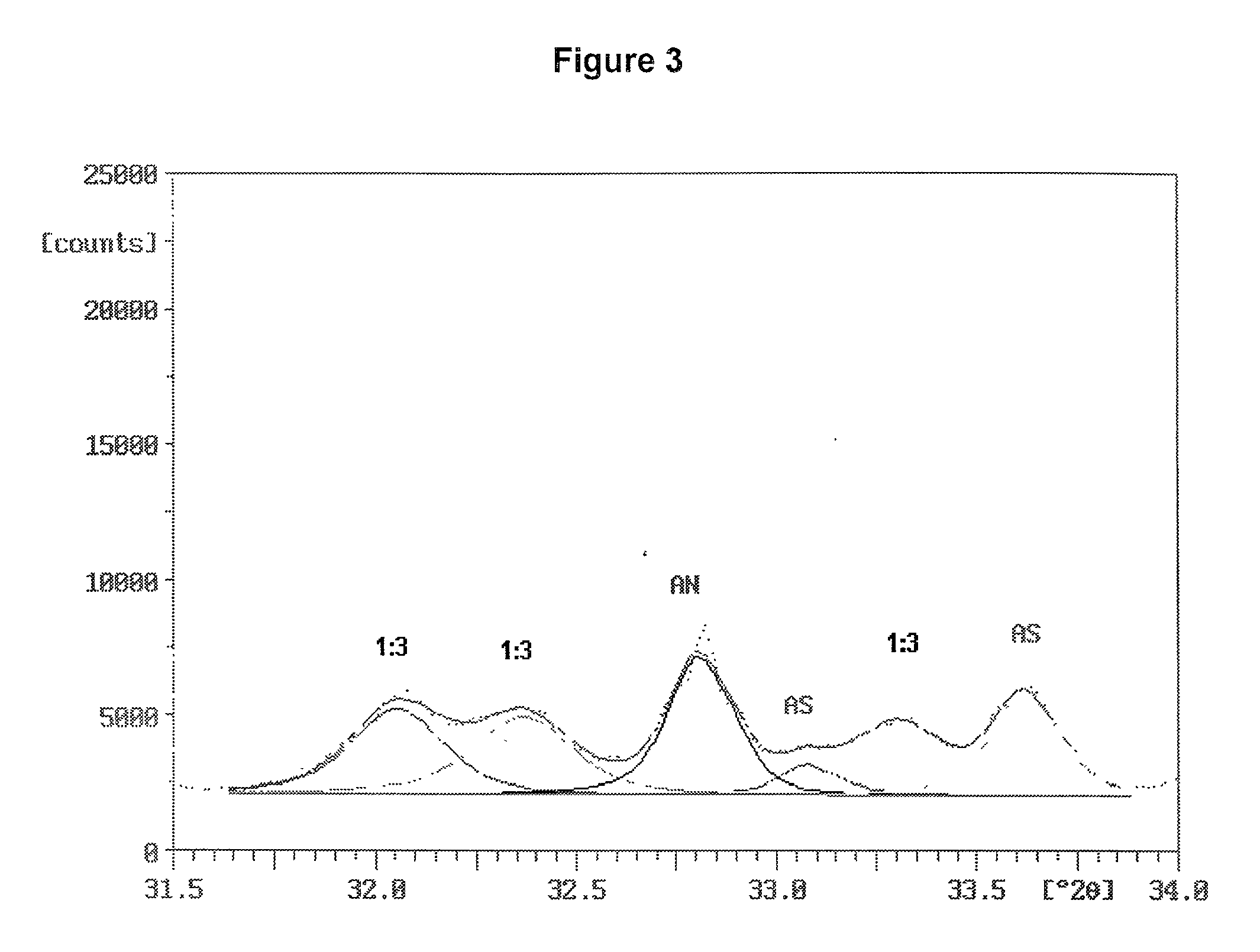
Examples
example 2
[0087] The same ammonium sulfate and ammonium nitrate as described in Comparative Example 1 were mixed in equal molar proportions. As in Comparative Example 1, the weights of the ammonium sulfate and ammonium nitrate totaled 10 g. However, in this example of the invention, water was added to the solids charged to the beaker. Water constituted 5.45 wt. % of the total charge.
[0088] The procedure in this example was identical to that of Comparative Example 1 with the exceptions of adding water to the batch and placing a thermocouple in the beaker as it left the oven to measure its cooling rate. It was found that the cooling rate to solidification of the batch was about 100.degree. C. / min. The composite of the product as determined by XRD and Karl Fischer analyses is shown in Table IV.
4TABLE IV Ex. or Wt. %, (water-free basis) Comp. (NH.sub.4).sub.2SO.sub.4. (NH.sub.4).sub.2SO.sub.4. Ex. Ammonium sulfate 2(NH.sub.4NO.sub.3) 3(NH.sub.4NO.sub.3) Ammonium nitrate Wt. % Water 1 36 1 52 11 0...
examples 37-38
[0096] Two ammonium sulfate nitrate materials were prepared and were examined for ammonium sulfate crystallite size and uniformity of dispersion amongst the crystals of double salt. Two charges were prepared, each consisted of 31.15 g of reagent grade ammonium sulfate (Fisher Scientific), 18.85 g of ammonium nitrate and 5.0 g of water. The ammonium sulfate and ammonium nitrate were in a molar ratio of 1.001:1. The ammonium sulfate had been ground to fine particles passing a Tyler No. 230 sieve (270 micrometer openings). The ammonium nitrate was ground from prills in a mortar and pestle.
[0097] The batches were mixed in small beakers and placed into an oven at 180.degree. C. Upon melting of the charge, the beakers were taken from the oven, mixed, and returned to the oven. One batch was removed, mixed and returned to the oven several times during the next 30 minutes. The other batch remained undisturbed in the oven for the 30 minutes after the initial mixing. At the end of this period,...
example 39
[0101] Accelerated rate calorimetry (ARC) was conducted by an independent testing laboratory on samples provided by Honeywell International Inc. The ARC method involves subjecting a sample to specified heat input until a self-accelerating reaction is identified. The particular method employed was an Open ARC Method in which a thermocouple is placed directly into the sample material in an open vessel. This method is used for highly energetic reaction systems which cannot be contained in a closed vessel and has been shown to provide consistent results for interpreting thermal hazard.
[0102] The several samples tested consisted of:
[0103] Ammonium sulfate nitrate material of the invention, prepared from an equi-molar mixture of ammonium sulfate and ammonium nitrate
[0104] b 1:3 double salt containing about 1-2 wt. % ammonium sulfate and about 3 wt. % ammonium nitrate.
[0105] Ammonium nitrate
[0106] The onset temperatures for spontaneous and energetic decomposition are shown in Table VIII.
8 ...
PUM
 Login to View More
 Abstract
Description
Claims
Application Information
 Login to View More