[0007] The invention relates to a premium upscale frozen pizza and methods for making that pizza. We have found that combining the highest quality meats, fish, sauces, cheeses and other toppings with the highest quality packaged frozen crust produces a pizza product that rivals a fresh pizza. The pizza includes a frozen parbaked premium crust portion made from a premium dough formula. The crust typically comprises a premium or super premium, generally flat, roughly square product having a surface that can be filled with sauce, cheese and other toppings. We have found a unique
recipe and process for the dough and crust that produces an enhanced premium crust. Careful control over
sugar,
moisture, oil and
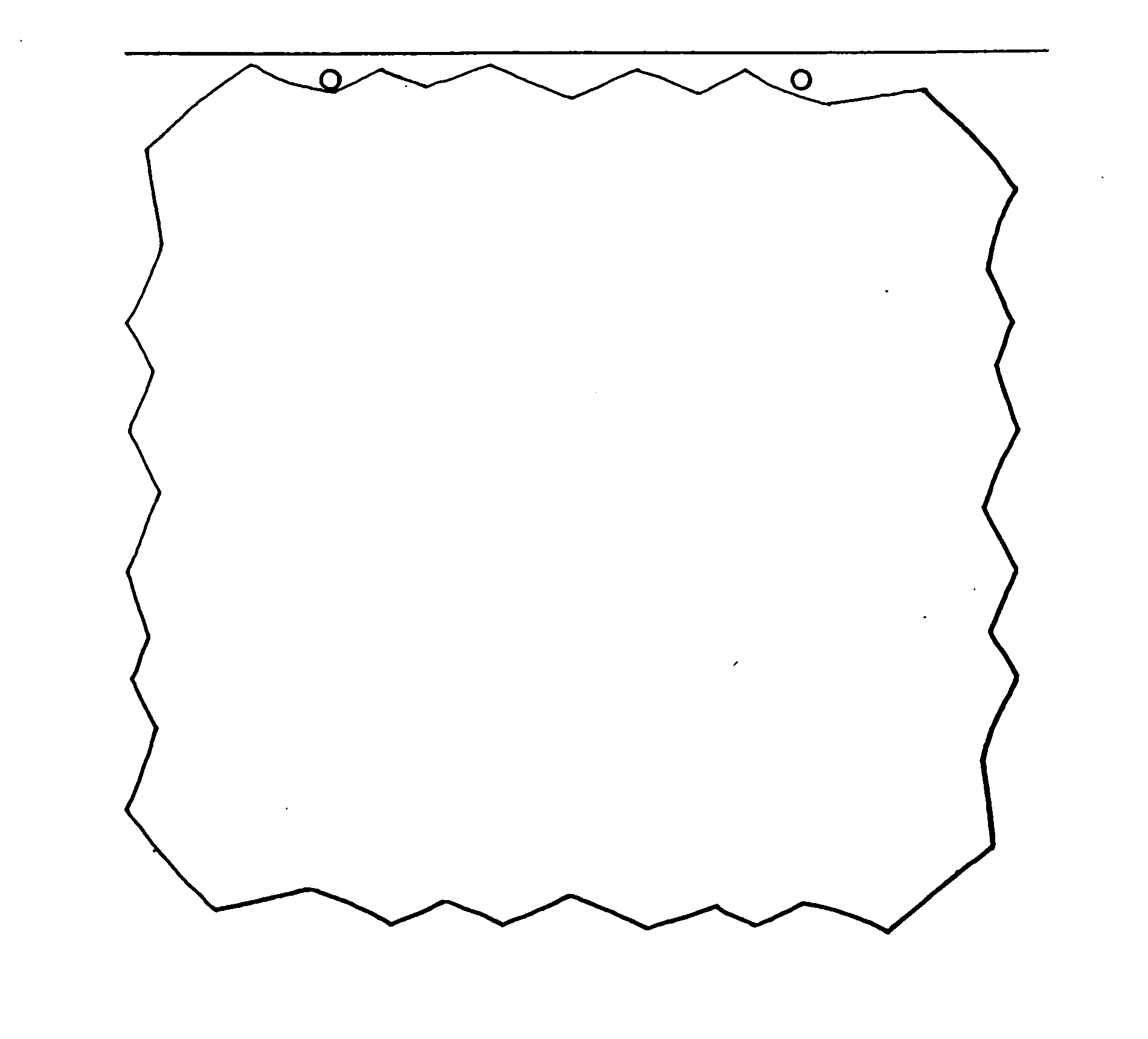
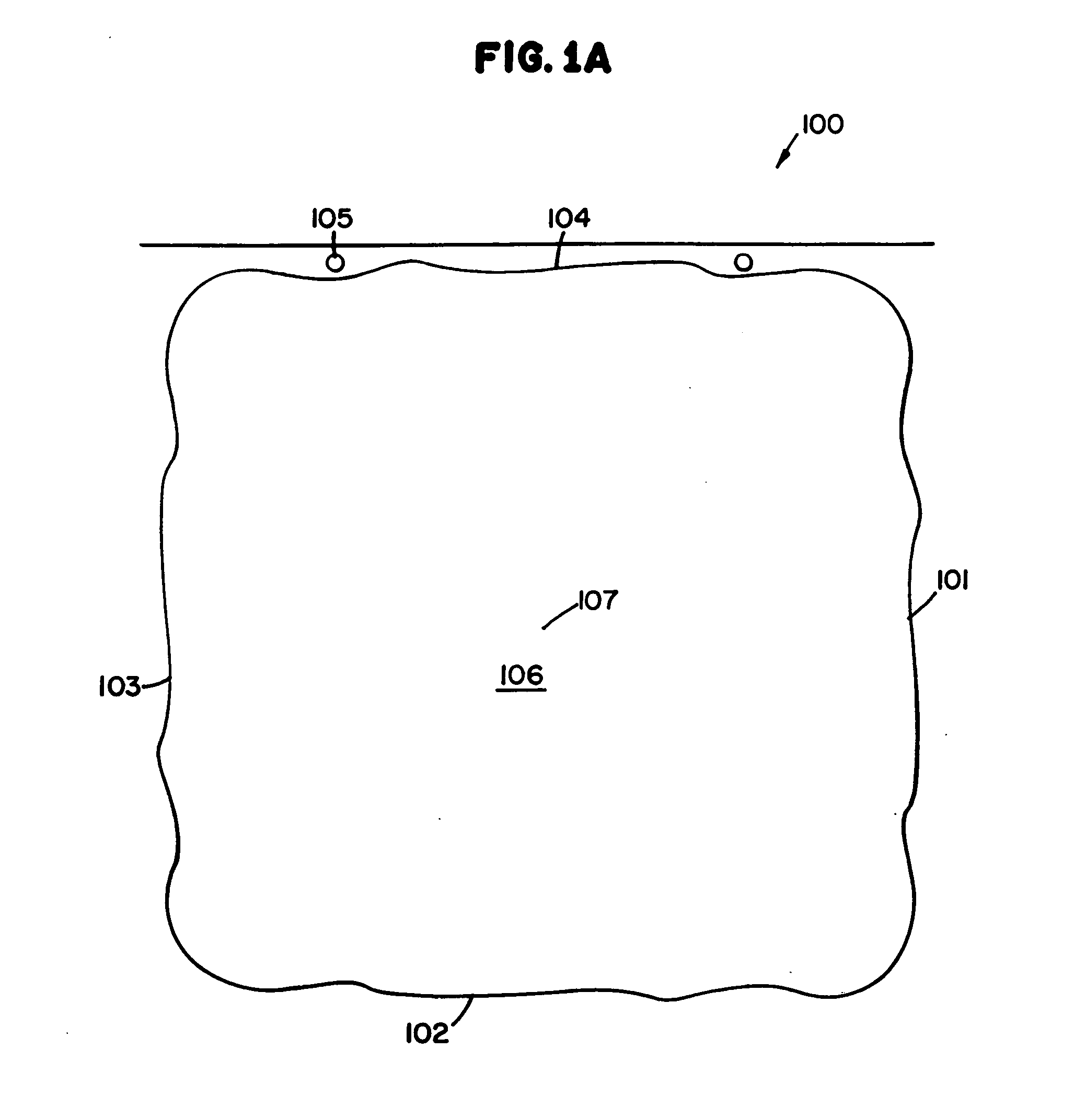
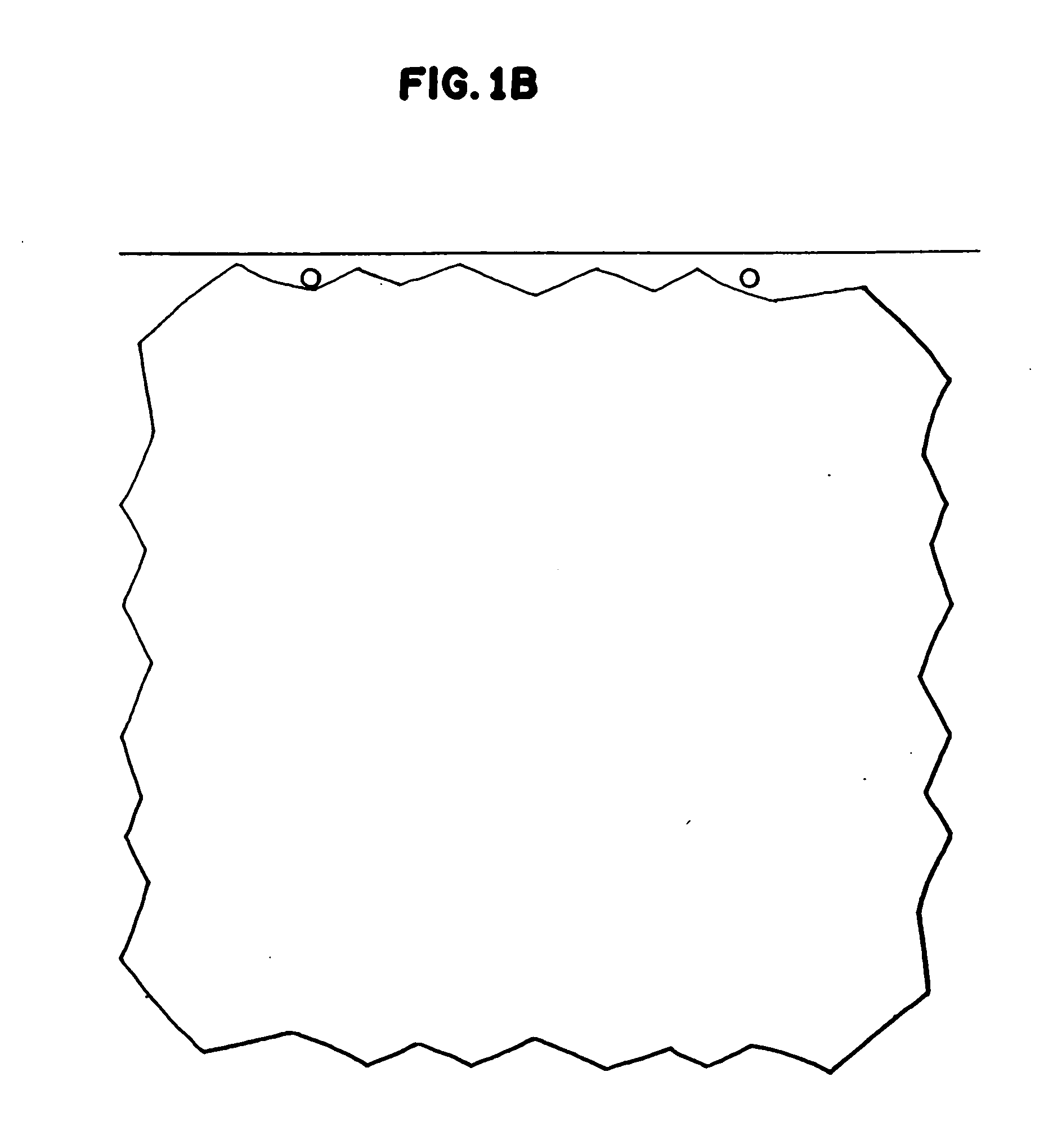
processing conditions results in a premium crust. The unique crust can be parbaked to a quality material. After adding pizza toppings, the premium pizza can be frozen and baked at home. Surprisingly, the crust expands when cooked at home obtaining a crisp exterior and soft bready interior. The periphery of the crust, while having an overall square configuration, has a deliberately formed, irregular perimeter mimicking a hand formed crust.
[0008] The premium dough formula includes high
moisture content and specific controlled
sugar (mono- and di-saccharide) content. The high
moisture and
sugar content provide the parbaked dough with the characteristic of
adaptation to a high temperature, short
time frame baking cycle in which the dough is converted into a parbaked premium pizza crust. The parbaked pizza crust has the unusual property that it rises both upon parbaking and upon final baking. The risen, expanded and baked crust obtains toast marks substantially similar to a
brick-oven fired conventional hand made dough structure. Typical pre-baked dough does not expand upon final baking under common production conditions. Thus the sugar content and high moisture content provide substantial
processing and
product value. The
processing value relates to the production of "no time" dough, requiring minimal floor time and no proof time to achieve the desired result. The floor time is just enough time for dough to transfer to the next stage in processing, generally less than 15 minutes, commonly less than 10 minutes, and often less than 5 minutes.
[0009] In the process of the invention, the dough is mixed with the unique
recipe or formula. After careful processing, the dough is
cut to the desired shape and the dough is then parbaked at high temperature for a short period of time to form the parbaked crust having the characteristic toast marks and the characteristic irregular edge, square aspect derived from sheeting and
cutting. The parbaking step ensures that the customer can bake the product at home forming a high quality premium pizza. The frozen parbaked topped pizza of the premium product of the invention, when baked at home, rises during baking, resulting in a less dense, more
open cell structure. The postbaked crusts, when completely baked at home, show horizontal lines within the plane of the crust indicating that larger bubbles or air cells have formed and then partially collapsed during final baking of the parbaked product. The fully baked crust typically increases in thickness, irregularity (departure from the plane of the crust) than that measured before baking. Not all height increase is due to aerosols, but the height results from irregular changes to the substantially plane or parbaked crust that increases stack height. The product of the invention can be frozen and packaged conventionally and shipped to retail outlets. A
consumer purchases the frozen premium pizza at the retail outlet and takes it home and maintains it in a frozen state until time for use. When used, the pizza product is then baked at conventional oven temperatures, commonly, 375.degree. F. to 450.degree. F. for 8-20 minutes to fully cook the toppings and to complete crust baking, crust expansion and
color formation in the crust. The meats, fish, cheese, sauce and toppings are completely baked when the product is baked at home. The toppings, cheese and sauce may be relatively uncooked when placed on the parbaked dough.
[0010] An important aspect of the invention is the method of making the pizza crust to form a premium high quality pizza product. In that process, dough is prepared having a carefully controlled moisture content and a carefully controlled sheer content along with a low
oil content and other conventional ingredients. The dough is then processed carefully to a point that it can be sheeted into a dough sheet. Such processing steps can include sheeting, combining the sheeted dough with bread crumbs, carefully modifying thickness of the sheeted layer, careful control of rest or floor time and a careful
cutting of the dough shape from the sheeted dough. Typically, the process of the invention includes no separate proofing time yet results in a high quality dough material.
[0011] In one preferred mode, the irregular characteristic of the crust is duplicated substantially identically on each edge such that the crust has a four way (also known as a C.sub.4) symmetry. In a four-way or C.sub.4 symmetrical crust format, the crust can be turned by 90.degree. increments and the irregular surface profile of each side will be substantially identical. One test of such identity is the overlap of a side with the adjacent side. This four way symmetry provides both the appearance of being hand formed, and manufacturing simplicity and convenience to ensure that the pizza is fully provided with sauce covering the desired surface portion. The sauce is combined with cheese
topping along with meat and vegetable add-ons as desired. The product is manufactured without a designed edge, however, in the baking process, the edge can have raised portions randomly depending on the non-uniformity in crust formulation and baking extent.
[0012] A further aspect of the invention resides in a preparation process that uses the overall square aspect having an irregular edge in a four fold symmetry. The irregular aspect and optional four fold symmetry, which is identical from crust to crust, provides an unique ability to place accurately the crust and register the crust in a specific location such that the sauce, cheese and other toppings can be carefully applied in exactly the right location. For the purpose of this disclosure, the term "registration" indicates that the crust is aligned carefully with the application apparatus such that the sauce, cheese and other toppings are placed exactly in the correct location on the crust in a repeatably precise location from crust to crust during production. Such accurate registration is obtained by placing the crust having registration indicia in the crust edge on a conveyor surface in contact with a registration means on the conveyor that holds the crust in place using the irregular edges.


 Login to View More
  Login to View More