Managed distribution of digital assets

a technology of managing distribution and digital assets, applied in the direction of digital transmission, instruments, computing, etc., can solve the problems of inability to account for events, events can happen quite easily, and neither of these solutions do much to protect the misuse of information by authorized insiders, so as to reinforce the user's understanding and acceptan

US20050060537A1Active Publication Date: 2005-03-17DIGITAL GUARDIAN LLC
20 Cites 144 Cited by

Patent Information

Authority / Receiving Office
US · United States
Current Assignee / Owner
Publication Date
2005-03-17

Smart Images

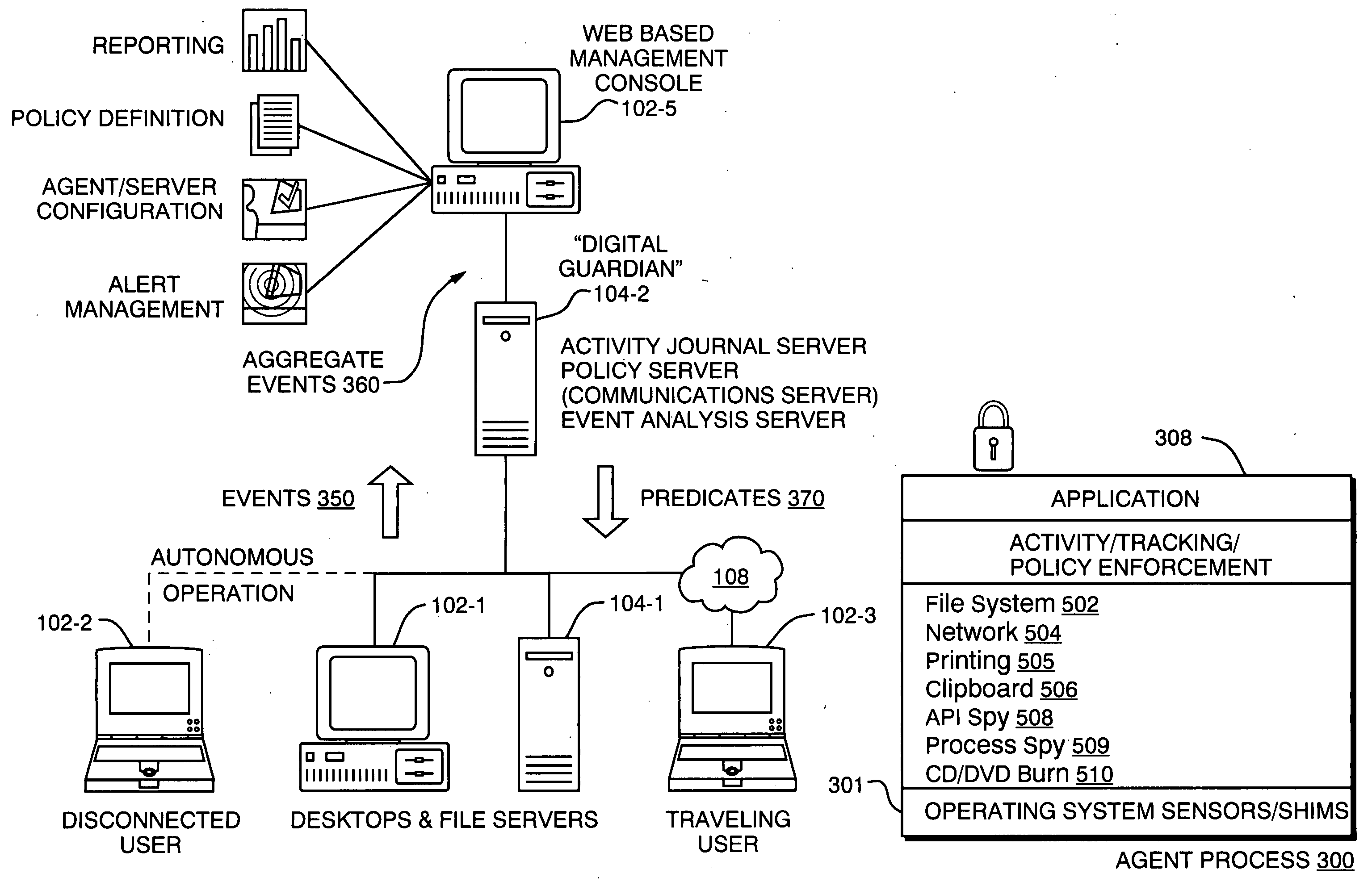
  • Figure 1
    Figure 1
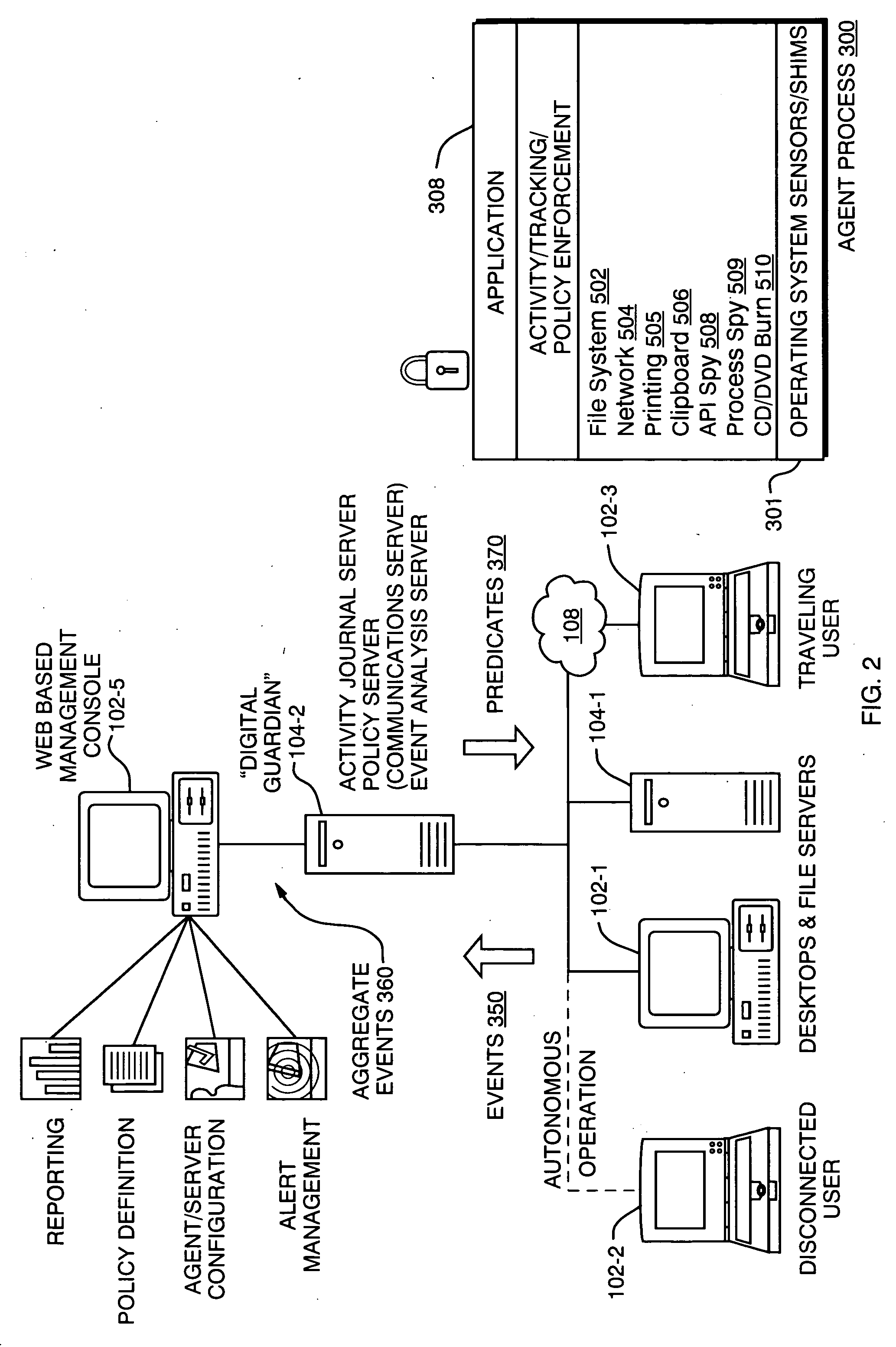
  • Figure 2
    Figure 2
  • Figure 3
    Figure 3
Patent Text Reader

Abstract

A technique for establishing usage control over digital assets such as computer files. The system model not only tracks authorized users' access to files, but monitors passage of such files to uncontrollable removable storage media or through network connections and the like which may indicate possible abuse of access rights. In accordance with a preferred embodiment, an autonomous independent agent process running at a point of use, such a background process in a client operating system kernel, interrupts requests for access to resources. The agent process senses low level system events, filters, and aggregates them. A policy engine analyzes sequences of aggregate events to determine when policy violations occur.
Need to check novelty before this filing date? Find Prior Art

Description

RELATED APPLICATION

[0001] This application claims the benefit of U.S. Provisional Application No. 60 / 442,464 entitled “Method and System for Adaptive Identification and Protection of Proprietary Electronic Information,” filed on Jan. 23, 2003. The entire teachings of the above-referenced application are hereby incorporated by reference.BACKGROUND OF THE INVENTION

[0002] Data security has been a significant issue facing system administrators since almost the inception of the data processing industry. Most computer users recognize the possibility of theft or misuse of data by unauthorized outsiders. The terms “hackers” and “crackers” are often used to describe outsiders who attempt to gain access to a system, and who are typically not involved in any way with an organization's operations, its internal employees or systems. Many different solutions already exist to protect an organization's data processing infrastructure from this kind of threat. These include physical access control,...

Examples

Embodiment Construction

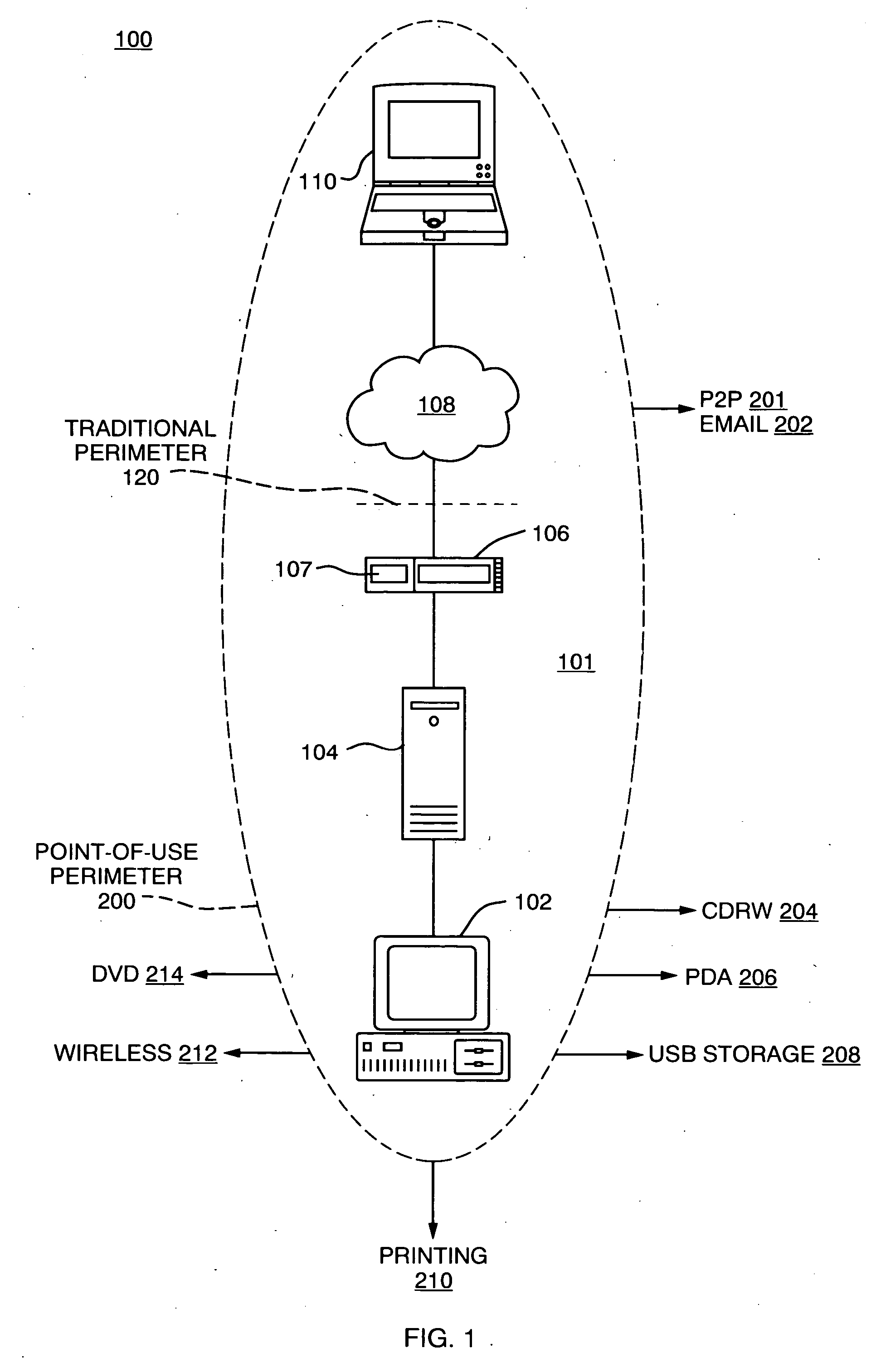
[0025]FIG. 1 is a diagram of a typical computer network 100 which consists of client devices 102 and servers 104 connected via local area network and / or inter-networking equipment. Connections to an outside network, such as the Internet 108, are made through devices such as routers or gateways 106. Connections through the Internet 108 can be also made to external computers 110.

[0026] Traditional security models attempt to prevent access by an untrusted outsider 110 to devices 102 and / or file servers 104 within the protected network 100. Thus, a network perimeter 120 is typically associated with network points of access, such as through router 106 and specifically at a firewall 107. The firewall 107 can thus prevent attempts by unauthorized users of outside computers 110 to access information stored in the server 104 or otherwise manipulate the local computers 102. Firewalls 107 can also establish a perimeter 120 for outgoing access such as, for example, by users attempting to acces...