Methods of using and fabricating a supporting substrate for the deposition, automated recognition, and spectroscopic identification of particles
a technology of supporting substrate and spectroscopic identification, applied in the direction of optical radiation measurement, instruments, spectrometry/spectrophotometry/monochromators, etc., can solve the problem of 500 nm investigation procedures not being possible, and achieve the effect of smooth structur
- Summary
- Abstract
- Description
- Claims
- Application Information
AI Technical Summary
Benefits of technology
Problems solved by technology
Method used
Image

Examples
Embodiment Construction
[0023] For the experiment laser of a wavelength of 785 nm is used, for example a TuiOptik Laser. The laser light is coupled into a microscope by means of a mirror and focussed on to the particles with an objective lens, for example a Nikon ULWD 40 lens. The backscattered light is collected by the same objective lens, coupled into a fiber and the exciter wavelength is filtered out by means of a notch filter, for example a supernotch filter (Kaiser Optical). Finally the inelastically scattered light is spectrally divided up in a spectrometer, for example an Acton spectrometer, and the Raman lines are recorded with a detector, for example a Backthinned CCD camera.
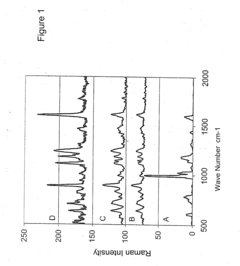
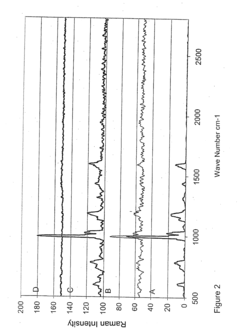
[0024]FIGS. 1A and 1D respectively illustrate the pure spectra of polystyrene, the particle to be analyzed, and polycarbonate, the filter membrane. FIG. 1B shows the spectrum of a polystyrene bead of a diameter of 3 μm which is disposed on an uncoated polycarbonate membrane. The focus of the laser beam with which this investi...
PUM
| Property | Measurement | Unit |
|---|---|---|
| roughness | aaaaa | aaaaa |
| thickness | aaaaa | aaaaa |
| thickness | aaaaa | aaaaa |
Abstract
Description
Claims
Application Information
 Login to View More