
Controller for semiconductor device
a technology of semiconductor devices and controllers, applied in the direction of motor/generator/converter stoppers, pulse techniques, instruments, etc., can solve the problems of inability to solve the erroneous judgment problem of the overcurrent protection function of the inrush current as described above, and the inability to start the motor at all
- Summary
- Abstract
- Description
- Claims
- Application Information
AI Technical Summary
Benefits of technology
Problems solved by technology
Method used
Image

Examples
first embodiment
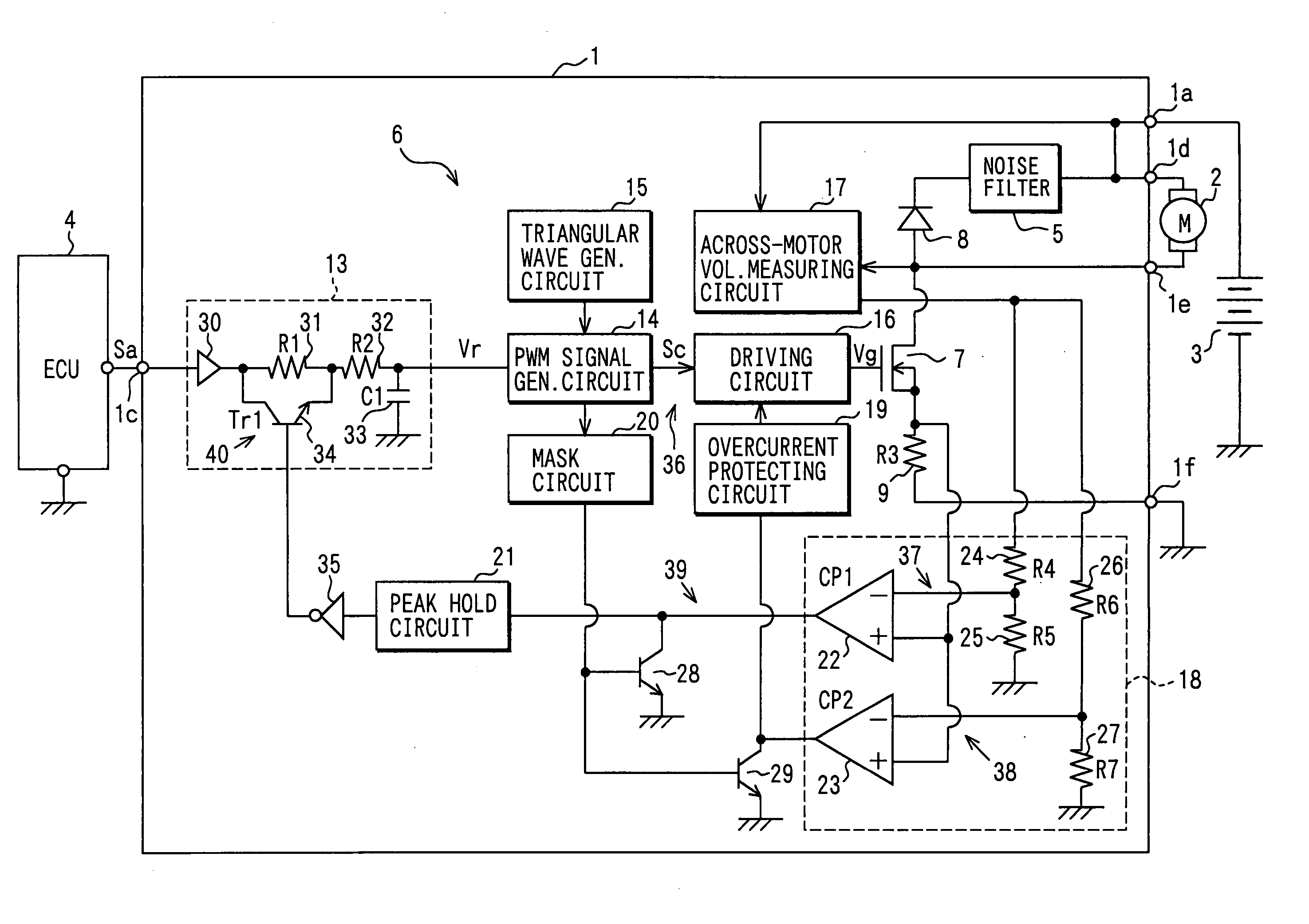
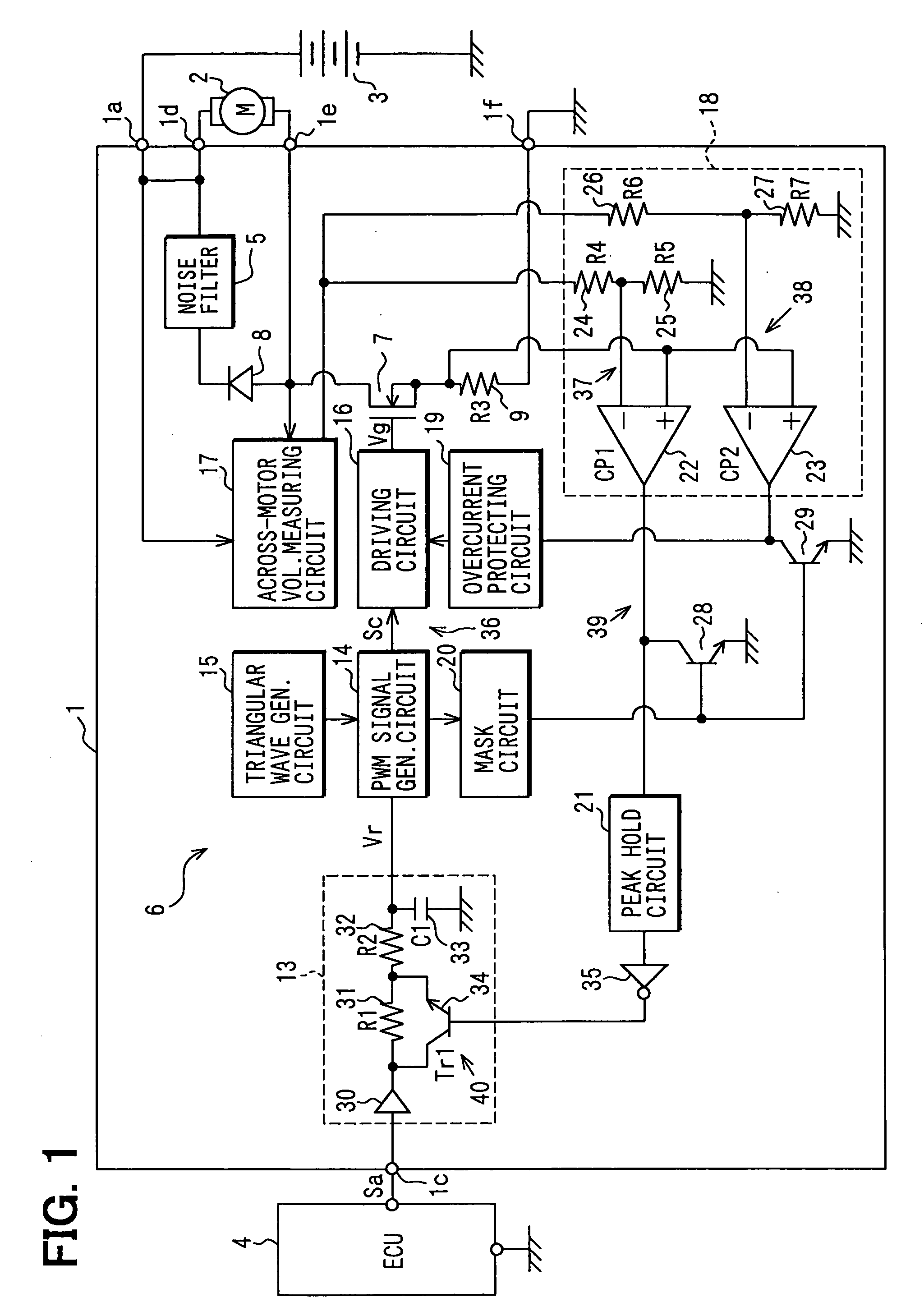
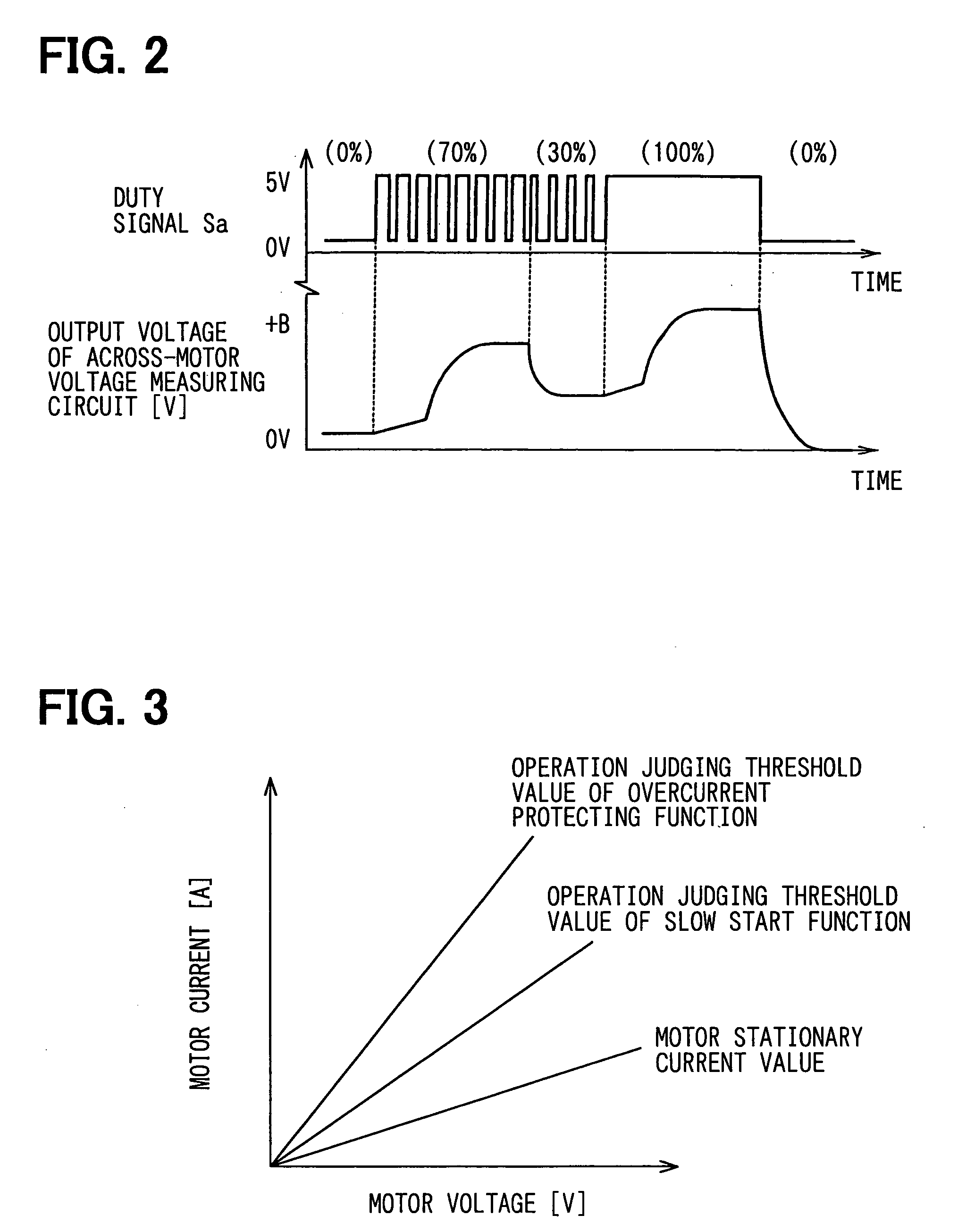
[0033] A first embodiment in which the controller is applied to a device for driving an air blowing fan motor of a heat exchange in a cooling system for a vehicle will be described with reference to FIGS. 1 to 4. FIG. 1 shows the electrical construction of a motor driving device. The motor driving device 1 drives an air blowing fan motor 2 (hereinafter referred to as motor 2), and it operates with a battery voltage supplied from a battery 3 to a terminal 1a as a power source voltage +B. Furthermore, an instruction signal Sa is supplied from an engine ECU 4 (Electronic Control Unit) to a terminal 1c. The instruction signal Sa is a PWM signal whose duty is varied in accordance with a voltage to be applied to the motor (load) 2.
[0034] The ECU 4 concentratively controls plural controllers for an engine such as fuel injection control, ignition timing control, idle rotational speed control, etc. As not shown, the ECU 4 is supplied with various signals such as a temperature signal of engi...
second embodiment
[0057]FIG. 5 shows a second embodiment. In FIG. 5, the same parts as in the first embodiment are represented by the same reference numerals, and the description thereof is omitted. Only the different parts from the first embodiment will be described hereunder. A FET controller 41 of the second embodiment by which the FET controller 6 is replaced is achieved by replacing the input signal processing circuit 13 with an input signal processing circuit 42. That is, in the input signal processing circuit 13, the resistance elements 31 and 32 are inserted in the input signal in series. However, in the input signal processing circuit 42, the series circuit comprising the transistor 34 and the resistance element 32 is connected to the resistance element 31 in parallel. These elements constitute a time constant switching unit 40a, and the other construction is the same as the first embodiment.
[0058] According to the second embodiment thus constructed, under the state that the transistor 34 i...
third embodiment
[0059]FIG. 6 shows a third embodiment, and only the different parts from the first embodiment will be described hereunder. In an FET controller 43 of the third embodiment, the resistance element 9 for current detection is eliminated, and the non-inverting input terminals of the comparators 22 and 23 are connected to the drain of MOSFET 7. According to the third embodiment thus constructed, the current flowing in the motor 2 can be detected by utilizing the ON-resistance when FET (current detecting unit) 7 is turned on in place of the resistance element 9. Accordingly, the construction can be more simplified.
PUM
 Login to View More
 Abstract
Description
Claims
Application Information
 Login to View More