[0011] The needs remaining in the prior art are addressed by the present invention, which relates to conditioning apparatus for use in a
chemical mechanical planarization (CMP) system and, more particularly, to an improved end effector arm configuration to provide well-controlled and efficient movement and operation of the effector arm with respect to the polishing pad surface during conditioning processes.
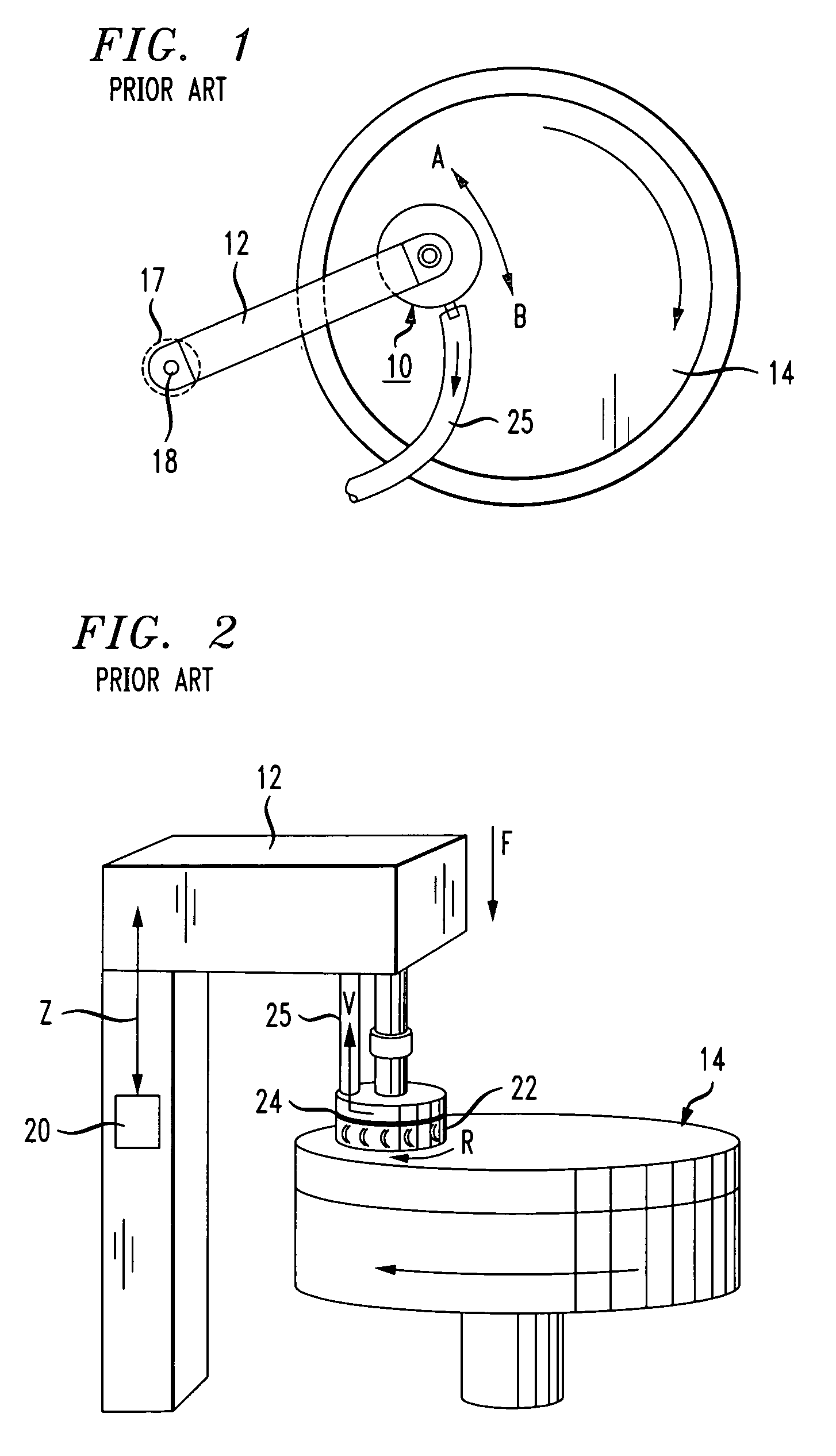
[0012] In accordance with the present invention, a conditioning apparatus end effector arm is formed to include various features that operate together in a manner that simplifies the maintenance associated with the conditioning disk itself, while also improving the precision and control of the
downforce applied by the conditioning disk onto the polishing pad surface. The enhanced end effector arm of the present invention provides for more consistent dressing of the polishing pad surface, which results in improving the quality and efficiency of the associated polishing operation(s) by limiting the opportunity for variations in the conditioning process to occur and upset the performance of the polishing process.
[0013] In an exemplary embodiment of the present invention, a “quick release” mechanism for removing / replacing the
abrasive conditioning disk is used that eliminates the need for other tools to be brought into contact with the conditioner head, or for an individual to physically contact the disk itself. The
elimination of these prior art actions is seen as thus limiting the potential for
contamination of the CMP system, or for breakage to occur as maintenance operations are performed on the
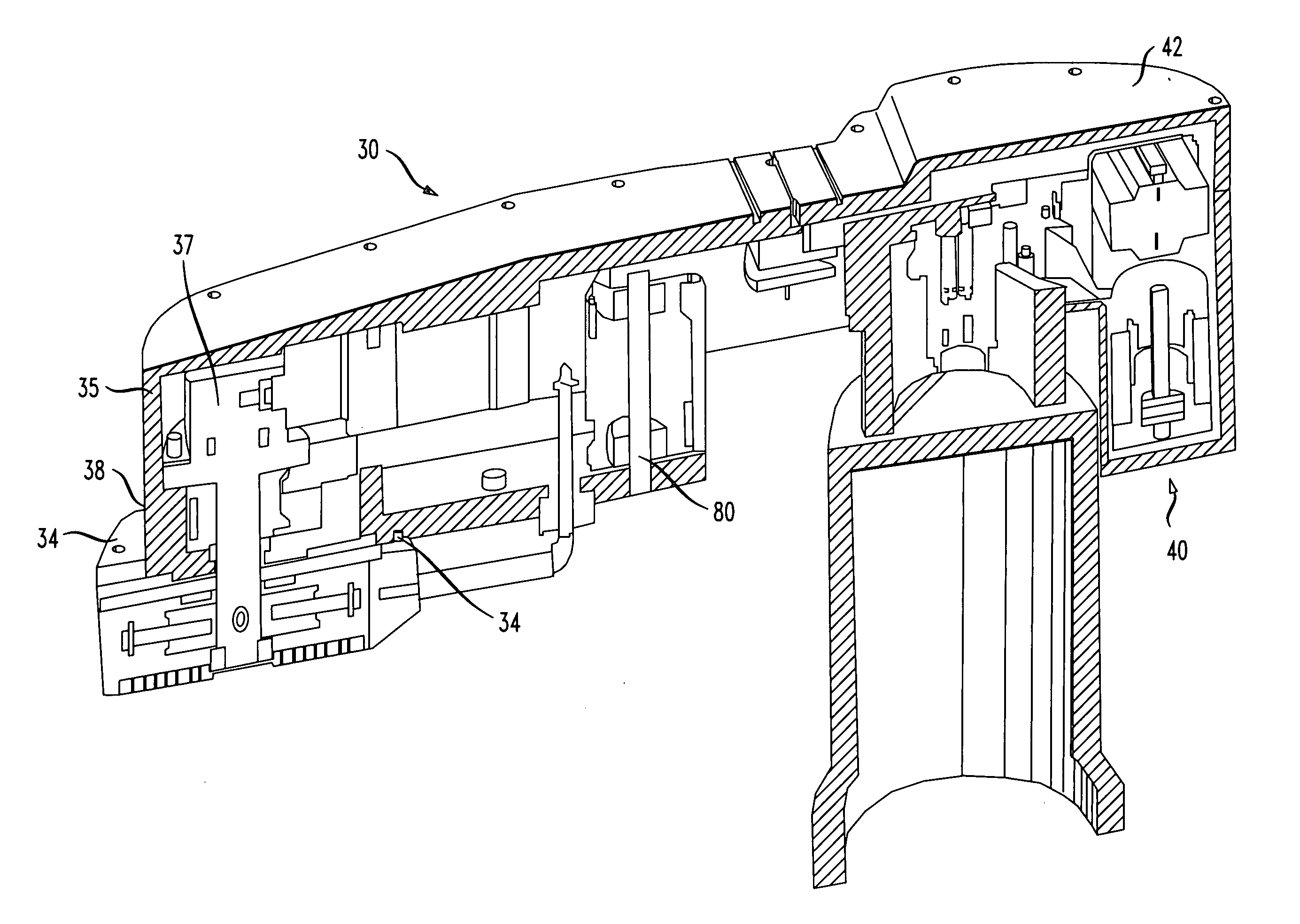
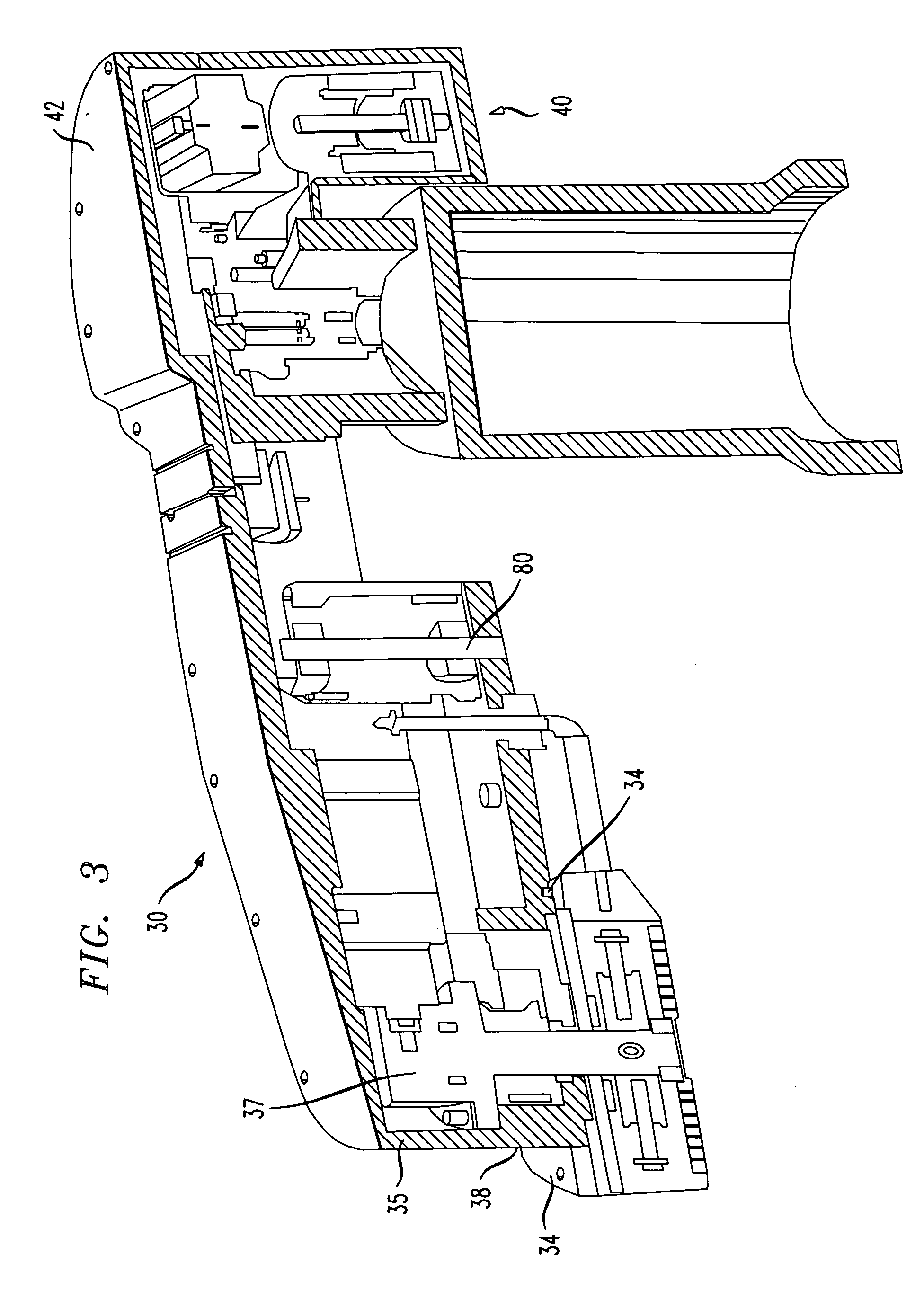
abrasive conditioning disk. The quick release mechanism takes the form of one or more ejector mechanism (for example, pins or plungers) that are disposed through the conditioner head and contact the conditioning disk such that by depressing the mechanism(s) the disk may be removed. Further improvement in the reliability of the conditioning disk is found by having a passive alignment arrangement, in the form of magnetic locators, disposed within the conditioning disk and the conditioner head itself, so that the disk will automatically attach to, and align with, the conditioner head upon replacement.
[0014] In one embodiment of the present invention, a pair of ejector mechanisms (which would typically be spring-loaded pins) are disposed at opposing locations on the outer periphery of the enhanced end effector arm conditioner head in a manner such that when the mechanisms are pressed downward, they contact the back surface of the abrasive conditioning disk with a force sufficient to release the magnetic or mechanical hold between the abrasive conditioning disk and the conditioner head. Advantageously, the application of a sufficient balanced force can easily be applied to the mechanisms by hand to quickly and easily remove the abrasive conditioning disk without the need for additional tools or physical handling of the conditioning disk itself.
[0015] Quality improvements associated with controlling the
downforce applied through the conditioning disk to the polishing pad are achieved in accordance with the enhanced end effector arm of the present invention through the incorporation of a “
static friction” (
stiction)-free
actuator for controlling both the vertical movement of the end effector arm and the downforce applied by the arm's conditioner head on the CMP polishing pad. In one embodiment of the present invention, a zero-
stiction actuator may comprise a two-way
piston including a glass housing with a
graphite piston. The
graphite piston rides within a very closely matched glass housing allowing for only very slight leakage around the sides, thus virtually eliminating any perceptible
static friction forces therebetween. The use of a precision pneumatic
regulator, which actively and predictably vents the feedback leakage pressure, provides for accurate control of the bi-directional movement of the actuator and a resulting accurate application of downforce to the conditioning head.
[0016] Quality problems associated with the tilting of the conditioner head as the polishing pad ages (resulting in a non-planar polishing pad surface) are addressed in accordance with the present invention through the use of a dual-drive / intermediate
pulley arrangement within the end effector arm. The use of a pair of drive belts has been found to minimize the unwanted tilting movement of the
belt drive system as the arm conforms to the uneven surface of an aging polishing pad. In particular, by using a “split” dual-drive belt, the span over which the arm must pivot is
cut in half, thus reducing the tilt that the belt must follow as the polishing pad ages.



 Login to View More