Check patentability & draft patents in minutes with Patsnap Eureka AI!

Reduced cross-talk signaling circuit and method

a signaling circuit and cross-talk technology, applied in the direction of logic circuit coupling/interface arrangement, line-transmission details, pulse technique, etc., can solve the problems of longer off-chip communication paths, more discontinuities, impedance mismatches, etc., to reduce coupling, remove noise, reduce cross-talk from paired data channels

Inactive Publication Date: 2007-03-01
GOOGLE LLC
View PDF2 Cites 15 Cited by
  • Summary
  • Abstract
  • Description
  • Claims
  • Application Information

AI Technical Summary

Benefits of technology

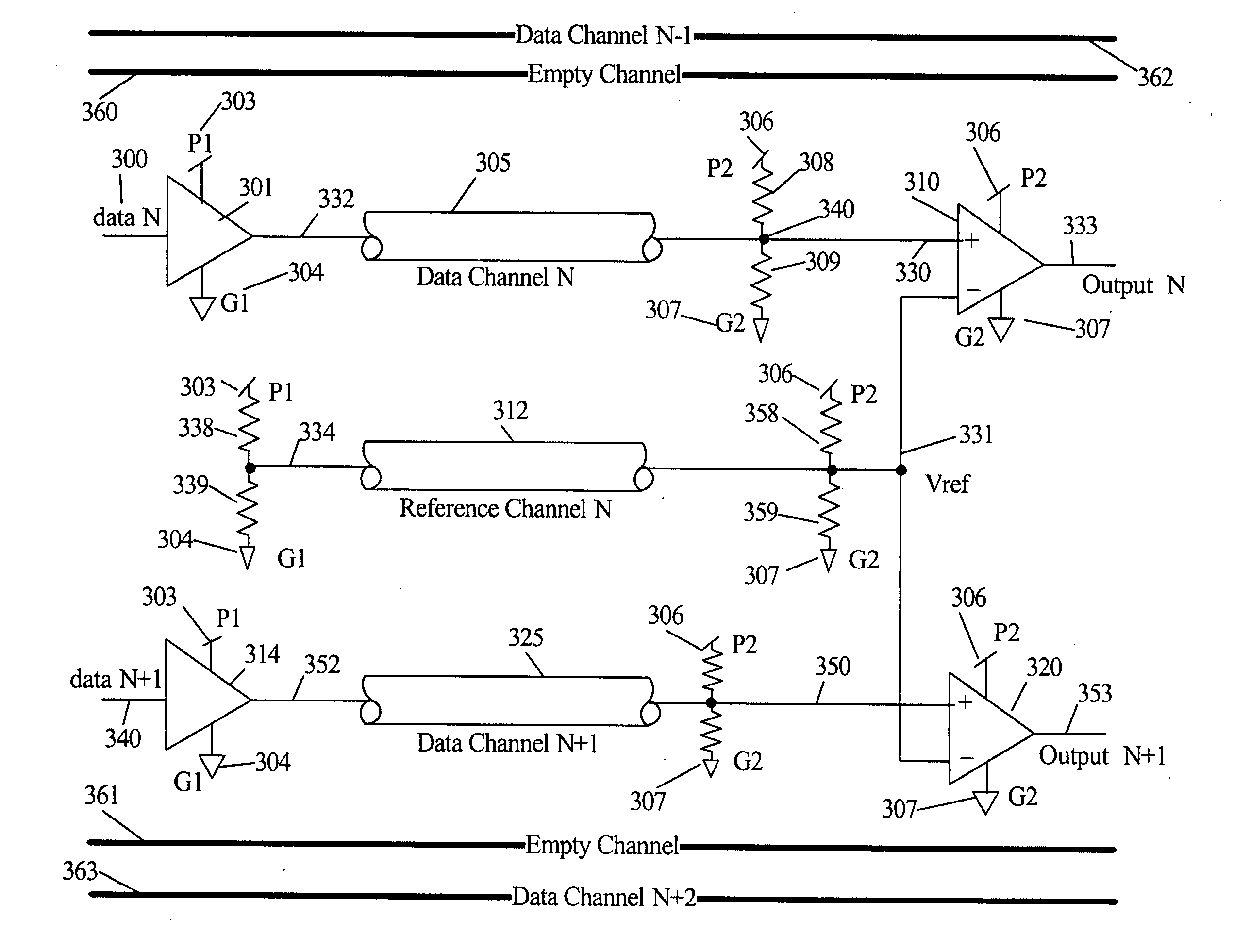
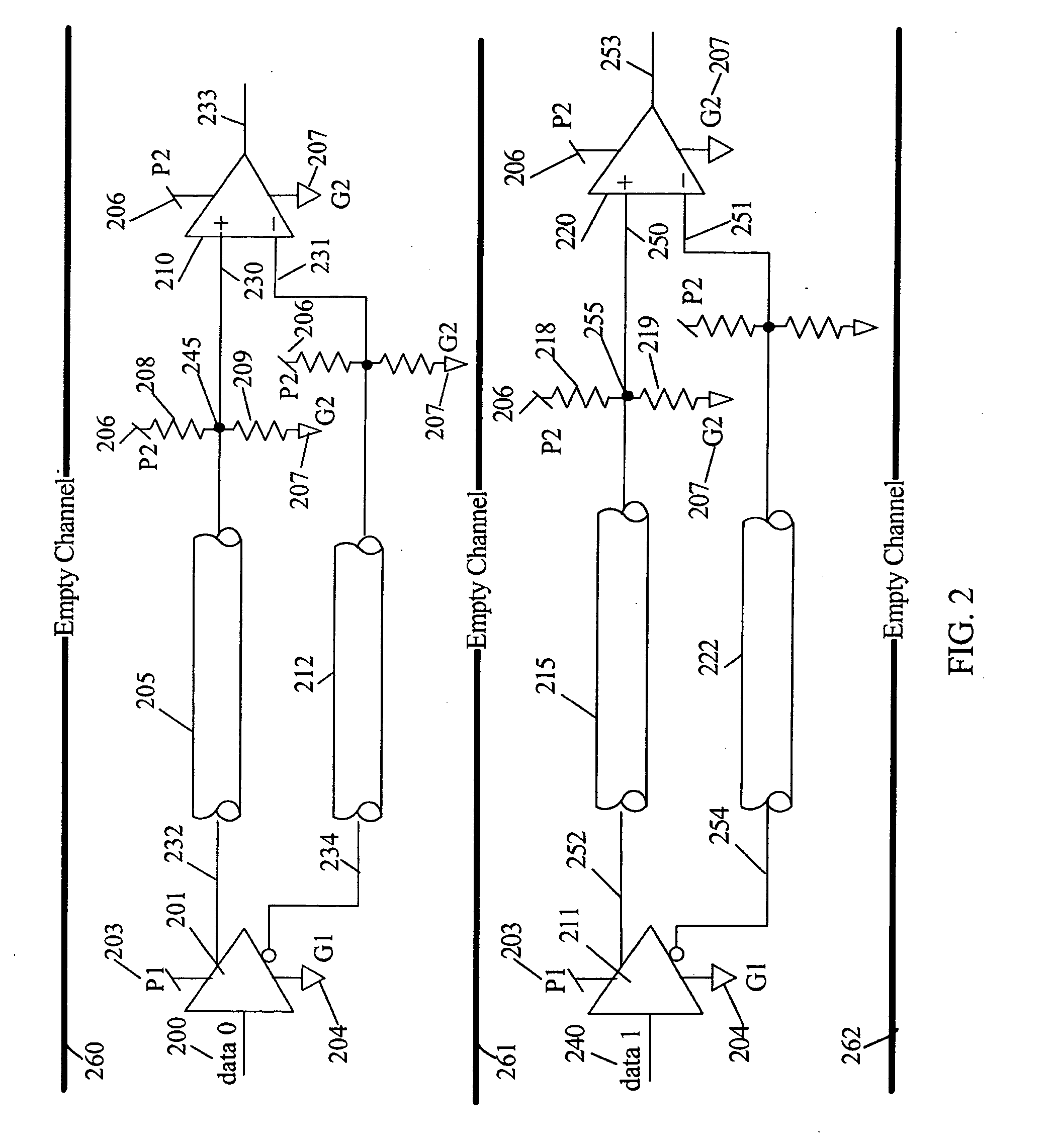
[0007] Adjacent data signals are paired and driven single ended from the driver side through transmission lines forming data channels. The data channels of the adjacent data signals are separated by a common reference channel. The adjacent data channels are coupled to one input of two differential receivers while their other inputs are coupled to the common reference signal transmitted over the common reference channel. Driver side and receiver side power supply noise is coupled as a common mode signal to the reference signal of the common reference channel. Cross talk from the paired data channels is reduced by the presence of the common reference channel. Common mode rejection of the differential receivers further removes noise. Adjacent paired data channels are separated by an empty wiring channel to reduce coupling between paired data channels.

Problems solved by technology

Off-chip communication paths are longer, have higher noise, impedance mismatches, and have more discontinuities than on-chip communication paths.
When using inter-chip high-speed signaling, noise and coupling between signal lines (cross talk) affects signal quality.
Additionally, an empty wiring channel is usually added between each differential channel which further adds to the wiring inefficiency.

Method used

the structure of the environmentally friendly knitted fabric provided by the present invention; figure 2 Flow chart of the yarn wrapping machine for environmentally friendly knitted fabrics and storage devices; image 3 Is the parameter map of the yarn covering machine
View more

Image

Smart Image Click on the blue labels to locate them in the text.
Viewing Examples
Smart Image
  • Reduced cross-talk signaling circuit and method
  • Reduced cross-talk signaling circuit and method
  • Reduced cross-talk signaling circuit and method

Examples

Experimental program
Comparison scheme
Effect test

Embodiment Construction

[0014] In the following description, numerous specific details are set forth to provide a thorough understanding of the present invention. However, it will be obvious to those skilled in the art that the present invention may be practiced without such specific details. In other instances, well-known circuits may be shown in block diagram form in order not to obscure the present invention in unnecessary detail. For the most part, details concerning timing considerations and the like have been omitted inasmuch as such details are not necessary to obtain a complete understanding of the present invention and are within the skills of persons of ordinary skill in the relevant art.

[0015] Refer now to the drawings wherein depicted elements are not necessarily shown to scale and wherein like or similar elements are designated by the same reference numeral through the several views.

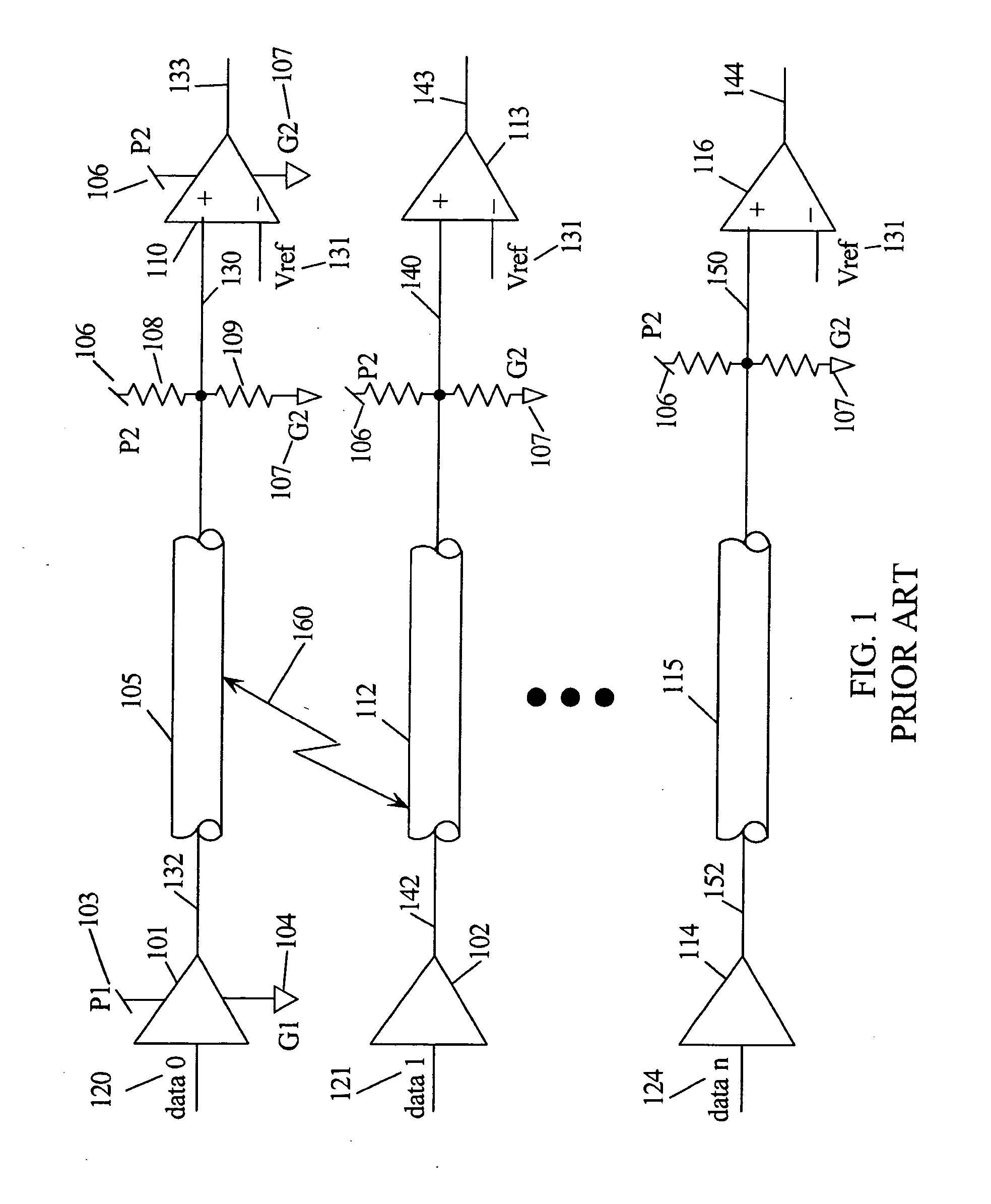
[0016]FIG. 1 is a circuit diagram of typical pseudo-differential signaling for transmitting data from a driver...

the structure of the environmentally friendly knitted fabric provided by the present invention; figure 2 Flow chart of the yarn wrapping machine for environmentally friendly knitted fabrics and storage devices; image 3 Is the parameter map of the yarn covering machine
Login to View More

PUM

No PUM Login to View More

Abstract

Signaling between two or more ICs use a signaling scheme wherein a reference signal is generated at the driver side and the receiver side. The driver side reference signal is coupled to the receiver side reference signal with a transmission line channel forming a reference channel. Data signal channels are paired with a reference channel between each two adjacent data channels. Adjacent pairs of data signal channels are each separated with an empty wiring channel. The paired data signals are received in one input of a differential receiver. The reference signal of the reference channel between the two paired data channels is coupled to the other input of the two differential receivers. Coupling from the paired data channels to the reference channel appears a common mode noise and is rejected by the differential receivers. The number of channels is reduced from a full differential signaling scheme.

Description

TECHNICAL FIELD [0001] The present invention relates in general to board level transmission line drivers and receivers, and in particular, to methods for reducing noise coupling between adjacent data channels. BACKGROUND INFORMATION [0002] Digital computer systems have a history of continually increasing the speed of the processors used in the system. As computer systems have migrated towards multiprocessor systems, sharing information between processors and memory systems has also generated a requirement for increased speed for the off-chip communication networks. Designers usually have more control over on-chip communication paths than for off-chip communication paths. Off-chip communication paths are longer, have higher noise, impedance mismatches, and have more discontinuities than on-chip communication paths. Since off-chip communication paths are of lower impedance, they require more current and thus more power to drive. [0003] When using inter-chip high-speed signaling, noise...

Claims

the structure of the environmentally friendly knitted fabric provided by the present invention; figure 2 Flow chart of the yarn wrapping machine for environmentally friendly knitted fabrics and storage devices; image 3 Is the parameter map of the yarn covering machine
Login to View More

Application Information

Patent Timeline
no application Login to View More
Patent Type & Authority Applications(United States)
IPC IPC(8): H01P5/00
CPCH04L25/0272H04B3/32
Inventor DREPS, DANIEL M.HARIDASS, ANANDTRUONG, BAO G.ZIEGELBEIN, JOEL D.
Owner GOOGLE LLC
Features
  • R&D
  • Intellectual Property
  • Life Sciences
  • Materials
  • Tech Scout
Why Patsnap Eureka
  • Unparalleled Data Quality
  • Higher Quality Content
  • 60% Fewer Hallucinations
Social media
Patsnap Eureka Blog
Learn More