[0005]It is an object of the invention to provide a membrane carburetor of the kind described above wherein a stable running performance of the engine is achieved also over longer operating times.
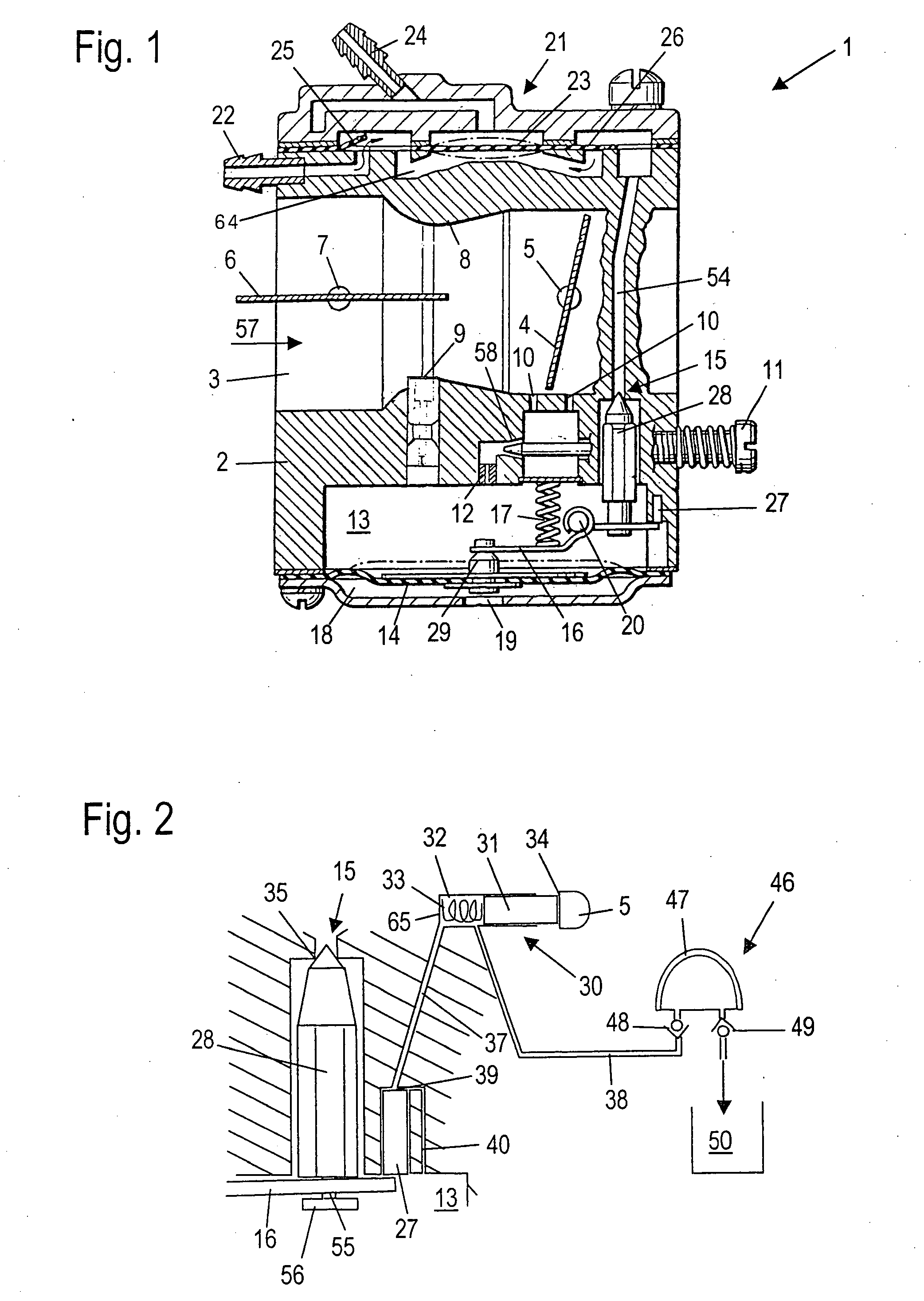
[0007]It has been shown that the disadvantages of the known acceleration pump can be avoided when the acceleration pump does not pump fuel directly into the control chamber or to the fuel openings but rather, when there is an intervention into the control performance via the acceleration pump. This is achieved in that the acceleration pump operates hydraulically on an actuating member in the control chamber. With the term “actuating member”, all components of the control chamber are designated which influence the fuel quantity supplied to the intake channel. The
hydraulic action on an actuating member of the control chamber leads to a direct change of the supplied fuel quantity. In this way, an acceleration enrichment can be achieved in a simple manner. Air bubbles, which collect in the acceleration pump, are not supplied to the control chamber. Accordingly, a supply of air into the fuel
system is avoided so that a stable running operation can be achieved.
[0009]Advantageously, a second suction line opens into the pump chamber which connects the pump chamber to the control chamber. In the second suction line, a
check valve is mounted which opens in the flow direction toward the pump chamber. In this way, a quick
scavenging of the pump chamber and a rapid filling of the pump chamber during deceleration operations is achieved so that the acceleration pump is rapidly again available for subsequent acceleration operations. The pump chamber can be scavenged with the
scavenging pump via the suction line. During decelerations, fuel can flow back from the control chamber into the pump chamber via the second suction line. The second suction line can be configured with a comparatively large flow cross section so that a rapid filling of the pump chamber results. The
check valve ensures that, during the pump
stroke, the total fuel present in the pump chamber actuates the actuating member via the pressure line and cannot escape to the control chamber via the suction line. In the pressure line, a
check valve can be mounted which opens in flow direction from the pump chamber. In this way, it is ensured that the filling of the pump chamber always takes place via the suction line. The characteristic of the acceleration pump can be well adjusted in this manner.
[0012]The pressure line is connected to the control chamber via a
throttle element. The pressure, which is present in the pressure line, can drop via the throttle element. For an acceleration, the actuating member is actuated via the pressure line. The pressure, which is present in the pressure line, is reduced via the throttle element and the actuating member can reset. The throttle element thereby prevents a continuous enrichment after an acceleration operation. The actuating member can advantageously be reset into the start position with a spring.
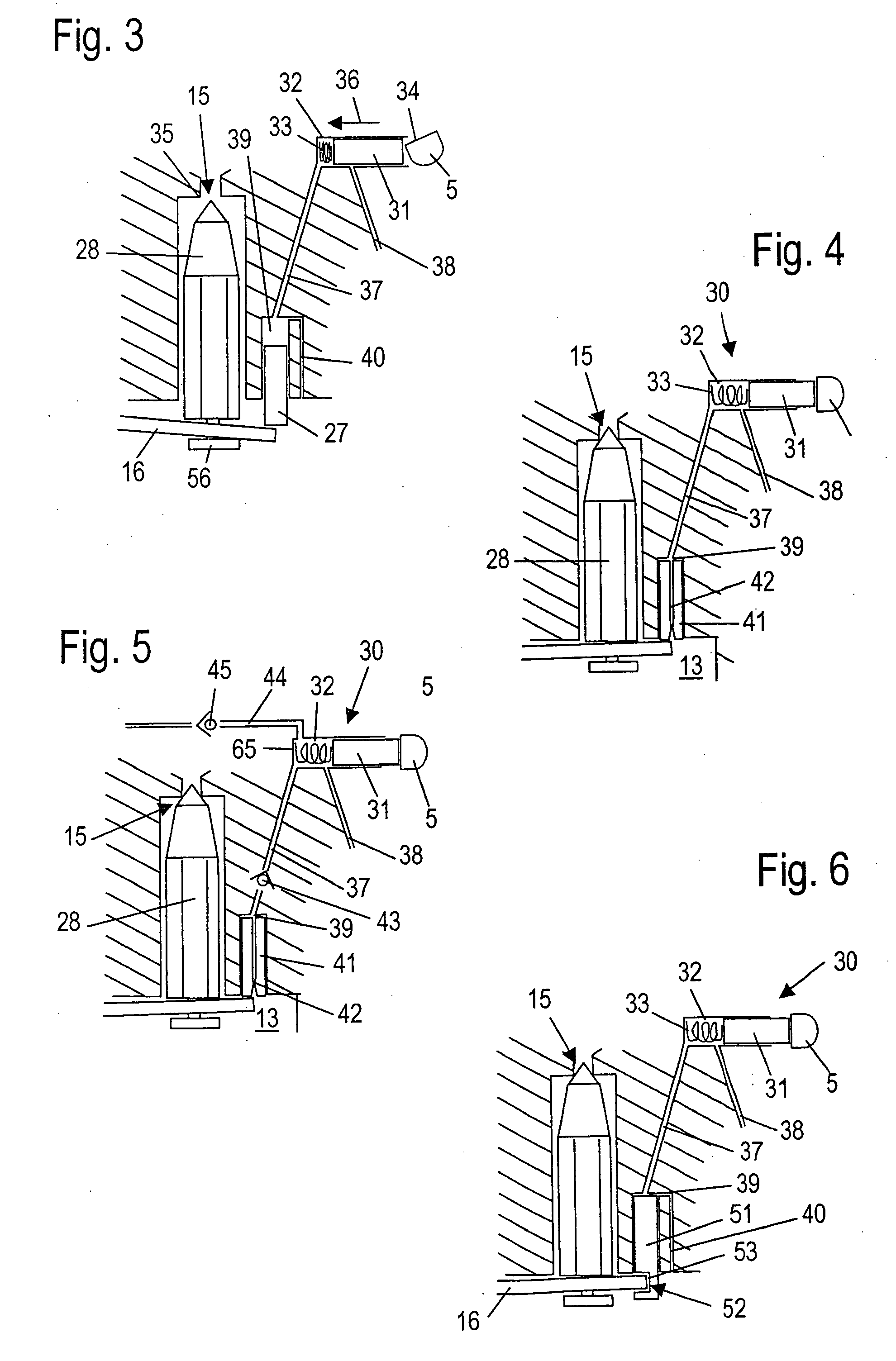
[0013]The actuating member is actuated via an actuating
piston which delimits a pressure chamber into which the pressure line opens. A simple configuration results when the throttle element is configured as a
discharge bore in the actuating
piston. Advantageously, the actuating
piston acts on the lever which couples the position of the
inlet valve to the position of the control membrane. In order to make possible that the actuating piston can act on the lever when there is a deceleration, the actuating piston is connected via a fixation to the lever which transmits a
stroke of the actuating piston in both directions to the lever. During the deceleration, the actuating member is reset thereby.
[0015]The inlet valve has a control body which is fixedly connected to the valve body of the inlet valve. Advantageously, the control body is configured as an actuating piston which delimits a pressure chamber into which the pressure line opens. With the configuration of the control body itself as an actuating piston, no additional components are needed. The control body can also be configured as one piece with the valve body of the inlet valve. The control body is especially configured as a weight body. The weight body can provide a position compensation of the membrane carburetor.


 Login to View More