
Counter Current Mixing Reactor
a technology of mixing reactor and counter current, which is applied in the direction of flow mixer, chemical/physical/physical-chemical stationary reactor, bulk chemical production, etc., can solve the problems of eventual blockage of the reactor and the restriction of flow, so as to reduce the potential for mixing, avoid premixing or stagnation, and reduce the effect of pipework blockag
- Summary
- Abstract
- Description
- Claims
- Application Information
AI Technical Summary
Benefits of technology
Problems solved by technology
Method used
Image

Examples
example 1
The Production of Nanoparticulate CeO2
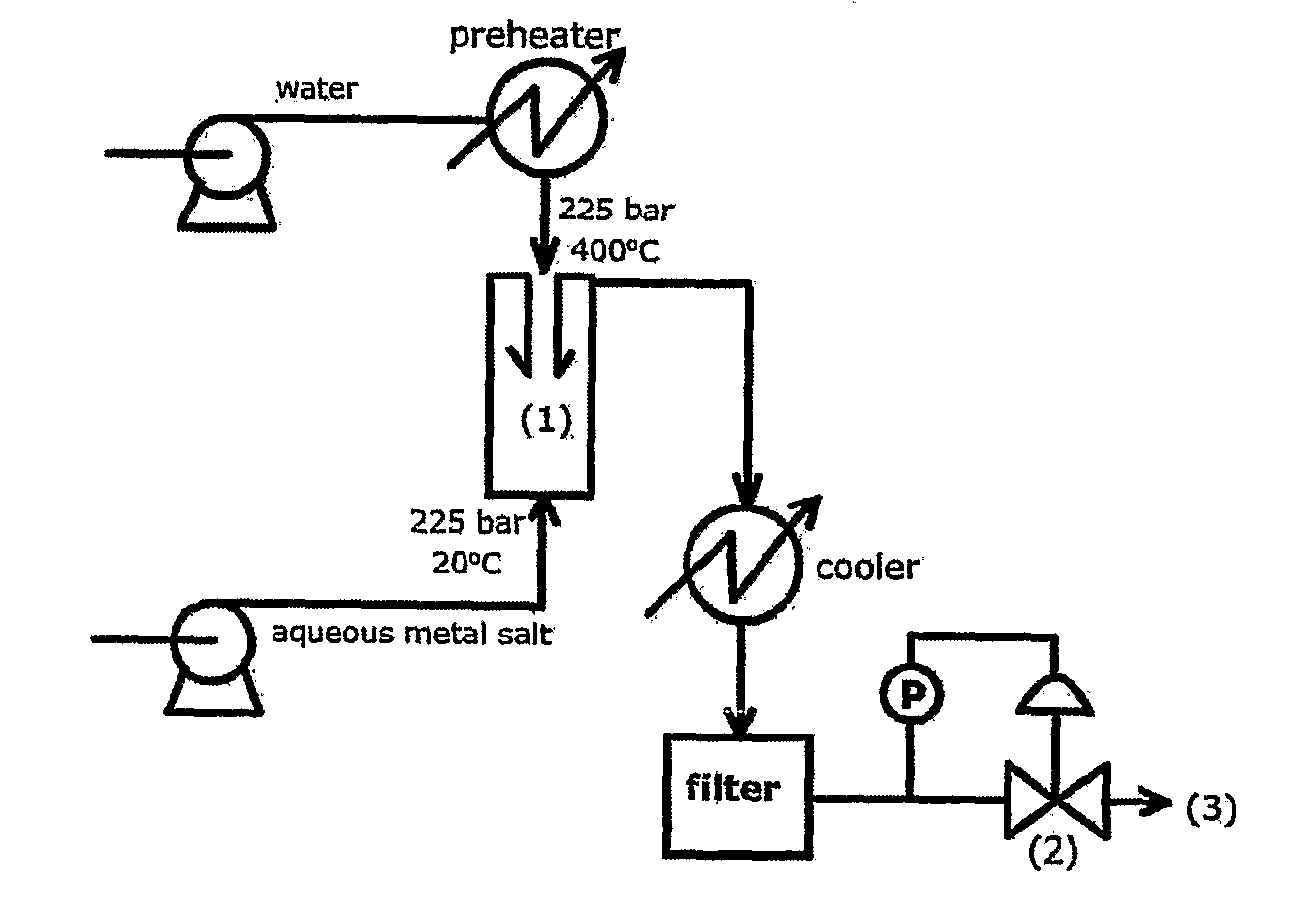
[0042] The following reaction was carried out using the mixing reactor of the invention incorporated into a rig configuration shown in FIG. 4.
Hydrolysis: Ce(NO3)4+4H2O→Ce(OH)4(s)+4HNO3
Dehydration: Ce(OH)4→CeO2+2H2O
[0043] System pressure was set to 228 bar. The metal salt solution (Ce(NO3)4, (0.2 M)) was flowed at 5 ml / min through the reactor. A total of 250 ml of the metal salt solution was used during the course of the 50 min run. The sCH2O was flowed at 10 ml / min through the reactor at a temperature of 400° C. The reactor was maintained at a temperature of 370° C. using a band heater for the duration of the reaction.
[0044] The high pressure pumps and back pressure regulator system allow the pressure to be maintained throughout the rig and then to be reduced at the end allowing liquid product to be released at ambient temperature and pressure. The rig, using the invention can be run for hours without blocking producing 2-...
example 2
Control Over Surface Area with Flow Rate within the Reactor
[0046]FIG. 5 shows the effect of increasing flow rate of cerium nitrate up through the reactor. Clearly there is an interesting trend of increasing surface area (from 65 m2 / g up to 100 m2 / g) with increasing metal salt flow up to a value of 8 ml / min beyond which the particle size begins to decrease. It is possible that the increase is caused by the relationship between flow velocity and reaction kinetics and the decrease is caused by an ‘excess’ of metal salt resulting in larger particles being produced.
example 3
Control Over Surface Area with Temperature within the Reactor
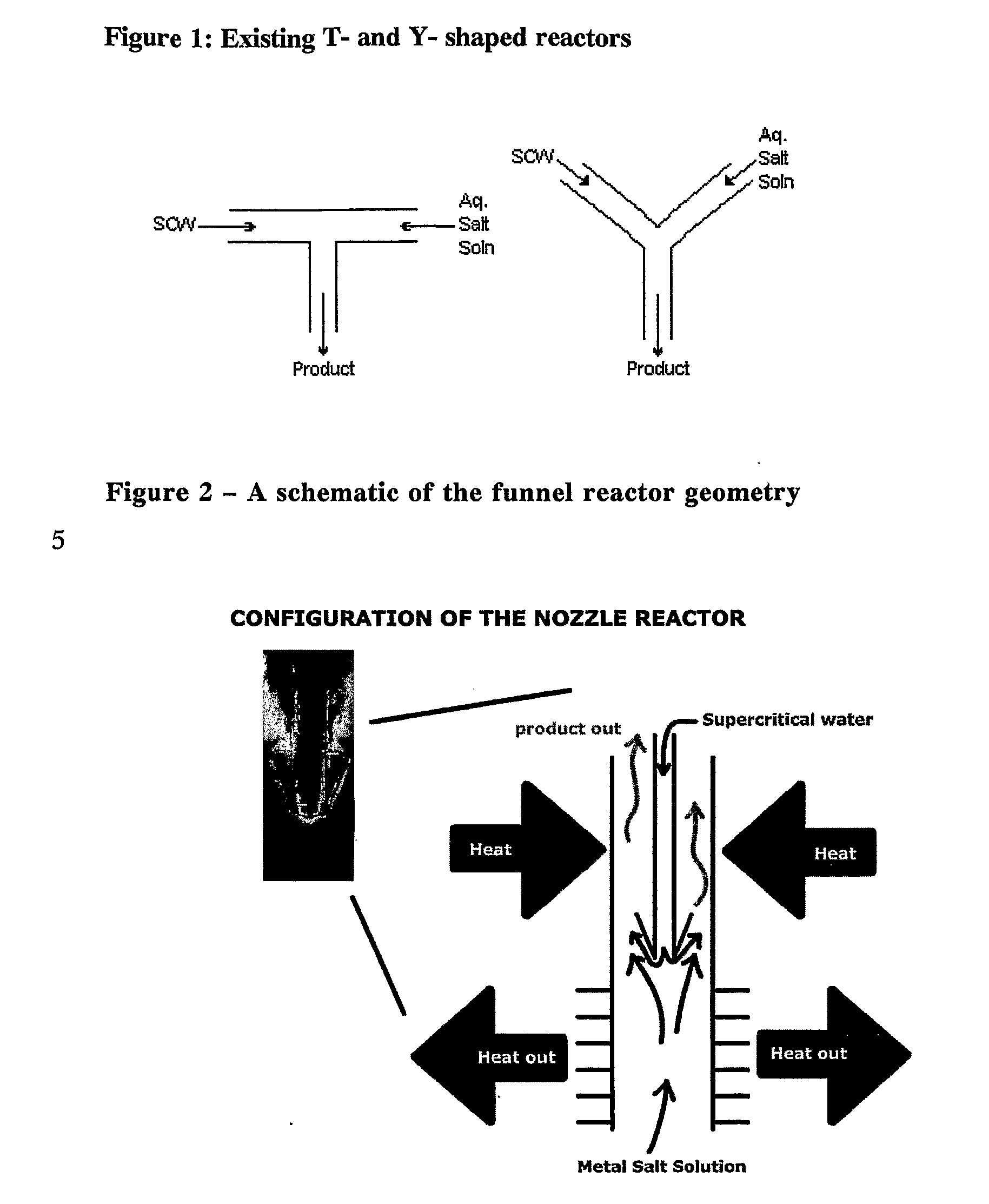
[0047] One area of interest is the effect of the operating temperature within the reactor and it's impact on surface area. The reactor can be heated externally to any given temperature sub, near or super critical, the relationship between surface area (and indirectly, particle size) and operating temperature can be established. Even though the heated water inlet inside the reactor may be operating sub critical, the temperature differential between the metal salt and the heated water still exists and this will cause the inlet flow to turn upwards into the downstream outlet of the pipe, as shown in FIG. 2.
[0048]FIG. 6 is a graph showing how surface area increases significantly with operating temperature. This indicates that the particle size (and possibly the morphology) can be tailored by adjusting the operating conditions of the reactor.
PUM
| Property | Measurement | Unit |
|---|---|---|
| temperature | aaaaa | aaaaa |
| temperature | aaaaa | aaaaa |
| temperature | aaaaa | aaaaa |
Abstract
Description
Claims
Application Information
 Login to View More