Check patentability & draft patents in minutes with Patsnap Eureka AI!

Analog MEMS with non-linear support

Active Publication Date: 2007-10-11
TEXAS INSTR INC
View PDF4 Cites 6 Cited by
  • Summary
  • Abstract
  • Description
  • Claims
  • Application Information

AI Technical Summary

Benefits of technology

[0012] The embodiments disclosed below seek to minimize the effects of the snap-through phenomenon that plagues conventional analog micromirrors. By delaying the onset of snap-through, analog micromirrors would gain a larger effective range of deflection; much more of the gap between the electrode and the micromirror would become usable, without the micromirror tending to overshoot the target angle and collapsing into the electrode. Increasing the range of angles available for an analog micromirror would allow it to operate more effectively, reflecting a wider array of shades. This may provide better picture quality when used in video image display systems. Additionally, when used within optical communication systems, the increase in possible micromirror positions may provide greater switching options.
[0013] In order to delay the onset of snap-through, the disclosed embodiments replace the conventional linear support mechanism for the micromirror with a non-linear support mechanism. By utilizing a support mechanism that provides non-linear resistance to the electrostatic force, the effective range of motion for the micromirror can be increased.

Problems solved by technology

DMDs often suffer stiction due to the contact forces present when the electrode pulls the micromirror into position against the electrode contact surface.
Conventional analog micromirrors face their own problems, however.
The result of the differing nature of the electrostatic force and the linear spring force of the torsion hinge is a phenomenon known as “snap-through.” Once the micromirror has deflected approximately one-third the total separation distance between its neutral position and the electrode, conventional analog micromirrors become unstable as the non-linear electrostatic force rapidly increases beyond the capacity of the linear spring force of the torsion hinge.
Thus, snap-through limits the useful range of motion of a typical analog micromirror device to approximately one-third of the initial separation distance between electrode and micromirror.
Conventional analog micromirrors also have a tendency to degrade over time due to hysteresis.
The repeated movement of the micromirror over time influences the responsiveness of the linear torsion spring for a conventional analog micromirror, leading to less precise control of the micromirror.

Method used

the structure of the environmentally friendly knitted fabric provided by the present invention; figure 2 Flow chart of the yarn wrapping machine for environmentally friendly knitted fabrics and storage devices; image 3 Is the parameter map of the yarn covering machine
View more

Image

Smart Image Click on the blue labels to locate them in the text.
Viewing Examples
Smart Image
  • Analog MEMS with non-linear support
  • Analog MEMS with non-linear support
  • Analog MEMS with non-linear support

Examples

Experimental program
Comparison scheme
Effect test

Embodiment Construction

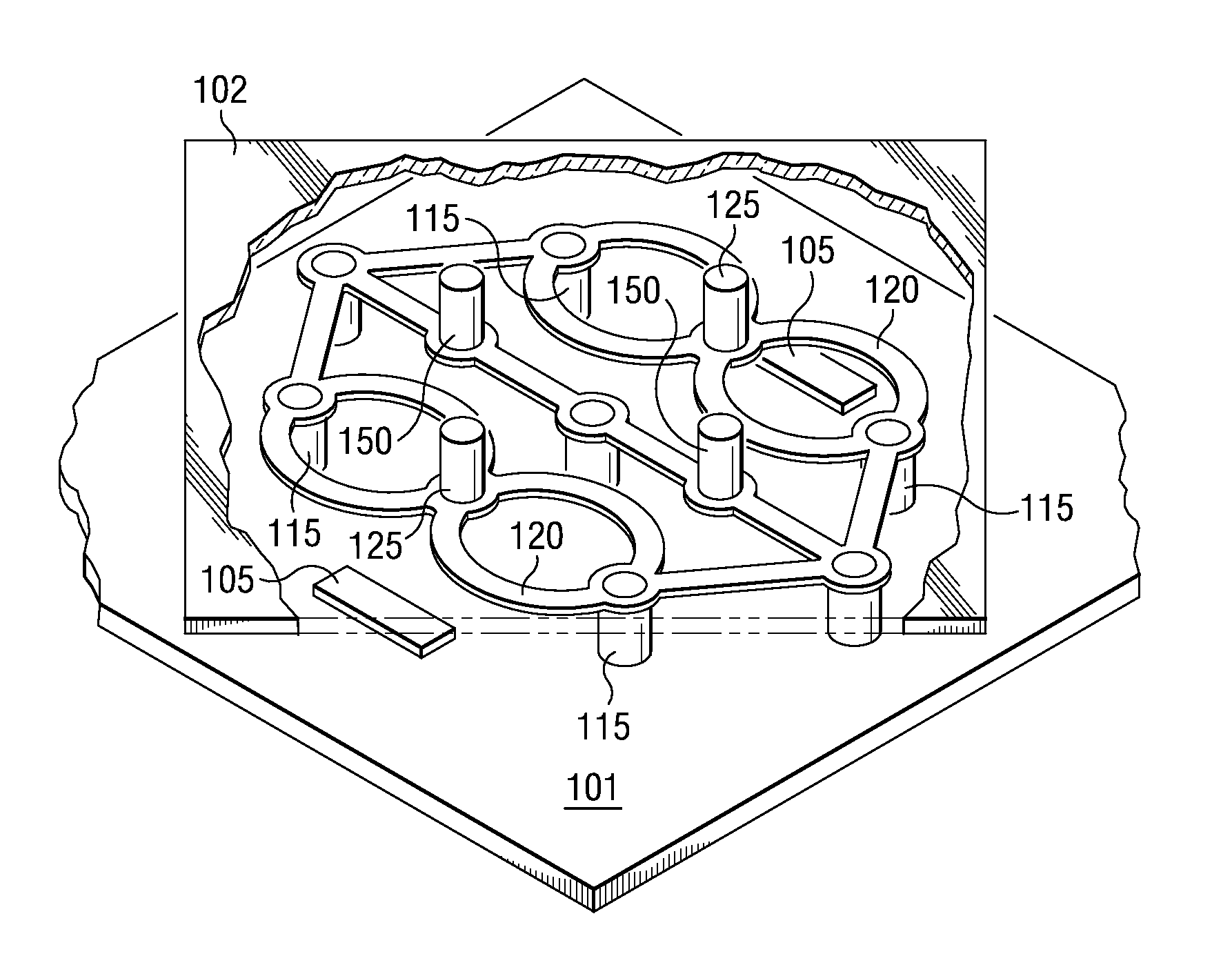
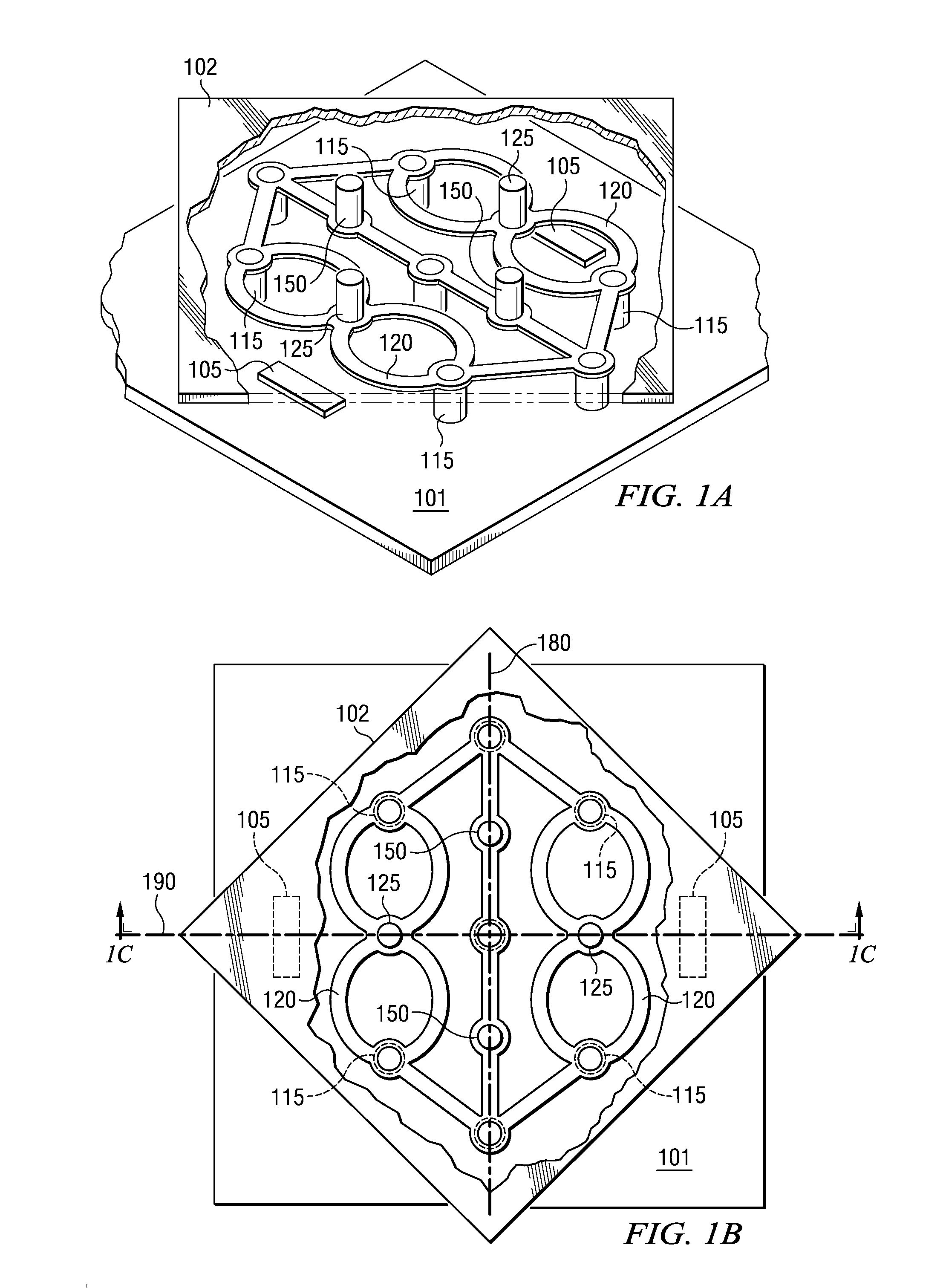
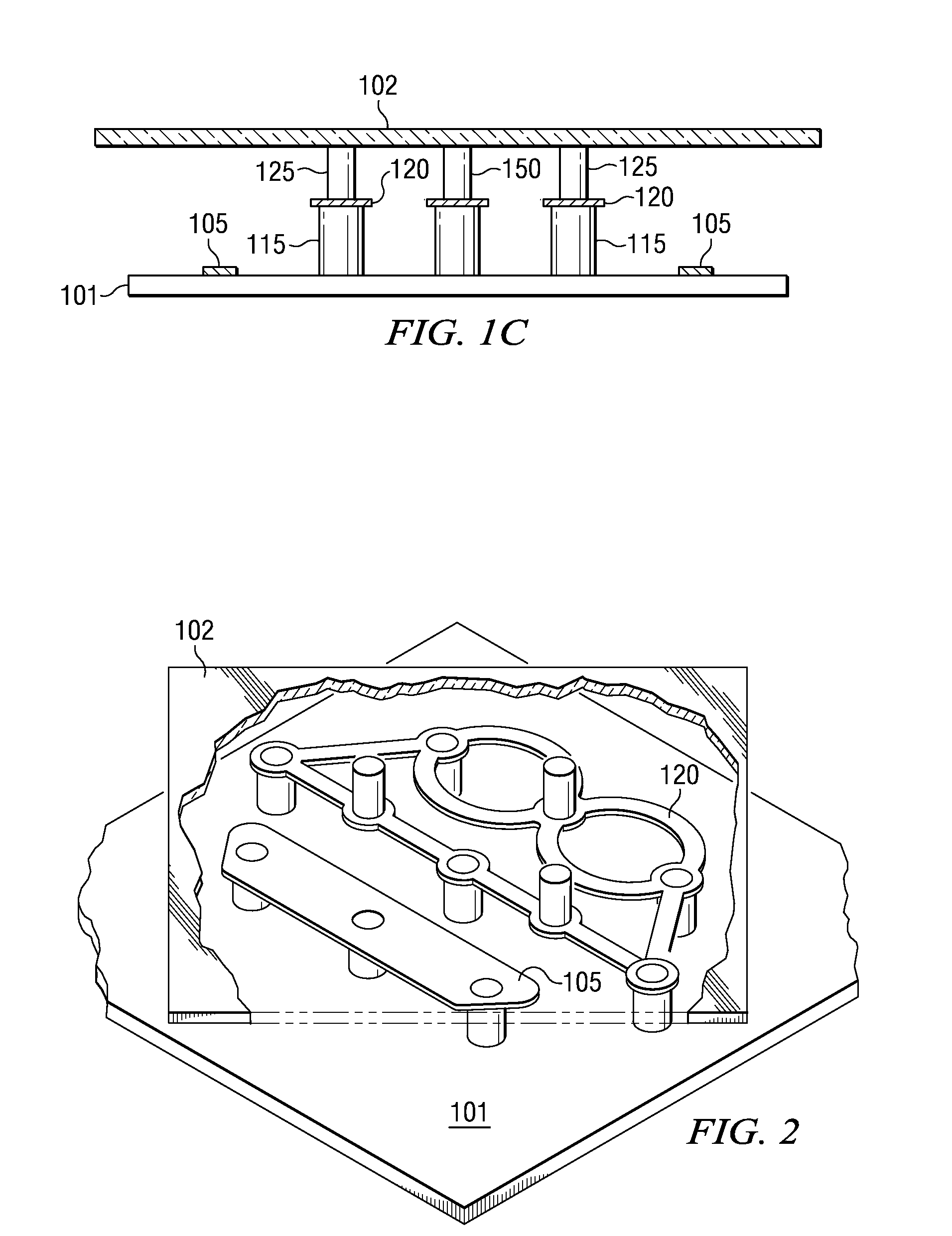
[0032] . 1A illustrates one of the disclosed embodiments for providing non-linear support for an analog micromirror 102. FIGS. 1B and 1C provide additional views of this embodiment, to aid in illustration. The disclosed embodiment has a substrate 101, serving as its base. Electrodes 105 are formed upon the substrate 101, in order to functionally provide an electrostatic attraction force upon a micromirror 102. A micromirror 102 is supported above the substrate 101 in such a way as to be capable of pivoting about a pivot-line axis 180. In the embodiment shown in FIG. 1A, the micromirror 102 is not supported by a torsional hinge; rather it is supported along its neutral pivot-line axis 180 by two pivot supports 150. And in the embodiment of FIG. 1A, one electrode 105 is located on each side of the pivot-line axis 180 of the micromirror 102, typically in a central location spaced between the pivot supports 150 of the micromirror 102, approximately along the center-line axis 190.

[0033]...

the structure of the environmentally friendly knitted fabric provided by the present invention; figure 2 Flow chart of the yarn wrapping machine for environmentally friendly knitted fabrics and storage devices; image 3 Is the parameter map of the yarn covering machine
Login to View More

PUM

No PUM Login to View More

Abstract

The disclosed embodiments reveal an analog MEMS device with a pivotal micromirror that is supported by one or more beams that provide non-linear resistance. An electrode can electrostatically attract the micromirror, while the beam(s) provide resistance to deflection. When the forces equalize, the micromirror is held at a target angle. The beam support disclosed in the embodiments is superior to conventional torsion hinge supports, because it provides non-linear support for the micromirror, better matching the non-linear nature of the electrostatic force.

Description

FIELD OF THE INVENTION [0001] The embodiments described below generally relate to providing non-linear support for micro-electromechanical systems, and more specifically to providing non-linear support for analog micromirrors. BACKGROUND OF THE INVENTION [0002] Recently, the miniaturization of various mechanical devices has sparked a new field of technical advancement. Such micro-electromechanical systems (“MEMS”) integrate mechanical elements with electrical control circuits on a substrate, and are typically manufactured using integrated circuit techniques. Because of their small size, MEMS have become increasingly useful in the development of modern, smart products. Common applications include accelerometers, pressure sensors, actuators, and spatial light modulators. [0003] One type of MEMS device involves micromirrors. Micromirror devices utilize an array of thousands or even millions of tiny, tilting reflective surfaces. These micromirrors can be used to reflect light onto a pro...

Claims

the structure of the environmentally friendly knitted fabric provided by the present invention; figure 2 Flow chart of the yarn wrapping machine for environmentally friendly knitted fabrics and storage devices; image 3 Is the parameter map of the yarn covering machine
Login to View More

Application Information

Patent Timeline
no application Login to View More
IPC IPC(8): G02F1/29
CPCG02B26/0841
Inventor MALONE, JOSHUA J.
Owner TEXAS INSTR INC
Features
  • R&D
  • Intellectual Property
  • Life Sciences
  • Materials
  • Tech Scout
Why Patsnap Eureka
  • Unparalleled Data Quality
  • Higher Quality Content
  • 60% Fewer Hallucinations
Social media
Patsnap Eureka Blog
Learn More