
Guided-mode resonance filter and fabrication method of same
a technology of guided-mode resonance and filter, which is applied in the direction of optical light guide, instruments, optics, etc., can solve the problems of power loss, tight fabrication, and inability to keep the traversing light stabl
- Summary
- Abstract
- Description
- Claims
- Application Information
AI Technical Summary
Benefits of technology
Problems solved by technology
Method used
Image

Examples
Embodiment Construction
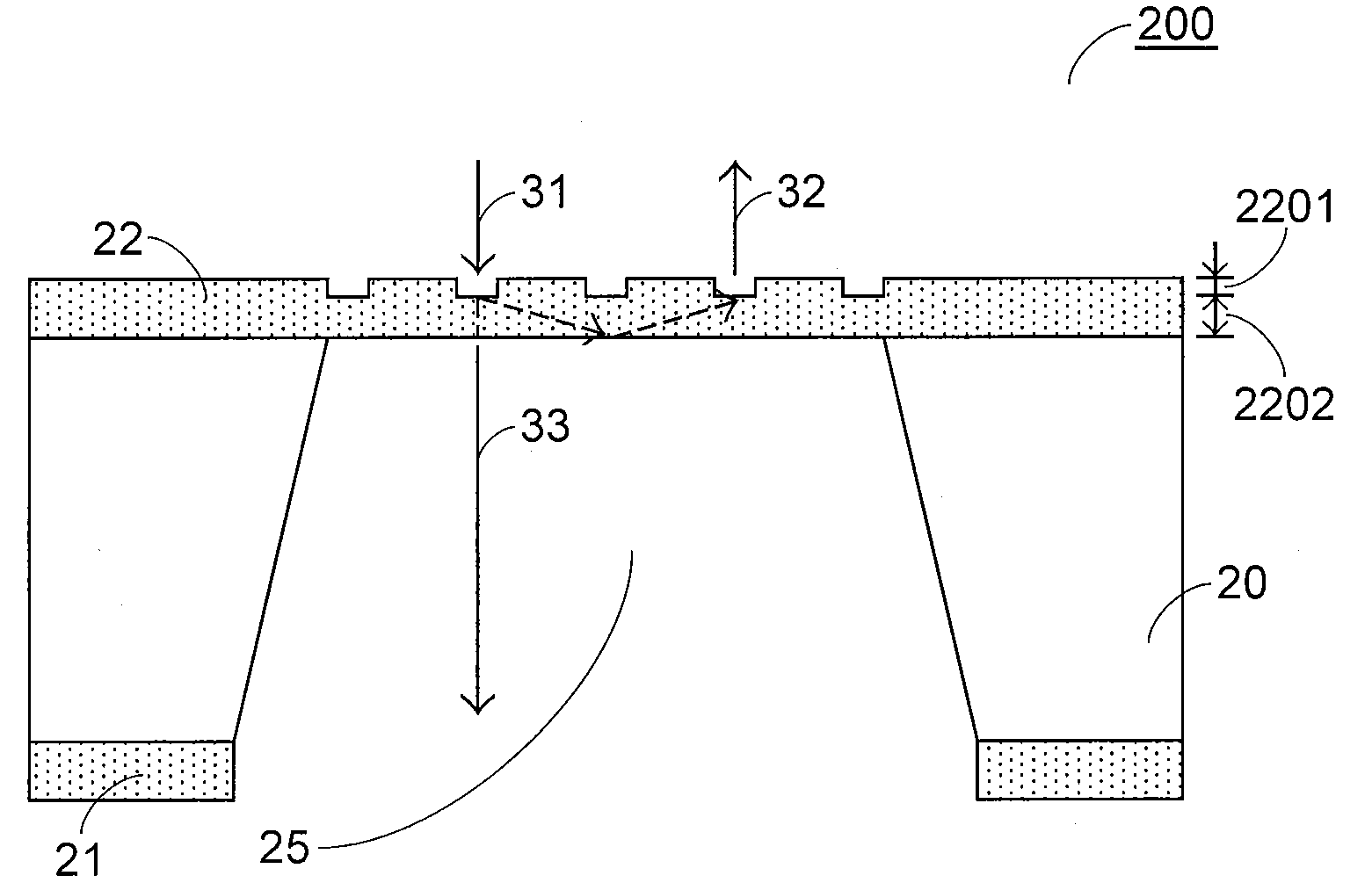
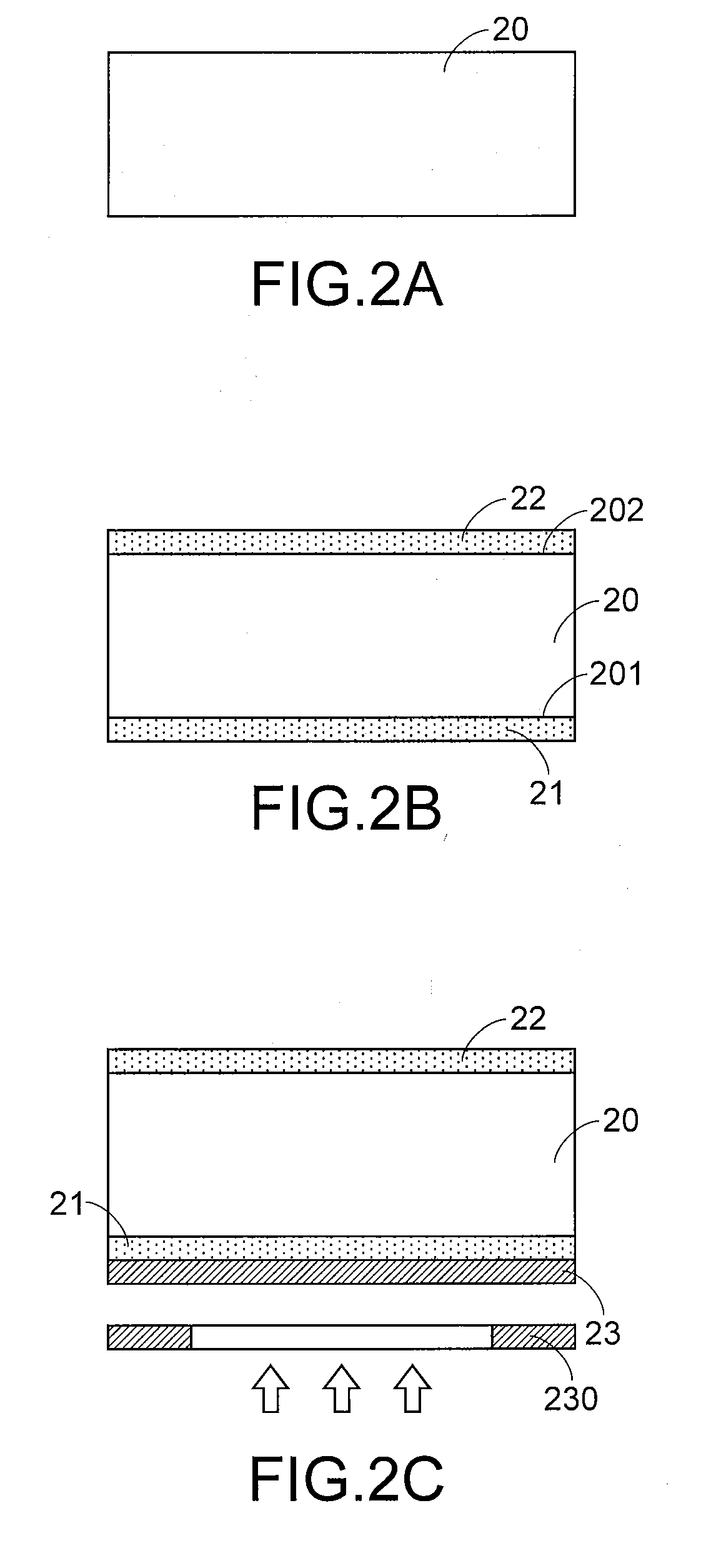
[0027]Referring to FIG. 2A˜2K, a method for fabricating a GMR filter according to an embodiment of the present invention is illustrated. A single-crystal silicon substrate 20 with an arbitrary lattice direction, e.g. (100), and thickness of about 500 μm is first prepared with polishing and RCA chemical cleaning processes, thereby removing impurity and dusts on its surface (FIG. 2A). Highly reflective thin films 21 and 22, e.g. low-stress silicon nitride (SiNx) thin films, are then deposited onto both sides 201 and 202 of the silicon substrate 20 by using a low-pressure chemical vapor deposition (LPCVD) process for an intended thickness, e.g. 1 μm (FIG. 2B). The deposited SiNx film is controlled to be rich in silicon and, hence, a high-refractive-index material. By sequentially spin-coating a photoresist layer 23 and applying a photomask 230 onto the thin film 21 (FIG. 2C), a square hole 231 is patterned. Then, a square hole 211 is opened on the backside SiNx thin film 21 by using ph...
PUM
| Property | Measurement | Unit |
|---|---|---|
| thickness | aaaaa | aaaaa |
| thickness | aaaaa | aaaaa |
| lattice | aaaaa | aaaaa |
Abstract
Description
Claims
Application Information
 Login to View More