Method of manufacturing laminated glass for vehicle and laminated glass for vehicle

a technology of laminated glass and vehicle, which is applied in the field of manufacturing a laminated glass and a vehicle, can solve problems such as not necessarily the case, and achieve the effects of reducing preventing the difference in bend degree, and reducing the gap between edges

a technology of laminated glass and vehicle, which is applied in the field of manufacturing a laminated glass and a vehicle, can solve problems such as not necessarily the case, and achieve the effects of reducing preventing the difference in bend degree, and reducing the gap between edges

US20080096026A1Active Publication Date: 2008-04-24NIPPON SHEET GLASS CO LTD

Image

Smart Image Click on the blue labels to locate them in the text.
Viewing Examples
Smart Image
  • Method of manufacturing laminated glass for vehicle and laminated glass for vehicle
  • Method of manufacturing laminated glass for vehicle and laminated glass for vehicle
  • Method of manufacturing laminated glass for vehicle and laminated glass for vehicle

Examples

Experimental program
Comparison scheme
Effect test

examples

[0077] A clear glass sheet with a thickness of 2.1 mm (FL, manufactured by Nippon Sheet Glass, Co., Ltd.) to be used as a first glass sheet and a heat absorbing glass sheet with a thickness of 2.1 mm (MFL, manufactured by Nippon Sheet Glass, Co., Ltd.) to be used as a second glass sheet each were produced by a known float glass process. The compositions of the respective glass sheets were adjusted so that the second glass sheet (outer sheet) had a lower solar transmittance than that of the first glass sheet (inner sheet).

[0078] With respect to these glass sheets, the visible-light transmittance (in a wavelength region of 380 to 780 nm), solar transmittance (in a wavelength region of 300 to 2500 nm), and infrared transmittance (at a wavelength of 1550 nm) were measured by using a spectrophotometer according to Japanese Industrial Standards (JIS) R3212:1998 and R3106:1998.

[0079] The clear glass sheet had a visible-light transmittance of 90.7%, a solar transmittance of 88.4%, and an ...

the structure of the environmentally friendly knitted fabric provided by the present invention; figure 2 Flow chart of the yarn wrapping machine for environmentally friendly knitted fabrics and storage devices; image 3 Is the parameter map of the yarn covering machine
Login to View More

PUM

PropertyMeasurementUnit
Thicknessaaaaaaaaaa
Compositionaaaaaaaaaa
Areaaaaaaaaaaa
Login to View More

Abstract

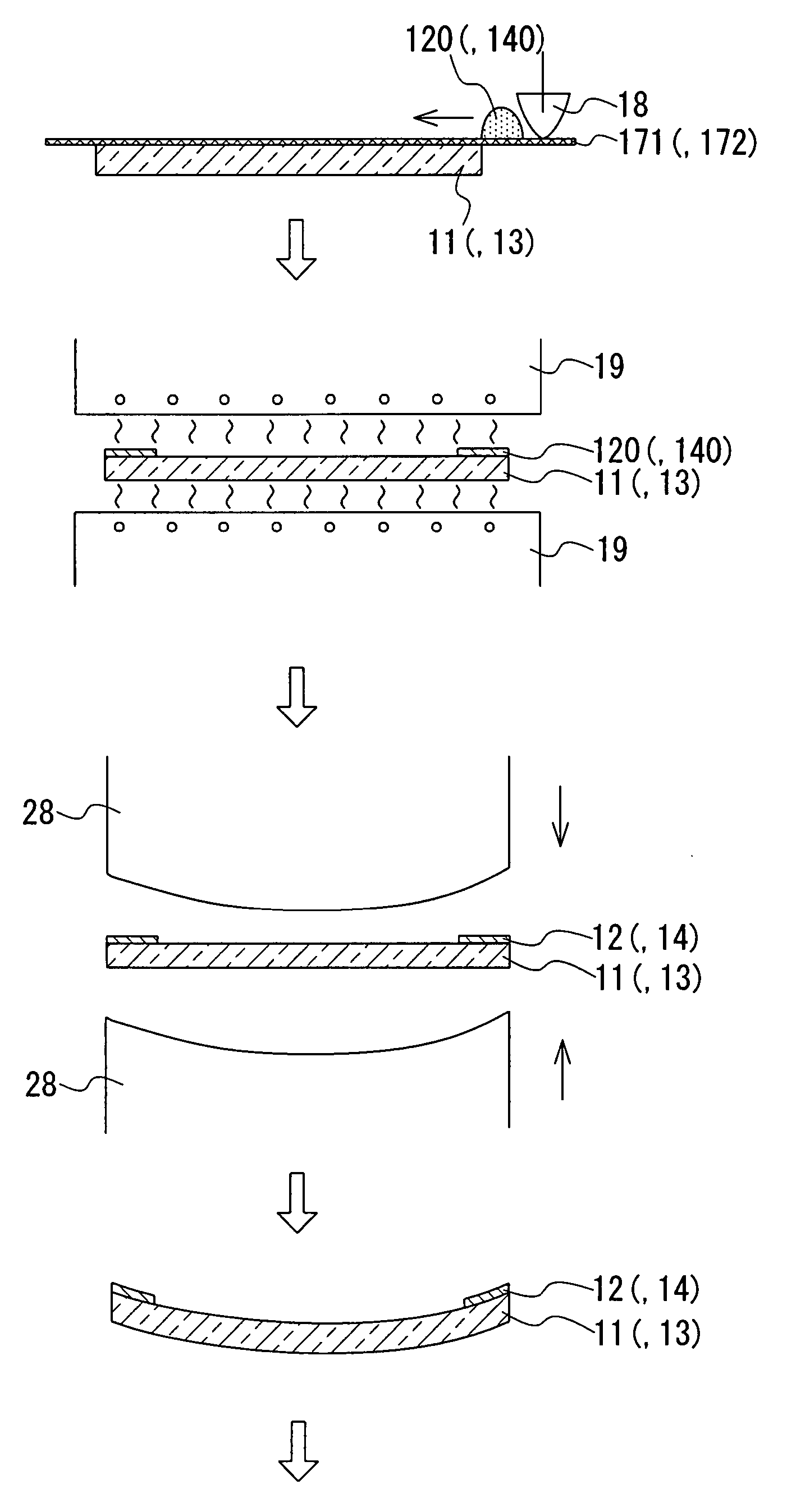
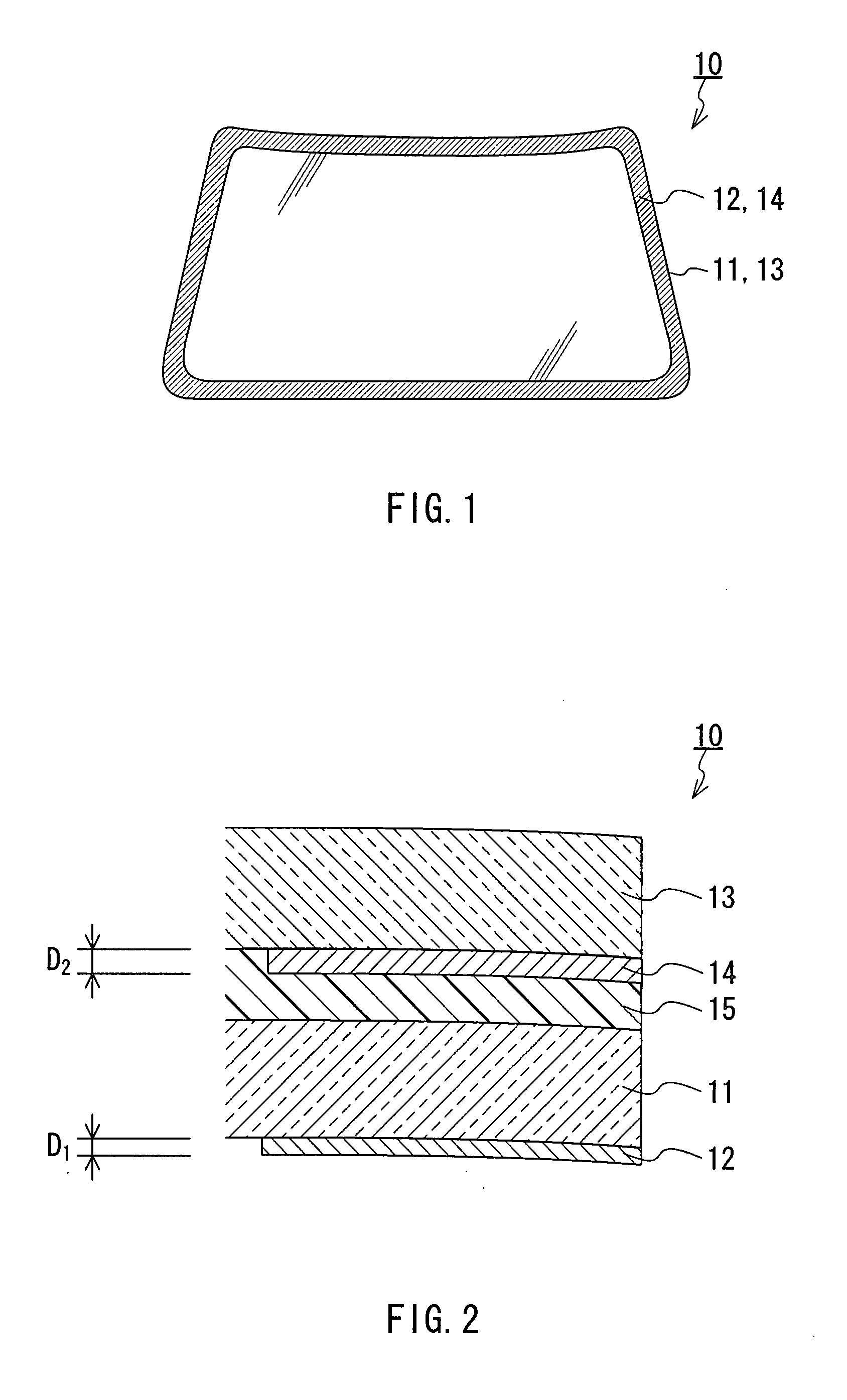
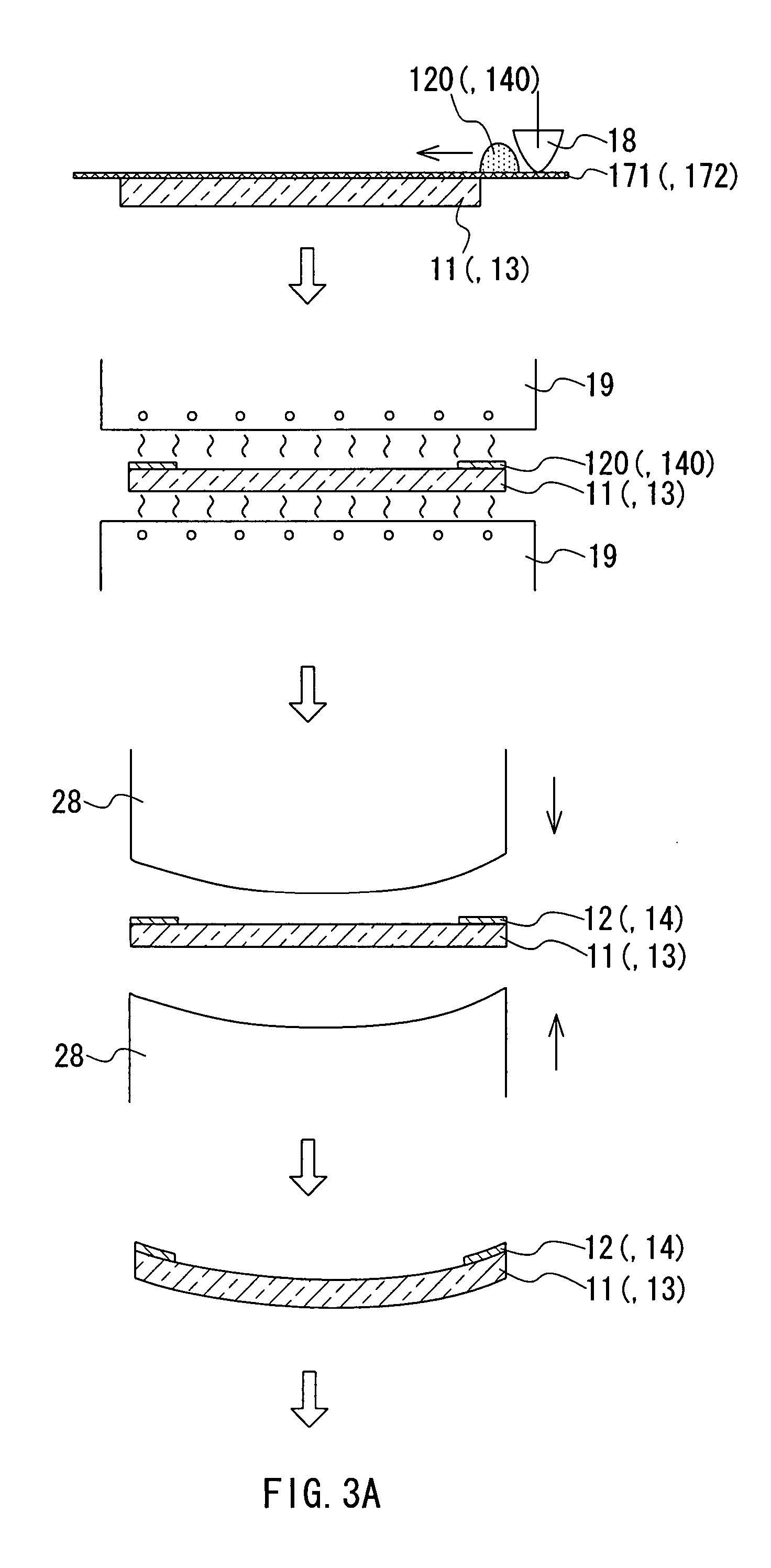
A ceramic paste is applied to a first glass sheet 11, and a ceramic paste is applied to a second glass sheet 13 with a lower solar absorptivity than that of the first glass sheet 11. In this case, the amount per unit area of the ceramic paste to be applied to the first glass sheet 11 is allowed to be smaller than that of the ceramic paste to be applied to the second glass sheet 13. Alternatively, a first ceramic paste and a second ceramic paste are allowed to have different compositions from each other. The first glass sheet 11 and the second glass sheet 13 are bent so that the surfaces onto which the ceramic pastes have been applied are shaped as concave surfaces. The applied ceramic paste is fired using the heating used for bending. Thus maskings 12 and 14 are formed. The first glass sheet 11 and the second glass sheet 13 are bonded to each other, with a resin interlayer film 15 being interposed therebetween.

Description

BACKGROUND OF THE INVENTION [0001] 1. Field of the Invention [0002] The present invention relates to a method of manufacturing a laminated glass for vehicles, and a laminated glass for vehicles. [0003] 2. Related Background Art [0004] For window glasses of automobiles, laminated glasses are used, each of which is formed of two glass sheets bonded to each other with a resin interlayer film interposed therebetween and dark-colored maskings provided for the peripheral parts thereof in the form of a frame (for instance, JP 2005-213101 A, JP2005-29083 A). The maskings are referred to often as “ceramic prints”. The maskings are intended to prevent an adhesive for fixing a window glass to a window frame from deteriorating due to solar radiation and to improve the appearance by shielding terminals of heating wires or a deicer. [0005] The maskings each are formed by printing a ceramic paste on peripheral parts of glass sheets to be bonded to each other and firing the ceramic paste that has b...

Claims

the structure of the environmentally friendly knitted fabric provided by the present invention; figure 2 Flow chart of the yarn wrapping machine for environmentally friendly knitted fabrics and storage devices; image 3 Is the parameter map of the yarn covering machine
Login to View More

Application Information

Patent Timeline
24 Apr 2008
Publication
US20080096026A1
IPC
B32B17/06; B32B37/14
CPC
B32B17/10036; B32B17/10761; B32B17/10889; C03B23/025; C03B23/0302; Y10T428/24926; C03C2218/34; Y10S428/913
Inventors
YAMADA, KAZUO; NISHIMOTO, SHINICHI