
Method and system for full-duplex mesochronous communications and corresponding computer program product
a full-duplex mesochronous communication and computer program technology, applied in the field of communication techniques, can solve the problems of inability to admit a standard implementation and/or lack of optimization to build full-duplex links supporting flow control management, and achieve the effect of providing full-duplex mesochronous communication links capable of effective flow control, reducing all the constraints on the clock skew, and reducing area
- Summary
- Abstract
- Description
- Claims
- Application Information
AI Technical Summary
Benefits of technology
Problems solved by technology
Method used
Image

Examples
Embodiment Construction
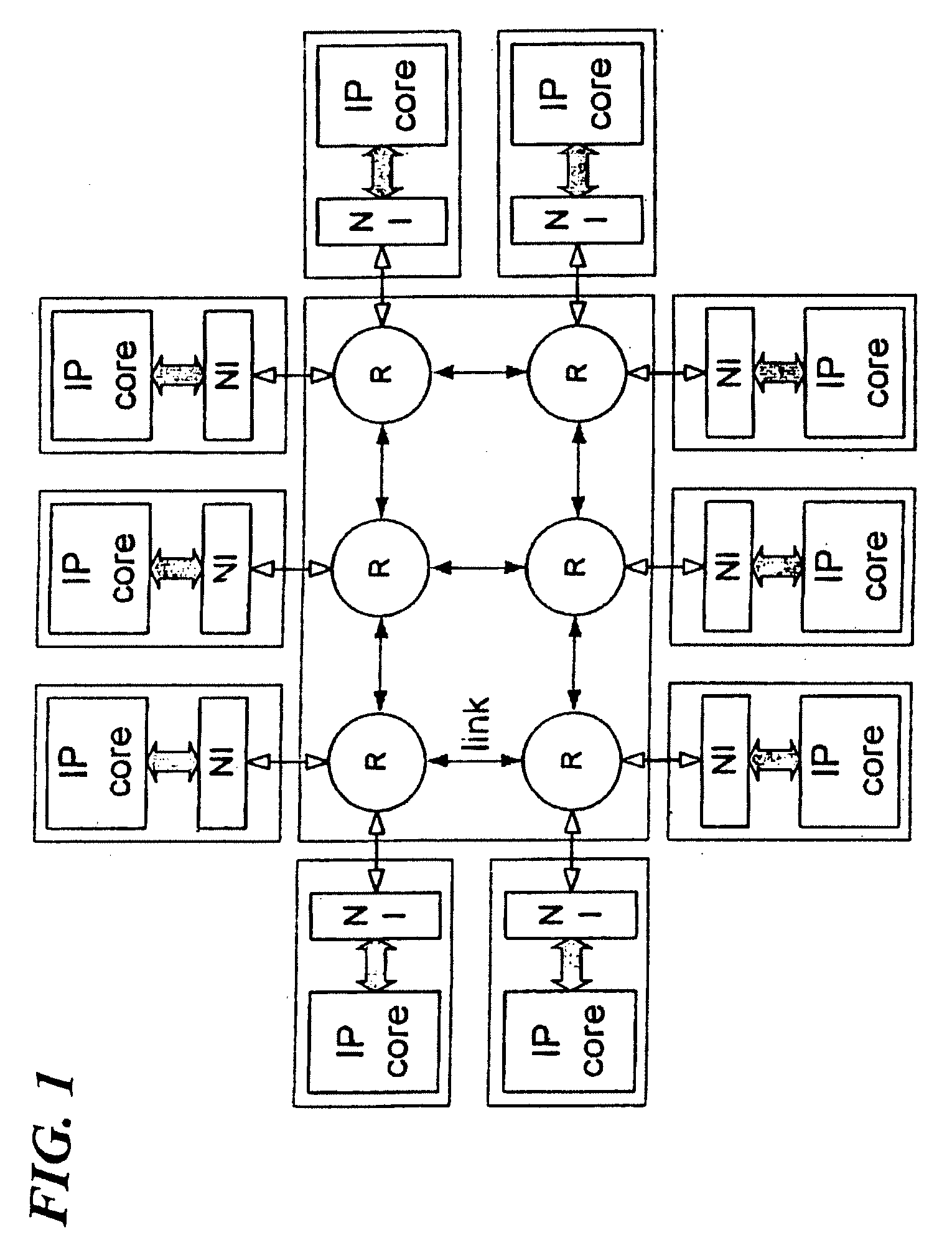
[0035]FIG. 1 is a block schematic representation of System-on-Chip (SoC) architecture based on the Network-on-Chip (NoC) paradigm.
[0036]The main building blocks of a Network-on-Chip arrangement are the Network Interfaces, the Routers and the links. In the block diagram of FIG. 1 the Network Interfaces and the Routers are denoted NI and R, respectively. The Network Interfaces provide access points for the various IP (Intellectual Property) cores—of any known type—while the routers R provide the actual data transport mechanism, and the links are used to set up point-to-point interconnections.
[0037]As indicated, NoCs are usually designed according to a Globally Asynchronous Locally Synchronous (GALS) approach. This means that multiple clock domains coexist, typically including an IP clock domain(s) and a NoC clock domain while the routers R are expected to work at the same clock frequency.
[0038]Synchronous / asynchronous links connect the Network Interfaces NI with the routers R, while r...
PUM
 Login to View More
 Abstract
Description
Claims
Application Information
 Login to View More