Unlock instant, AI-driven research and patent intelligence for your innovation.

Methods and compositions relating to isocyanate conjugates

a technology of isocyanate and conjugate, applied in the field of compositions and methods, can solve the problems of under-reporting of actual rates of dnco-induced diseases, marked dermal inflammation, allergic contact dermatitis and asthma attacks,

Active Publication Date: 2010-04-22
UNITED STATES OF AMERICA
View PDF1 Cites 0 Cited by
  • Summary
  • Abstract
  • Description
  • Claims
  • Application Information

AI Technical Summary

Benefits of technology

The present invention provides compositions and methods for detecting diisocyanate-protein conjugates in a sample. The compositions include an isolated antibody or antigen binding antibody fragment that binds specifically to a reaction product of a protein moiety and an isocyanate moiety. The binding specificity of the antibody is independent of the identity of the protein moiety. The methods involve contacting a sample with the isolated antibody or antigen binding antibody fragment and detecting the binding with a known amount of diisocyanate-protein conjugate or a negative control. The invention can be used in various applications such as detecting diisocyanate-protein conjugates in a sample from an individual or an environmental sample. Kits for detection of diisocyanate-protein conjugates are also provided.

Problems solved by technology

Direct skin contact can cause marked dermal inflammation.
Diisocyanates can also sensitize workers, making them subject to allergic rhinitis, allergic contact dermatitis and asthma attacks upon re-exposure.
Due to their widespread use in the general population particularly from products commercially available at hardware stores actual rates of dNCO induced diseases may be under-reported.
Detection of dNCO exposure and diagnosis of related pathological conditions is difficult.
For example, detection of dNCO exposure-induced antibodies against dNCO in a subject is challenging and is typically attempted using poorly characterized haptenated albumin.
The contribution of using inappropriate antigen to the lack of specific-IgE detection in dNCO asthmatics is not known, but most studies evaluating different haptenated protein preparations, usually find differences in affinities of anti-TDI IgEs, but rarely identify a significant increase in TDI specific-IgE prevalence in TDI asthmatics.
Brief periods away from the workplace may result in a decrease in serum IgE levels to levels undetected by conventional methods29.
Without accurate exposure information, negative isocyanate-specific IgE assays may lead to misdiagnosis and false conclusions about pathogenic mechanisms.

Method used

the structure of the environmentally friendly knitted fabric provided by the present invention; figure 2 Flow chart of the yarn wrapping machine for environmentally friendly knitted fabrics and storage devices; image 3 Is the parameter map of the yarn covering machine
View more

Image

Smart Image Click on the blue labels to locate them in the text.
Viewing Examples
Smart Image
  • Methods and compositions relating to isocyanate conjugates
  • Methods and compositions relating to isocyanate conjugates
  • Methods and compositions relating to isocyanate conjugates

Examples

Experimental program
Comparison scheme
Effect test

examples

Example

Conjugation

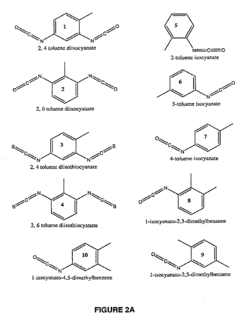
[0090]Keyhole limpet hemocyanin (KLH, Hemocyanin from Megathura crenulata), mouse serum albumin (MSA, fraction V), human serum albumin (HSA, fraction V), lysozyme (chicken egg white), keratin protein (derived from hair, wool, horn, nails or other similar tissues in animals), and collagen (calf skin type 1 species) are obtained from Sigma Aldrich (St. Louis, Mo.). Dimethy phenyl isocyanates (DMPI) (2,3 DMPI, 3,5 DMPI and 2,5 DMPI) are obtained from Alfa Aesar (Wade Hill Mass.). 2,4 toluene diisocyanate (2,4 TDI), 2,6 toluene diisocyanate (2,6 TDI), hexamethylene diisocyanate (HDI), o-toluene isocyanate (OTT), p-toluene isocyanate (PTI), toluene diisothiocyanate phenyl isocyanates (2,4 TITC and 2,6 TITC) and methylene bis-cyclohexylisocyanate (MDI) are obtained from Sigma Aldrich (St. Louis, Mo.).

[0091]All proteins are dissolved or suspended to 5 mg / mL in phosphate buffed saline (PBS), pH 7.4. Five μl, aliquots of each dNCO, mono-isocyanate (NCO) or dithioisocyanate ...

example

Western Blot Analysis of mAbs Reactivity

[0144]FIGS. 4A and 4B shows results of Western blot analysis of mAbs reactivity. In this example, protein-isocyanate conjugates are separated by SDS-PAGE (5 μg / lane, 7.5% separation gels) and transferred overnight at 15 mA to nitrocellulose membranes (0.2 μm, Biorad, Hercules, Calif.). The membranes are blocked with 3% BSA in PBST for 1 hr before being reacted with a 1 / 10 dilution of mAb CSNs for 1 hr. After washing, the blot is incubated with Biotin-SP-conjugated Affinity Pure goat anti-mouse IgM secondary antibody (Jackson Immuno Research Laboratories, Inc., West Grove, Pa.) for 1 h at 37° C. at a dilution of 1 / 5000 in PBSTM. Immune complexes were labeled with alkaline phosphatase-conjugated streptavidin (Jackson Immuno Research Laboratories, Inc., West Grove, Pa.) by incubating a 1 / 5000 dilution in PBSTM for 1 h at 37° C. Protein bands were visualized using a nitroblue tetrazolium / bromo-chloro-indolyl phosphate substrate reagent kit (NBT / BL...

the structure of the environmentally friendly knitted fabric provided by the present invention; figure 2 Flow chart of the yarn wrapping machine for environmentally friendly knitted fabrics and storage devices; image 3 Is the parameter map of the yarn covering machine
Login to View More

PUM

PropertyMeasurementUnit
dissociation constantaaaaaaaaaa
Login to View More

Abstract

Compositions are provided according to embodiments of the present invention which include an isolated antibody or antigen binding antibody fragment characterized by binding specificity for a conjugate which is a reaction product of a protein moiety and an isocyanate moiety. Methods of detecting diisocyanate-protein conjugates in a sample are provided according to embodiments of the present invention which include contacting a sample with one or more isolated antibodies or antigen binding antibody fragments characterized by binding specificity for corresponding diisocyanate-protein conjugate antigens.

Description

REFERENCE TO RELATED APPLICATION[0001]This application claims priority from U.S. Provisional Patent Application Ser. No. 61 / 104,429, filed Oct. 10, 2008, the entire content of which is incorporated herein by reference.GOVERNMENT SPONSORSHIP[0002]This invention was made by the Centers for Disease Control and Prevention, an agency of the United States Government. This invention was funded in part by NIEHS-NIOSH interagency agreement # Y1-ES-0001.FIELD OF THE INVENTION[0003]The present invention relates generally to compositions and methods for the isolation, detection and / or quantification of diisocyanate-protein conjugates. In particular embodiments, the present invention relates to methods and compositions including monoclonal antibodies for specific recognition of 2,4-toluene diisocyanate; 2,6-toluene diisocyanate, methylene diphenyl diisocyanate and / or hexamethylene diisocyanate moieties of protein conjugates.BACKGROUND OF THE INVENTION[0004]Over 200,000 workers are directly emplo...

Claims

the structure of the environmentally friendly knitted fabric provided by the present invention; figure 2 Flow chart of the yarn wrapping machine for environmentally friendly knitted fabrics and storage devices; image 3 Is the parameter map of the yarn covering machine
Login to View More

Application Information

Patent Timeline
no application Login to View More
Patent Type & Authority Applications(United States)
IPC IPC(8): G01N33/53C07K16/00
CPCG01N33/5308C07K16/44
Inventor SIEGEL, PAUL D.RUWONA, TINASHE BLESSINGBEEZHOLD, DONALD H.JOHNSON, VICTORSCHMECHEL, DETLEF
Owner UNITED STATES OF AMERICA