Thermal transfer sheet
- Summary
- Abstract
- Description
- Claims
- Application Information
AI Technical Summary
Benefits of technology
Problems solved by technology
Method used
Image



Examples
embodiments
Thermal Transfer Sheet
Configuration of Thermal Transfer Sheet
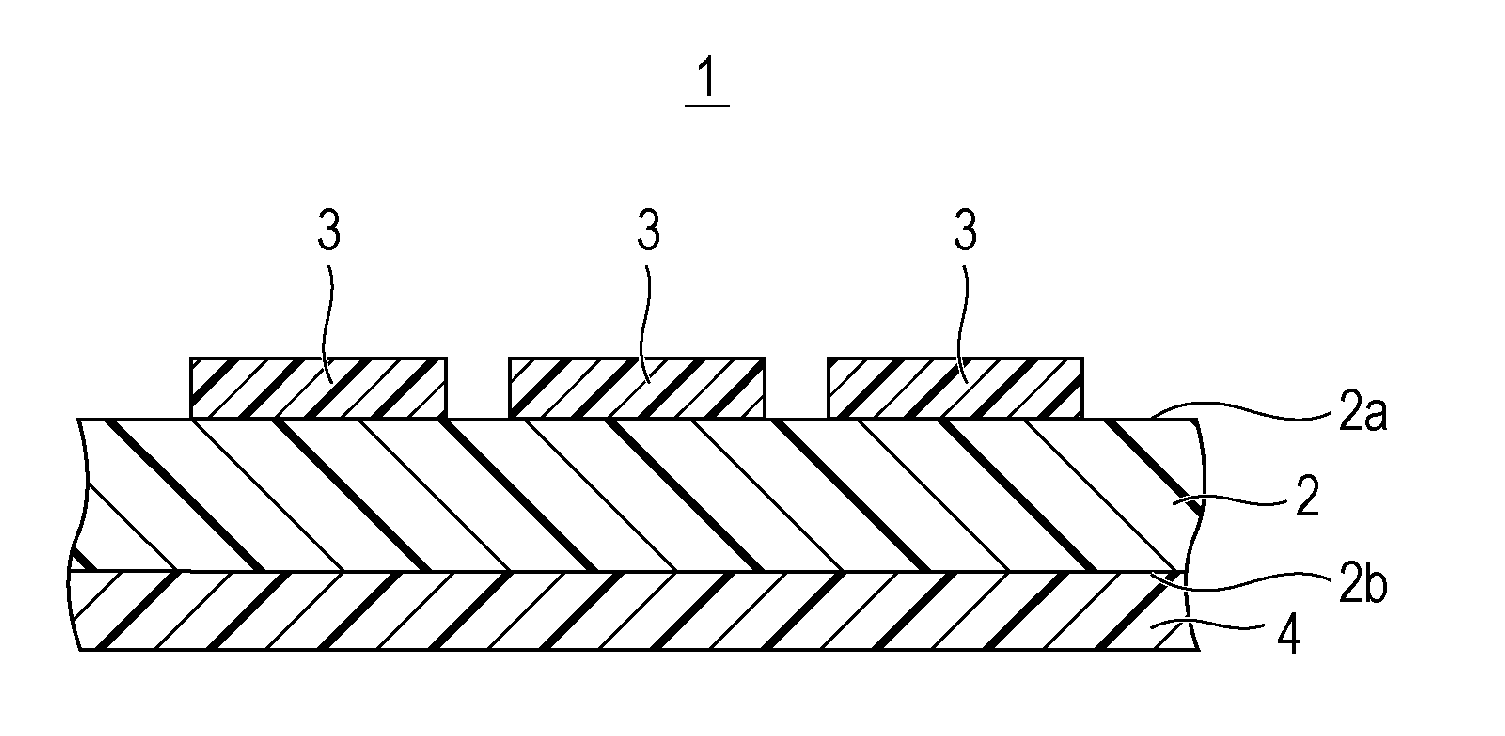
[0026]Regarding a thermal transfer sheet 1 according to an embodiment of the present invention, as shown in FIG. 1, thermal transfer dye layers 3 are disposed on one surface 2a of a base material sheet 2 and, in addition, a heat-resistant lubricating layer 4 is disposed on a surface 2b opposite to the one surface 2a.
Base Material Sheet
[0027]Various base materials in the related art can be used for the base material sheet 2. For example, polyester films, polystyrene films, polypropylene films, polysulfone films, polycarbonate films, polyimide films, and aramid films can be used. The thickness of this base material sheet 2 is determined at will. For example, the thickness is 1 to 30 μm, and preferably 2 to 10 μm.
[0028]The thermal transfer dye layers 3 (may be simply referred to as dye layers 3) are disposed on the surface 2a of the above-described base material sheet 2. In the case of monochrome, this thermal transfer dye l...
example 1 to example 14
[0057]
Composition of heat-resistant lubricating layerPolyacetal resin 100 parts by weight(trade name DENKA BUTYRAL #3000K,produced by DENKI KAGAKU KOGYO K.K.)Polyisocyanate 20 parts by weight(trade name Coronate L, NIPPONPOLYURETHANE INDUSTRY CO., LTD.,45 percent by weight, the remainder is 55percent by weight of ethyl acetate serving asan organic solvent)Spherical silica 3 parts by weight(TOSPEARL XC99, produced by ToshibaSilicone Co., Ltd.)Organic solvent (methyl ethyl ketone:toluene =1,900 parts by weight1:3)
[0058]The types and the amounts of addition of Compound 1, silicone compound, phosphate esters, and the like serving as lubricants are shown in Table 1 described below. In this connection, percent by mass in Table 1 indicates the proportion of the mass of the lubricants contained in the heat-resistant lubricating layer after formation.
TABLE 1Mass in layerParts byLubricant(%)weightExample 1Compound 12.53Example 2Compound 11520Example 3Compound 14076Example 4Compound 17.510...
PUM
| Property | Measurement | Unit |
|---|---|---|
| Percent by mass | aaaaa | aaaaa |
| Percent by mass | aaaaa | aaaaa |
| Percent by mass | aaaaa | aaaaa |
Abstract
Description
Claims
Application Information
 Login to View More