This helps you quickly interpret patents by identifying the three key elements:
Problems solved by technology
Method used
Benefits of technology
Benefits of technology
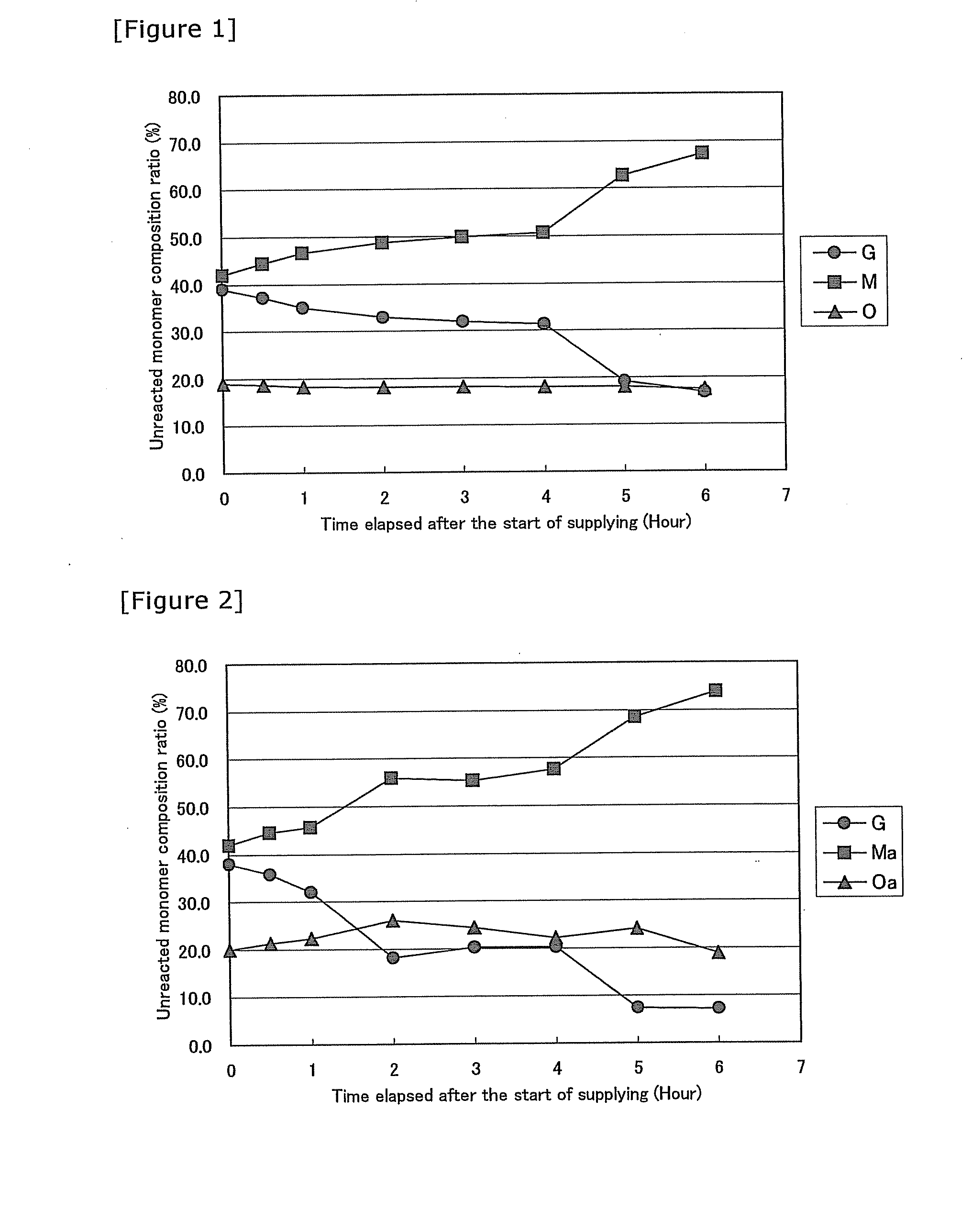
[0020]According to the present invention, a method for production of a copolymer for photoresists in which the bias of the monomer composition ratio is small can be provided. According to such a method, by lessening the bias of the monomer composition ratio of the copolymer for photoresists, improvement of the solubility to a resistsolvent, and improvement of defects and LER can be attained
Problems solved by technology
However, due to the miniaturization of a photoresist pattern in recent years, necessity for further improvement of defects and LER is imminent.
Method used
the structure of the environmentally friendly knitted fabric provided by the present invention; figure 2 Flow chart of the yarn wrapping machine for environmentally friendly knitted fabrics and storage devices; image 3 Is the parameter map of the yarn covering machine
View more
Image
Smart Image Click on the blue labels to locate them in the text.
Viewing Examples
Smart Image
Click on the blue label to locate the original text in one second.
Reading with bidirectional positioning of images and text.
Smart Image
Examples
Experimental program
Comparison scheme
Effect test
example 1
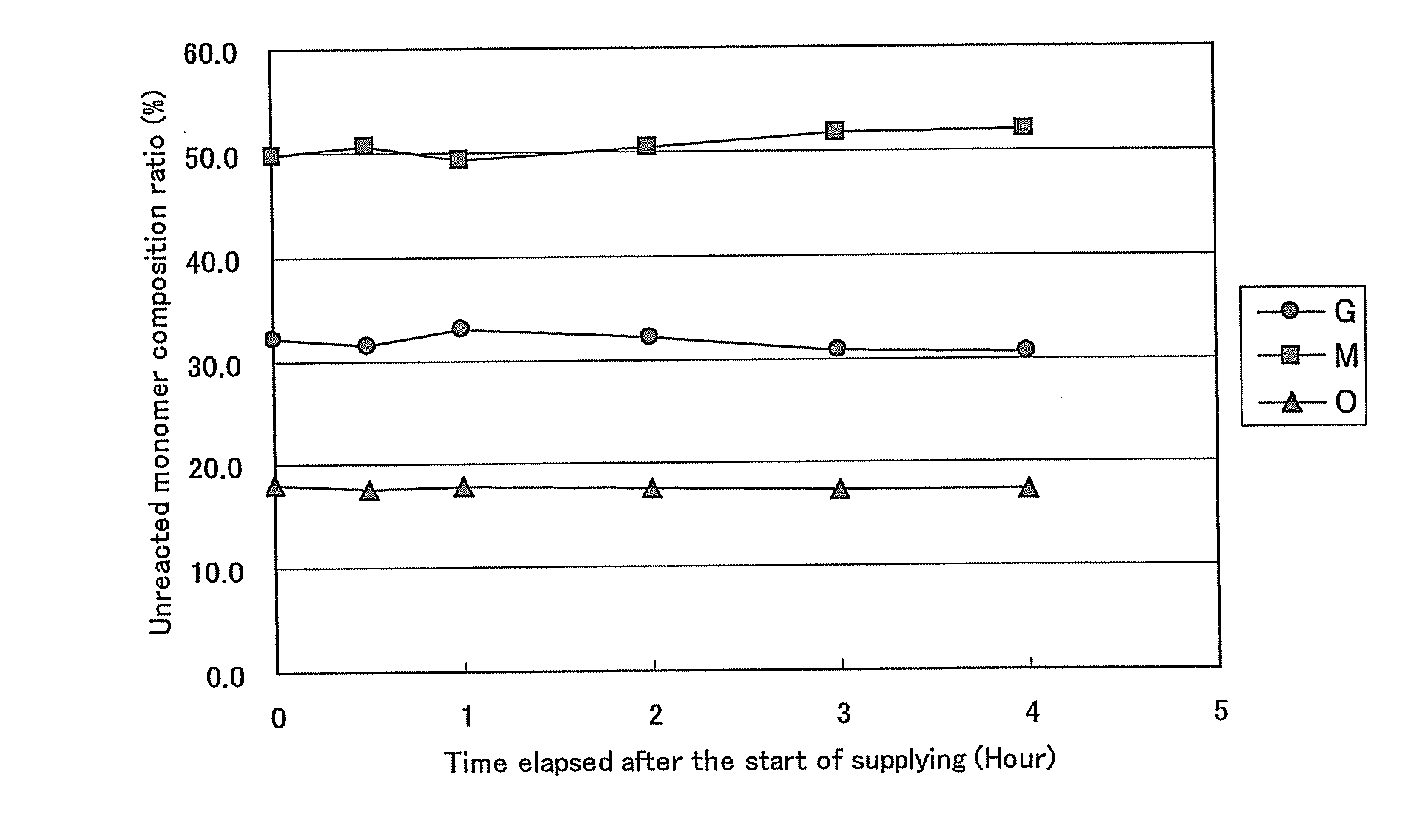
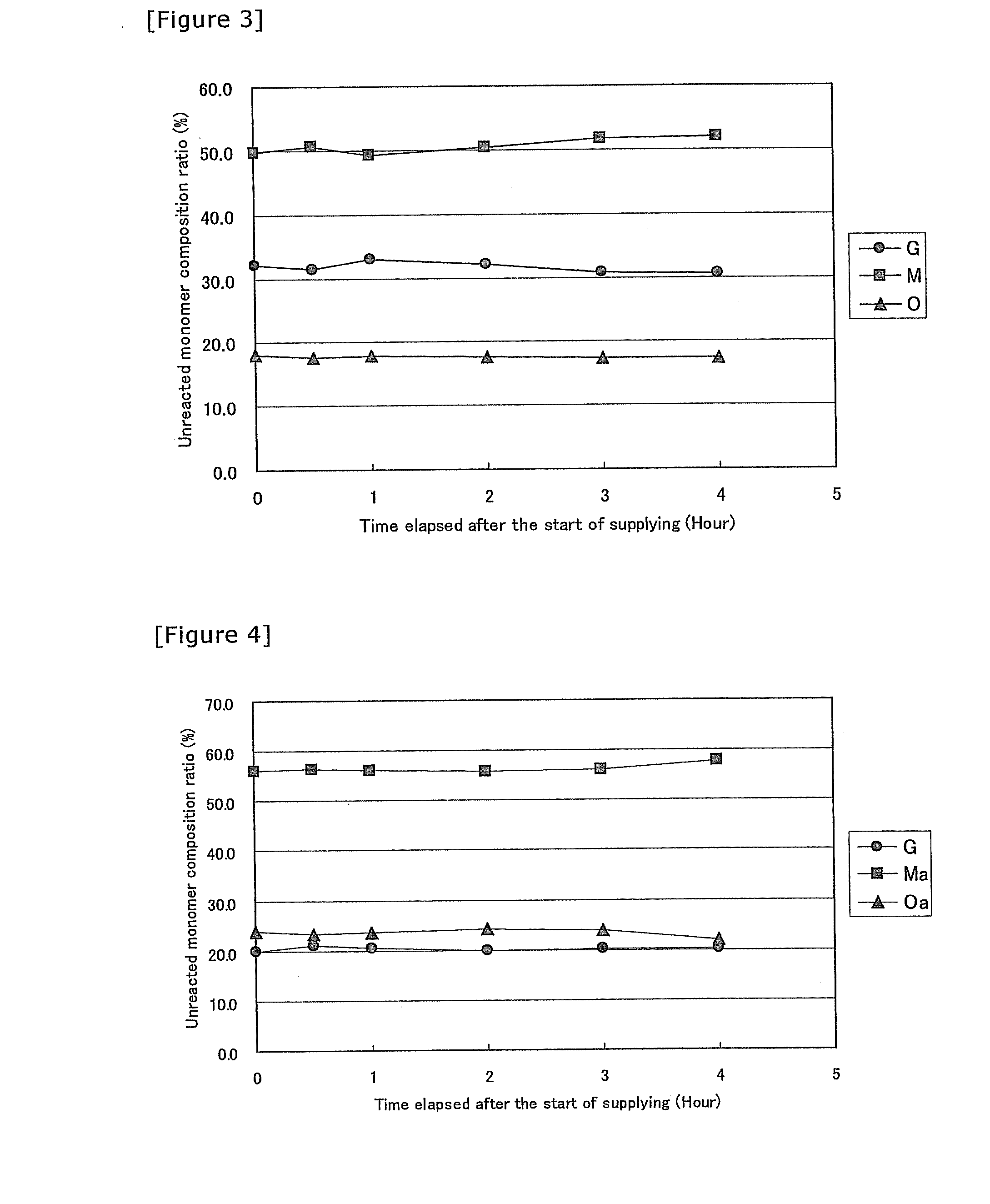
[0141]Production target composition ratio: G / M / O=40 / 40 / 20
[0142]Monomer solution (I) composition ratio: G / M / O=32 / 50 / 18
[0143]Monomer solution (II) composition ratio: G / M / O=40 / 40 / 20
[0144]Based on Comparative Synthesis Example 1, the composition ratios were determined as described above and a copolymer was produced by the following procedures.
[0145]MEK 84 g, monomer G 18.4 g, monomer M 39.6 g, and monomer O 14.4 g were added in a container and dissolved to prepare a uniform monomer solution (I). Also, MEK 506 g, monomer G 138.0 g, monomer M 190.3 g, and monomer O 96.0 g were added in another container and dissolved to prepare a uniform monomer solution (II). Further, MEK 150 g and MAIB 28 g were dissolved in another container to prepare a uniform polymerization initiator solution. The ratio of the amount of the monomer between the monomer solution (I) and monomer solution (II) was set to 1 / 7. The ratio of the volume of the solution was also set to about 1 / 7.
[0146]After feeding MEK 300 g...
example 2
[0153]Production target composition ratio: G / Ma / Oa=41 / 39 / 20
[0154]Monomer solution (I) composition ratio: G / Ma / Oa=20 / 56 / 24
[0155]Monomer solution (II) composition ratio: G / Ma / Oa=41 / 39 / 20
[0156]Based on Comparative Synthesis Example 2, the composition ratios were determined as described above and a copolymer was produced by the following procedures.
[0157]MEK 53.6 g, monomer G 7.3 g, monomer Ma 26.6 g, and monomer Oa 11.5 g were added in a container and dissolved to prepare a uniform monomer solution (I). Also, MEK 536.4 g, monomer G 150.2 g, monomer Ma 197.5 g, and monomer Oa 101.9 g were added in another container and dissolved to prepare a uniform monomer solution (II). Further, MEK 150 g and MAIB 17 g were dissolved in another container to prepare a uniform polymerization initiator solution. The ratio of the amount of the monomer between the monomer solution (I) and monomer solution (II) was set to 1 / 11. The ratio of the volume of the solution was also set to about 1 / 11.
[0158]After f...
the structure of the environmentally friendly knitted fabric provided by the present invention; figure 2 Flow chart of the yarn wrapping machine for environmentally friendly knitted fabrics and storage devices; image 3 Is the parameter map of the yarn covering machine
Login to View More
PUM
Property
Measurement
Unit
Fraction
aaaaa
aaaaa
Fraction
aaaaa
aaaaa
Fraction
aaaaa
aaaaa
Login to View More
Abstract
The present invention provides a method for production of a copolymer for photoresists in which the bias of the monomer composition ration is small. This method for production is a method for production of a copolymer for photoresists, which copolymer containing at least two types of repeating units, the method having a supplying step of supplying a monomer solution and a solution containing a polymerization initiator into a polymerizationreaction system, wherein the range of fluctuation of the monomer composition ratio of unreacted monomers is within the range between minus 15% and plus 15% or the standard deviation of the monomer composition ratio of unreacted monomers is within 2 in the polymerizationreaction system during the period from the start of the polymerization reaction to the end of supplying of the monomer solution.
Description
TECHNICAL FIELD[0001]The present invention relates to: a method of producing a photoresist material, photoresist composition and polymer useful as base polymer thereof, which are suitably used in an ultra-fine photolithography process and other photo-fabrication processes such as microfabrication technique in the production step of semiconductor elements and the production of VLSIs and high capacity microchips; and a photoresist material and photoresist composition obtained by the method.BACKGROUND ART[0002]In the field of the microfabrication represented by the production of semiconductorintegrated devices such as VLSI, due to a trend of ultra high integration of an integrated circuit, ultrafine pattern formation in a range of submicron to quarter micron is demanded. Along with this, with regard also to a exposurewavelength, in order to obtain a higher degree of integration by the g-line to the i-line, a light source with wavelength shorter than an ArF excimerlaser (wavelength 1...
Claims
the structure of the environmentally friendly knitted fabric provided by the present invention; figure 2 Flow chart of the yarn wrapping machine for environmentally friendly knitted fabrics and storage devices; image 3 Is the parameter map of the yarn covering machine
Login to View More
Application Information
Patent Timeline
Application Date:The date an application was filed.
Publication Date:The date a patent or application was officially published.
First Publication Date:The earliest publication date of a patent with the same application number.
Issue Date:Publication date of the patent grant document.
PCT Entry Date:The Entry date of PCT National Phase.
Estimated Expiry Date:The statutory expiry date of a patent right according to the Patent Law, and it is the longest term of protection that the patent right can achieve without the termination of the patent right due to other reasons(Term extension factor has been taken into account ).
Invalid Date:Actual expiry date is based on effective date or publication date of legal transaction data of invalid patent.


 Login to View More