
Energy Saving System and Method for Devices with Rotating or Reciprocating Masses
a technology of energy saving system and rotating or reciprocating mass, which is applied in the direction of positive displacement liquid engine, piston pump, direction control of ac motor, etc., can solve the problems of inefficient generator, significant over-exceeding of generated energy, and mechanical solutions that have not worked, so as to achieve further energy saving, not consuming energy, and consuming energy
- Summary
- Abstract
- Description
- Claims
- Application Information
AI Technical Summary
Benefits of technology
Problems solved by technology
Method used
Image

Examples
Embodiment Construction
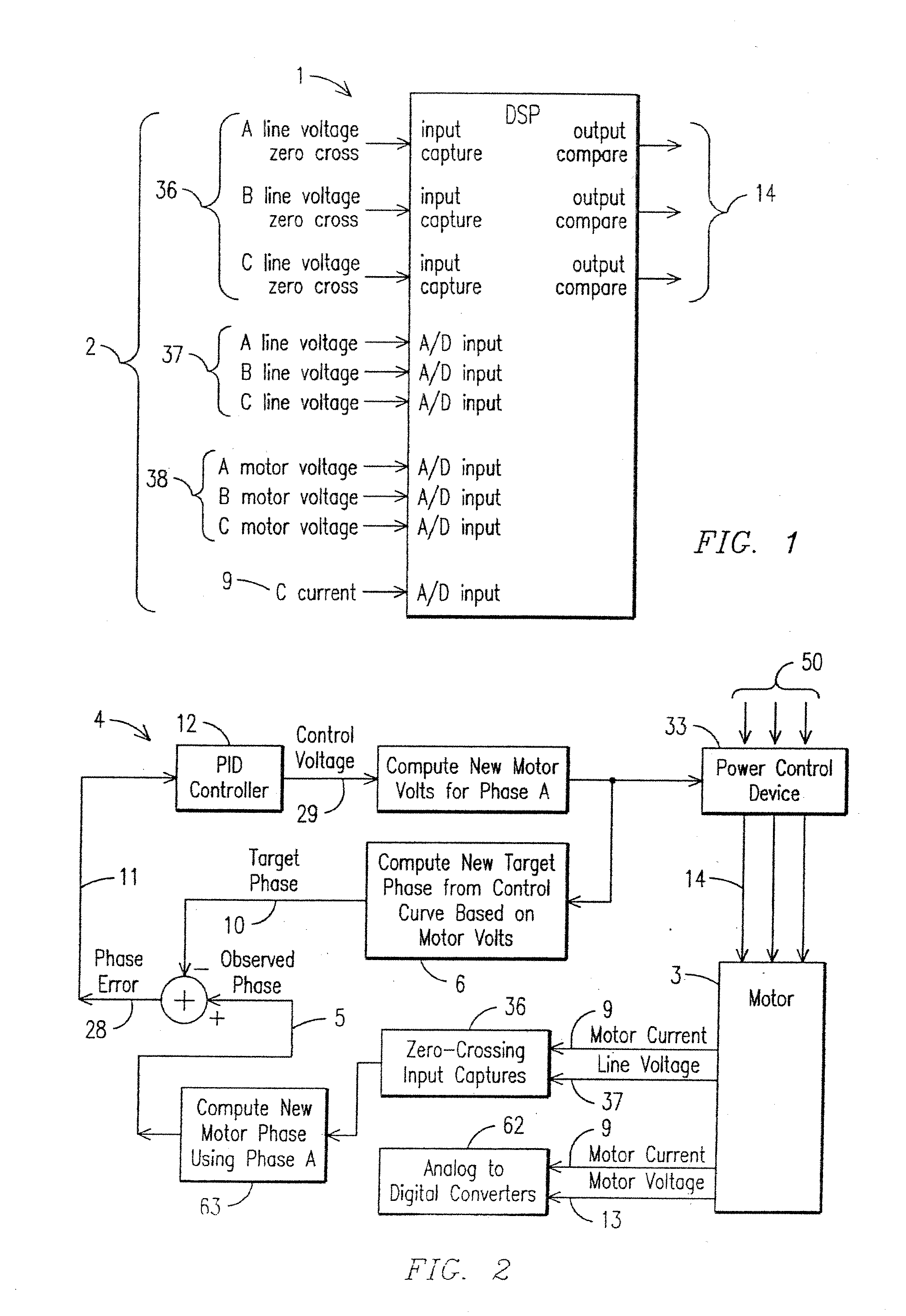
[0061]With reference to FIG. 1, a block diagram of a digital signal processor (DSP) 1 and hardware inputs and outputs is shown. The DSP 1 can observe the operational characteristics of a motor and make corrections to root mean square (RMS) voltage for the motor that is running and under closed loop control. Hardware inputs 2 capture phase zero crossing inputs 36, phase line voltage 37, phase motor voltage 38 and current 9 and passed through the DSP 1 for processing and then onto power control devices through the power control device outputs 14.
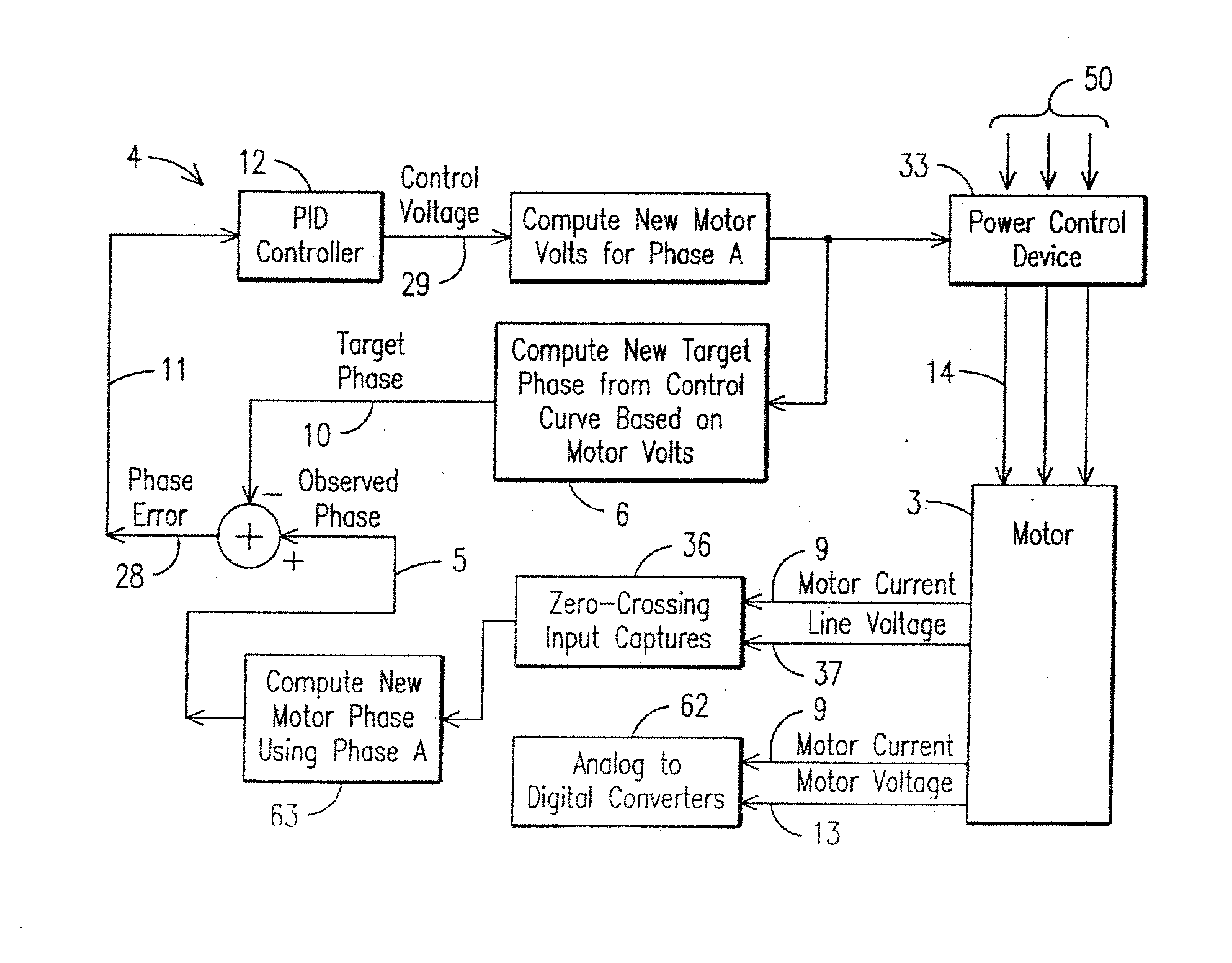
[0062]Referring now to FIG. 2, a block diagram of a system and method of the DSP-based motor controller 4 is shown. First, the motor controller 4 reads the voltages 37 of each phase A, B and C and current 9 to capture the zero-crossing inputs 36. At this point voltage 13 and current 9 may be converted from analog to digital using converters 62. Next, computations 63 of motor phase angle for each phase are calculated to yield an observed phase ...
PUM
 Login to View More
 Abstract
Description
Claims
Application Information
 Login to View More