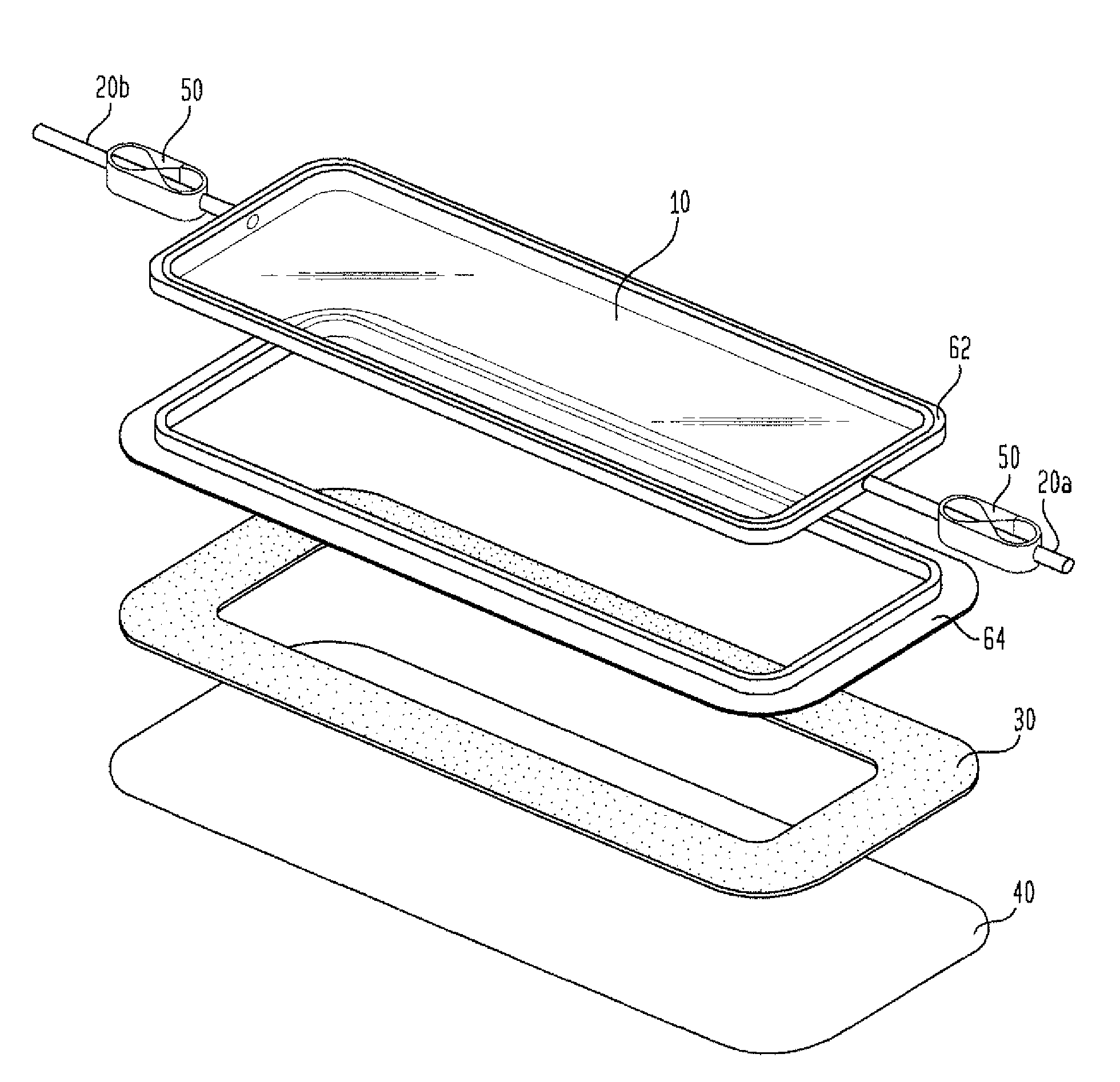
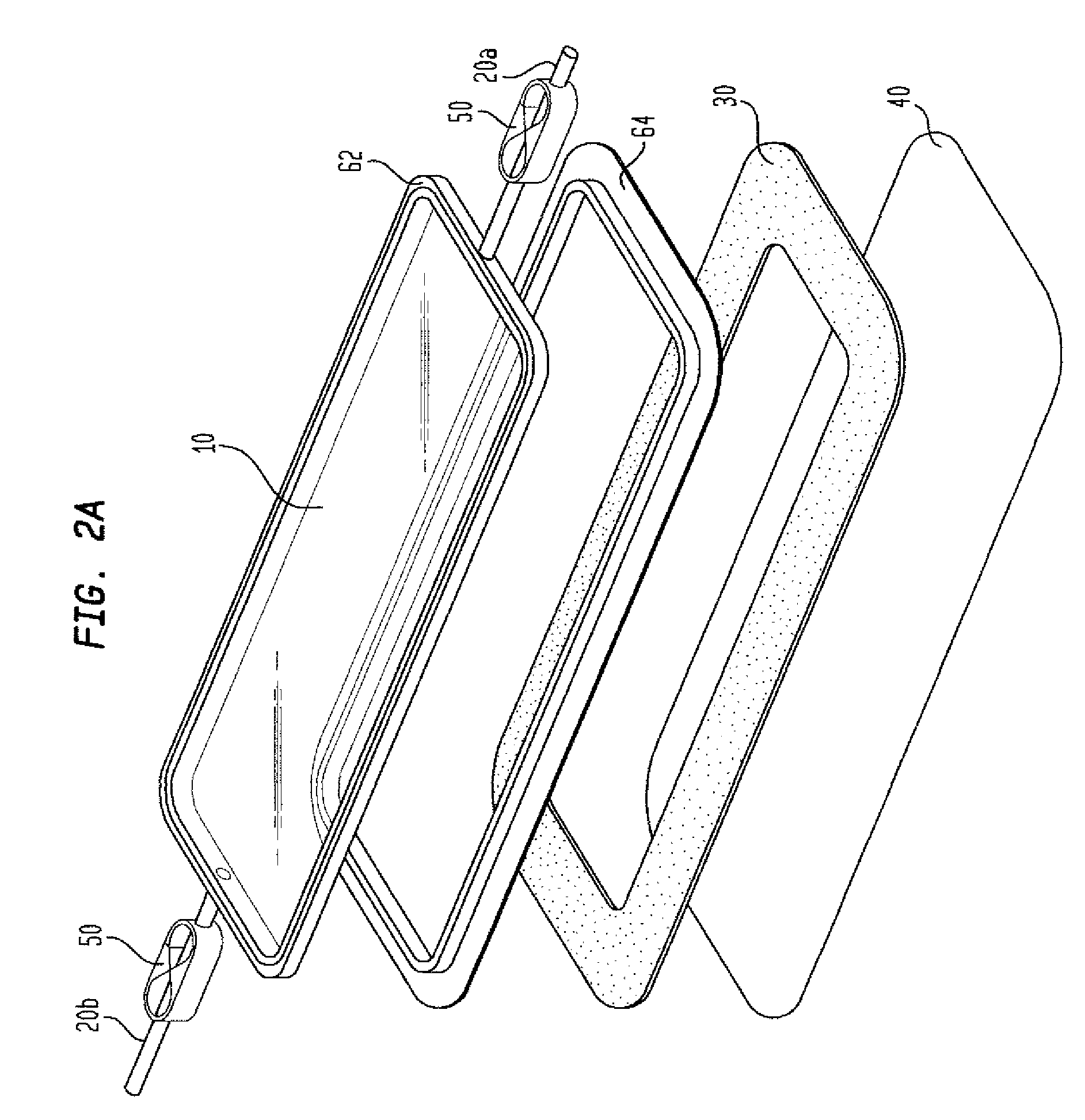
[0017]The removal
system (60), particularly when it is a female-male
flange, acts like TUPPERWARE™. It allows the top side
flange (62) to be removed while the body side
flange (64) with the
adhesive remains on the patient. The chamber top, which comprises the top side (62) of the removal
system (60), the film (10) and the ports (20), is removed to allow cleaning of the wound, observation of healing, and changing of a
hydrocolloid dressing, if any, while minimizing the loss of barrier properties and providing comfort to the patient. The two-piece device extends the life of the environmental control chamber. The one-piece device is expected to have a life of up to three days, dependent upon the amount of
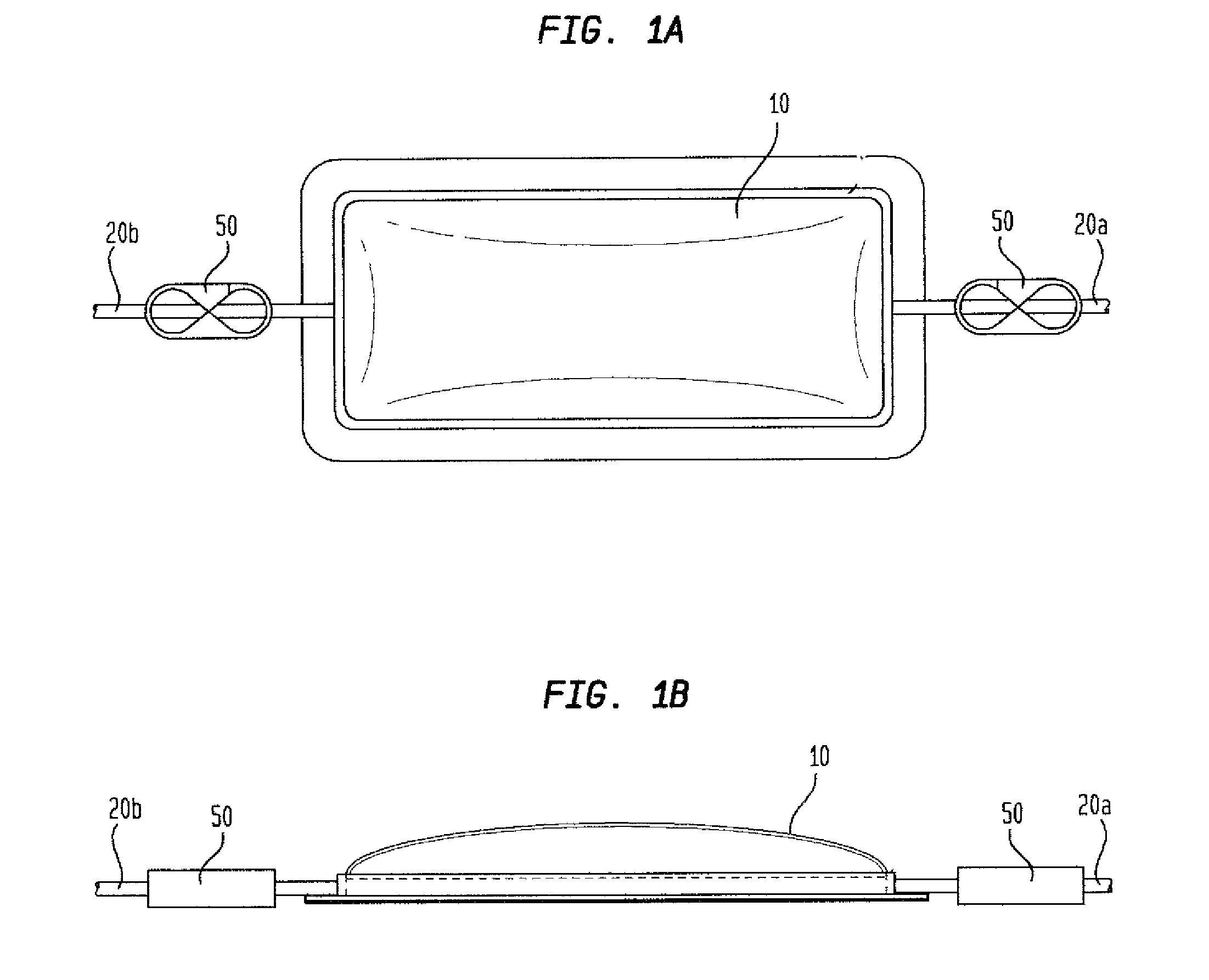
wound exudate produced. The two-piece device is expected to have a life of up to seven days. (The chamber top and any accompanying dressing may be replaced without removing the bottom connector). The environmental control chamber may provide gas to the
wound site in either a
continuous flow by leaving the gas outlet tube open or it may, by closing the outlet tube, fill the chamber.
[0020]Hydrocolloids are known to function well as occlusive dressings and also proven to be effective bacterial barriers. Hydrocolloid dressings also provide additional healing properties, absorb
wound exudate, and prolong the useful life of the environmental control chamber. As such, in another embodiment, an optional
hydrocolloid dressing may be applied directly over the wound in combination with the environmental control chamber. The hydrocolloid may be formulated to have antibacterial properties.
[0022]The environmental control chamber may be made more comfortable by adding a layer of foam. The
adhesive may be applied to a
closed cell or
reticulated foam that allows a physical
cushioning of the device. The foam may also contain antibacterial agents, such as ionic silver to provide even more protection for the healing wound.
[0023]The environmental control chamber of the present invention simplifies and miniaturizes the application of a gas to a
wound site. Now, instead of confining the patient to a chamber, the environmental control chamber is applied directly over the wound using any medical grade adhesive. In so doing, the environmental control chamber is applying
positive pressure. In another embodiment, the environmental control chamber may be used as a catheter tent. In this embodiment, as with the one-piece hyperbaric chamber embodiment, the catheter tent comprises a gas impermeable film (10) having three ports (20) (input, output, catheter connector) with an adhesive border (30) around the perimeter which is optionally covered by a
release liner (40). In the case of a two-piece catheter tent, it comprises an impermeable film (10), a removal
system (60), three ports (20) (input, output, catheter connector), an adhesive border (30) attached to the bottom side of the removal system (60) and an optional
release liner (40). The input and output ports (20a and 20b) in this embodiment function as they did in the hyperbaric chamber embodiment. The third port (20c) provides a connection for the catheter and in some instances provides a delivery
route to the catheter. As with the hyperbaric chamber embodiment, application of a gas may inflate the chamber top, thus providing
positive pressure around the catheter connection and the wound site. The
positive pressure generated within the tent provides a barrier to bacterial invasion in the catheter and diminishes the chances of hospital acquired infections, which are a problem in all hospitals.
[0024]Hospital acquired infections are particularly prevalent with
indwelling catheters (feeding tubes, etc.) required for
patient care. It is not uncommon to coat the lumen of catheters with antibacterial solutions, such as silver, to prevent intrinsic infection, which results from
bacteria driving down the lumen of a catheter or tube. However, the extrinsic infections that occur when
bacteria grow on the outside surface of the catheter and its
biofilm have not been adequately addressed. Further, as the patient moves, or is moved, slippage of the catheter can inoculate the patient with contaminants. The catheter embodiment of the present invention addresses the issue by locking the catheter in place with a barbed fitting and simultaneously providing positive pressure containment around the
insertion site and connection section. The flexible design provides
patient comfort and ease of use by the healthcare giver.
[0025]In general, the environmental control chamber of the present invention provides gas to a wound site to aid healing and curtail infections.



 Login to View More
  Login to View More