
Dielectric ceramic and laminated ceramic capacitor
a technology of laminated ceramic and dielectric ceramic, which is applied in the direction of fixed capacitors, stacked capacitors, inorganic insulators, etc., can solve the problems of difficult to achieve a balance between insulation resistivity and likely decrease in insulation resistivity, so as to reduce the variation in ca concentration and increase the reliability of high-temperature load
- Summary
- Abstract
- Description
- Claims
- Application Information
AI Technical Summary
Benefits of technology
Problems solved by technology
Method used
Image

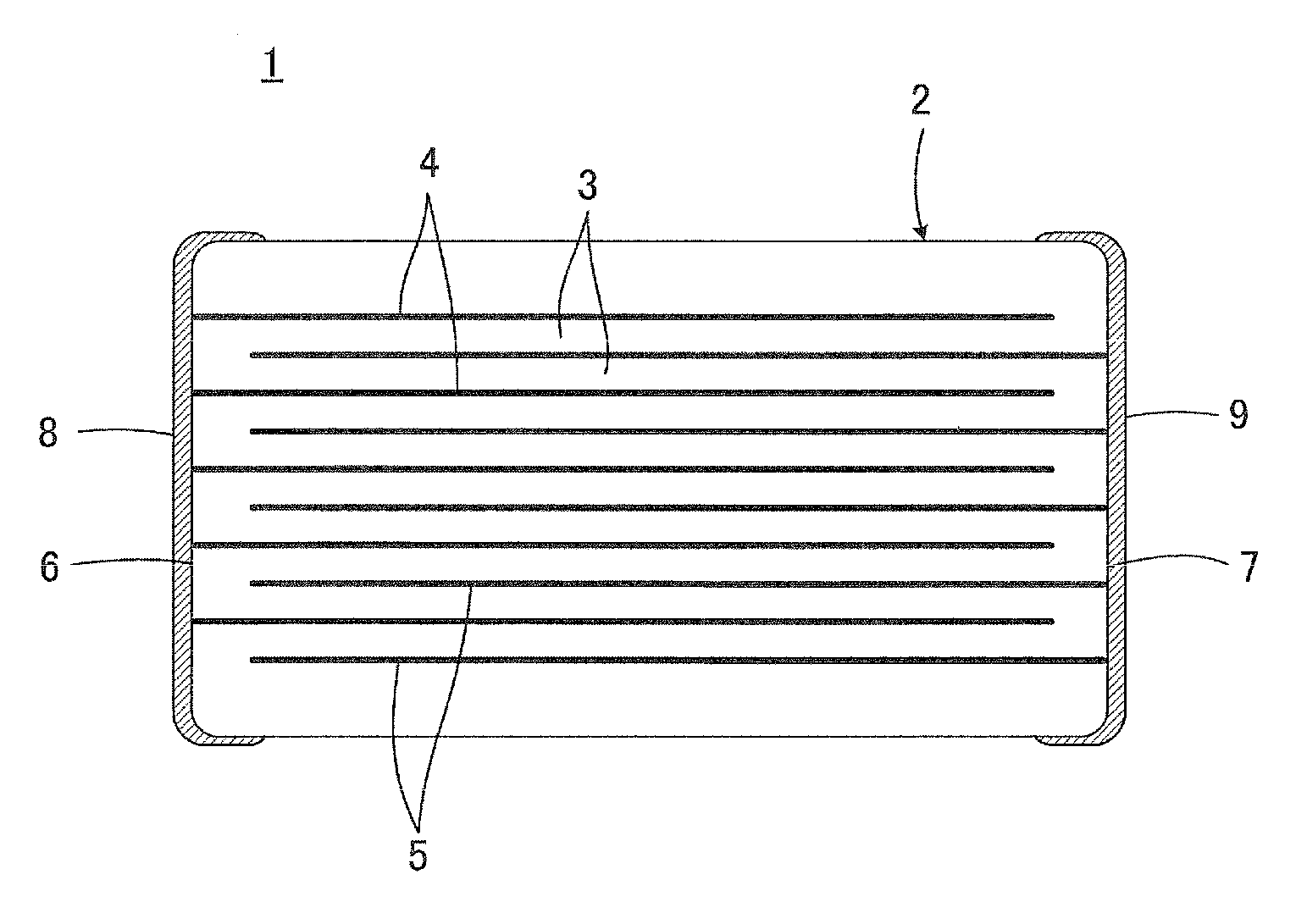
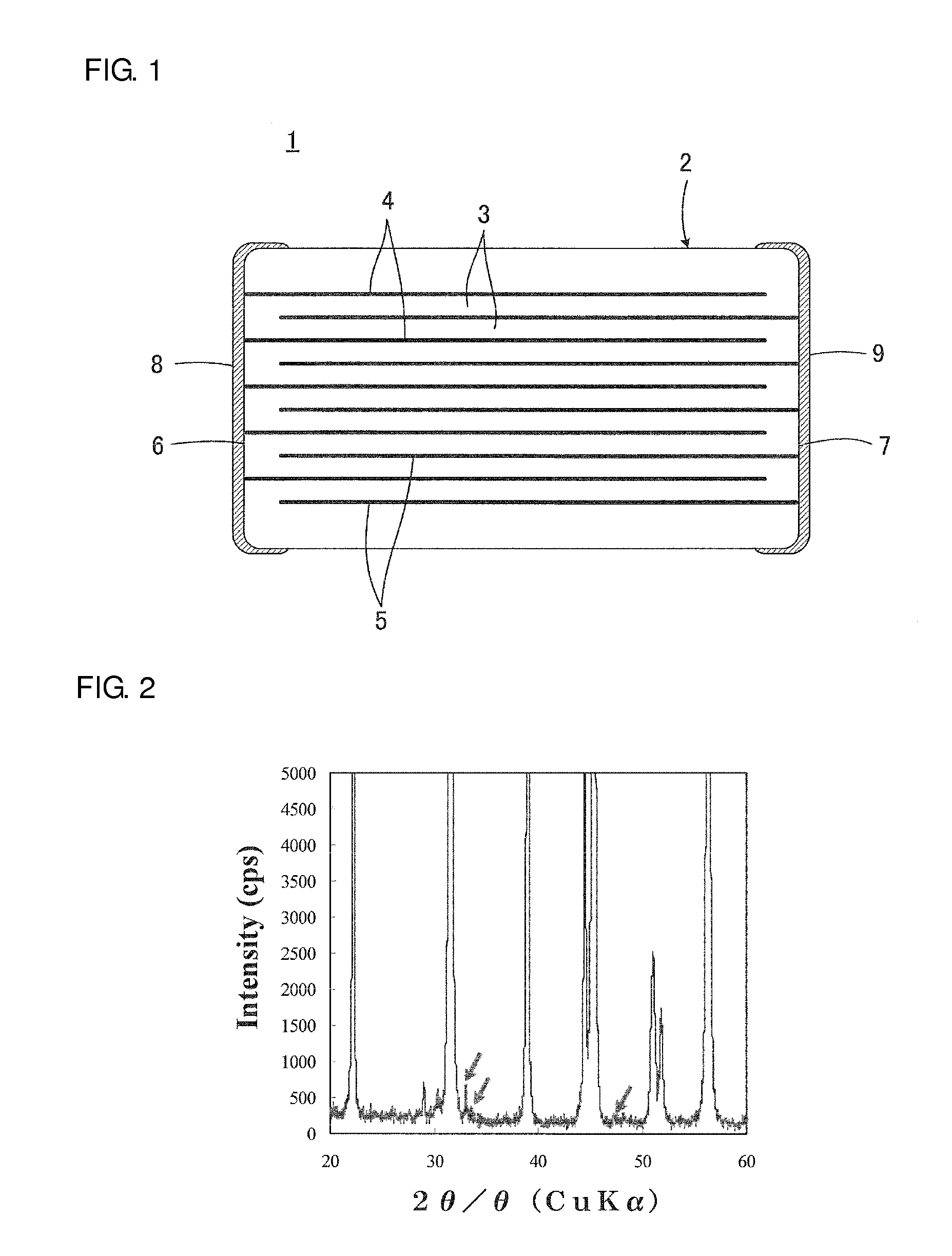
Examples
experimental example 1
[0030](Ba1-yCay)TiO3 adjusted in Ca substitution amount to the “y” shown in Table 1, CaTiO3, MnO, and SiO2 were prepared, and these materials were weighed so that “x”, “c”, and “e” achieved the numerical values shown in Table 1 in the composition formula of (1−x) (Ba1-yCay)TiO3+xCaTiO3+cMnO+eSiO2 to prepare a mixed raw material powder. In this case, “c” and “e” represent parts by mol with respect to 1 mol of (1−x) (Ba1-yCay)TiO3+xCaTiO3.
[0031]Next, this raw material powder combined with a polyvinyl butyral based binder and an organic solvent such as ethanol was subjected to wet mixing in a ball mill to prepare a ceramic slurry.
[0032]The ceramic slurry was formed into the shape of a sheet by a doctor blade method to obtain ceramic green sheets.
[0033]A conductive paste containing Ni as its main constituent was printed onto the ceramic green sheets to form conductive paste films to serve as internal electrodes.
[0034]Then, multiple ceramic green sheets were stacked so as to alternate t...
experimental example 2
[0048](Ba0.89Ca0.11)mTiO3 adjusted to the (Ba, Ca) / Ti ratio “m” shown in Table 2, CaTiO3, Y2O3, Gd2O3, Dy2O3, Ho2O3, Er2O3, MgO, V2O3, and SiO2 were prepared, and these materials were weighed so that “m”, “a”, “b”, “c”, “d”, and “e” achieved the numerical values shown in Table 2 in the composition formula of (1−x) (Ba0.89Ca0.11)mTiO3+xCaTiO3+aRe2O3+bMgO+cMnO+dV2O3+eSiO2 to prepare a mixed raw material powder. In this case, “a”, “b”, “c”, “d” and “e” represent parts by mol with respect to 1 mol of (1−x) (Ba0.89Ca0.11)mTiO3+xCaTiO3.
[0049]Then, laminated ceramic capacitors samples were obtained in the same way as in the case of Experimental Example 1.
[0050]For laminated ceramic capacitors obtained according to each sample, the relative permittivity (ε) and insulation resistivity (ρ) were found in the same way as in the case of Experimental Example 1.
[0051]Furthermore, the electrostatic capacitance was measured while varying the temperature within the range from −55° C. to +150° C. in o...
PUM
| Property | Measurement | Unit |
|---|---|---|
| Substance count | aaaaa | aaaaa |
| Dielectric polarization enthalpy | aaaaa | aaaaa |
| Composition | aaaaa | aaaaa |
Abstract
Description
Claims
Application Information
 Login to View More