However, in fact actual units, such as the NightHunters described below, can only be turned on and off with one-hand control and two hands must be used in order to operate the
zoom focus.
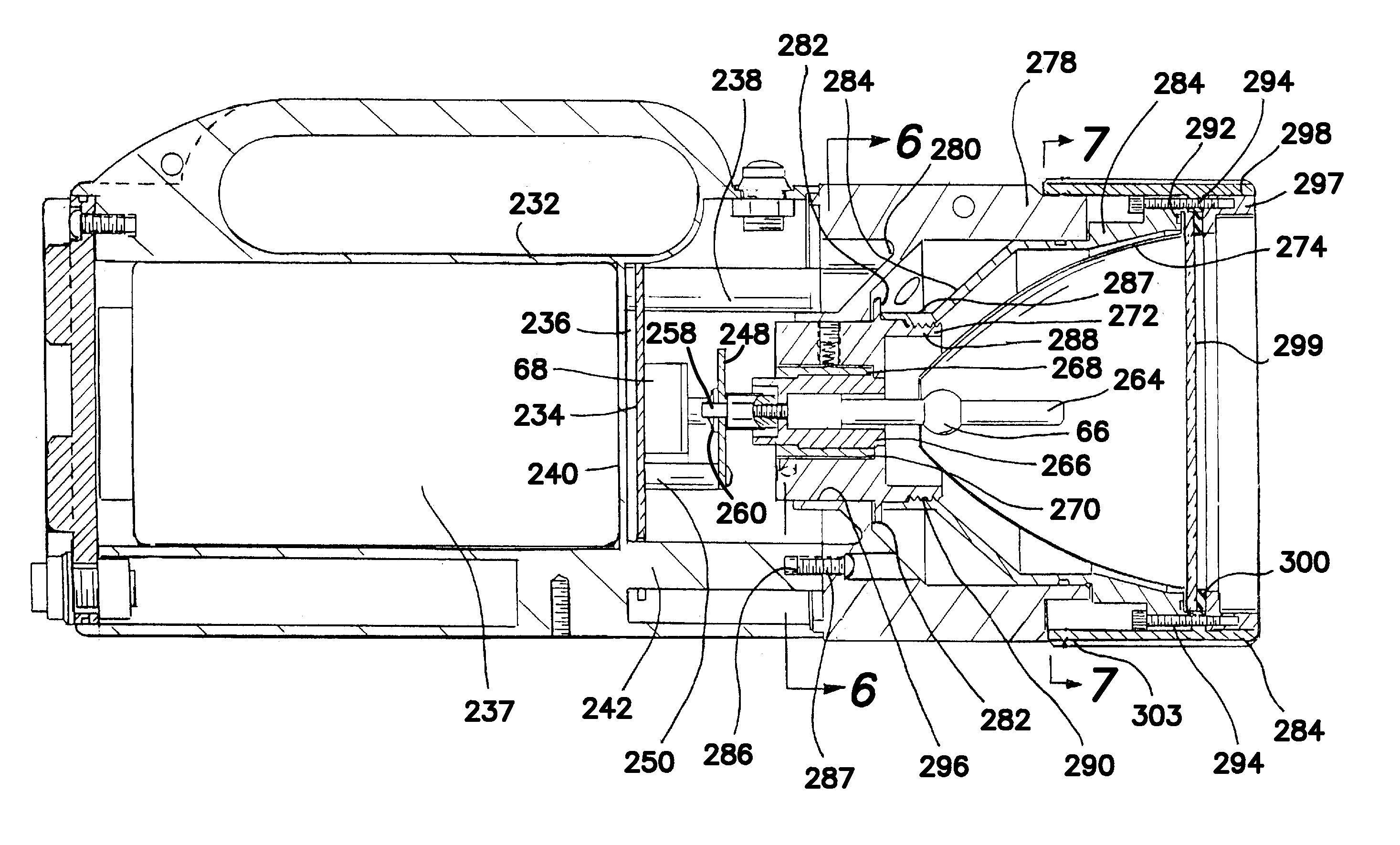
Therefore, small instabilities of any kind in the NightHunter in the relative position of the focal point of the reflector relative to the
plasma ball or center or the origin of the light from the arc lamp cause similar instabilities in the degree of collimation which are greatly magnified into instabilities of the size and location of the spot that is projected at large distances.
In the case of the NightHunter, NightHunter One, NightHunter 2 , and NightHunter 3, for example, there is no stability control provided for the rotatable threaded coaxial connection between a unit holding the arc lamp and the reflector housing, resulting in unmanageable instabilities in the size and location of the spot that is projected at large distances.
When the NightHunter is subject to vibrations, which is always the case when the light is mounted on a vehicle or firing gun
mount of any kind, the size of the spot projected at large distances fluctuates wildly and out of control, making the level of illumination on the target unstable and target identification difficult.
This is a material inherent defect in the NightHunter designs, since one of the device's primary uses is intended to be for gun mounts for night firing.
Still further the inherent backlash in the screw drive results in a
lag in the zoom control when the direction of zoom is changed which is perceived by the user as an inaccuracy of adjustment, or nonresponsiveness in the control when the direction of zoom is changed.
Further, the clearance in the zoom control threading of the NightHunter not only allows the center of focus of the reflector and the
plasma ball of lamp to be displaced from each other both in generally forward and reverse direction of the
optical axis of the reflector, thereby causing the degree of collimation of the beam to uncontrollably fluctuate, but also to allow the
optical axis of the reflector to become uncontrollably inclined relative to the desired axis of the gun
mount or reflector direction.
This latter error causes the
light beam to be centered at a location other than where the gun is aimed.
While this uncontrolled position and orientation of the center of focus and
optical axis of the reflector, caused by the looseness or inherent thread clearance between the reflector and its head or mounting, is small, its effect as seen in the performance at the beam at typical operating distances is a
material defect and clearly noticeable, The uncontrollable performance is aggravated when the light is mounted in a high vibrational environment, such as on a firing gun
mount, where every gun
discharge can potentially and does reconfigure the optical focal point and optical axis of the reflector from its prior position and orientation.
Further, even without the presence of mechanical vibrations the thermal heating caused by the hot arc lamp in the NightHunter will change the relative position of the focal point of the reflector relative to the
plasma ball or center or the origin of the light from the arc lamp and cause the size of projected spot to drift.
This inherent problem of the NightHunter designs is particularly exacerbated in cold night combat situations during which the hot lamp may be focused on a target and then turned off, The cooling during the off phase is sufficient to materially change the relative position of the focal point of the reflector relative to the plasma ball or center or the origin of the light from the arc lamp, so that when the cold lamp is turned back on, the previously focused spot no longer has the same size and hence illumination intensity on the target has changed as compared to what it was when it was last turned off.
However, in the field any intrusion of sand,
dirt or other debris on the juxtaposed flat surfaces of either the IR filter or the
flashlight results in a small spacing or crack between the two, which is particularly magnified if the debris is near the hinge, through which crack a substantial amount of
white light can leak making the user of the IR
torch very visible.
Further, there is no means which conveniently allows the user of the NightHunter 3 to know that the light is on when the IR filter is in place.
Unless the user happens to have IR
night vision googles on and operating, it is possible to unknowingly open the IR filter with the
torch on, resulting in a strong unintended display of
white light.
Further yet, the IR filter in the NightHunter 3 is hinged so that, when in its fully open position, the IR filter is cantilevered out from the body of the
torch at nearly right angles to the torch, making use of the torch in the non-IR mode very awkward.



 Login to View More
  Login to View More