
Drive shaft for a surgical reamer
a technology of surgical reamer and drive shaft, which is applied in the field of drive shaft for surgical reamer, can solve the problems of more costly and fragile than the conventional drive shaft, the device is however costly and must be re-used, and the cleaning and sterilization is difficult, so as to achieve the effect of light and less expensive, avoiding the difficulties and costs of sterilization, and facilitating the insertion and withdrawal of the tool
- Summary
- Abstract
- Description
- Claims
- Application Information
AI Technical Summary
Benefits of technology
Problems solved by technology
Method used
Image

Examples
Embodiment Construction
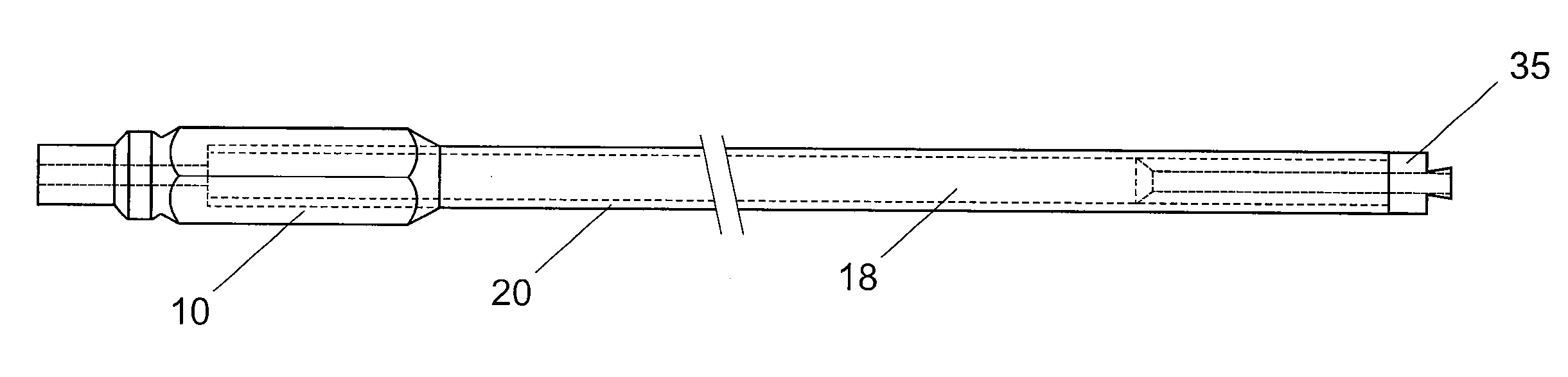
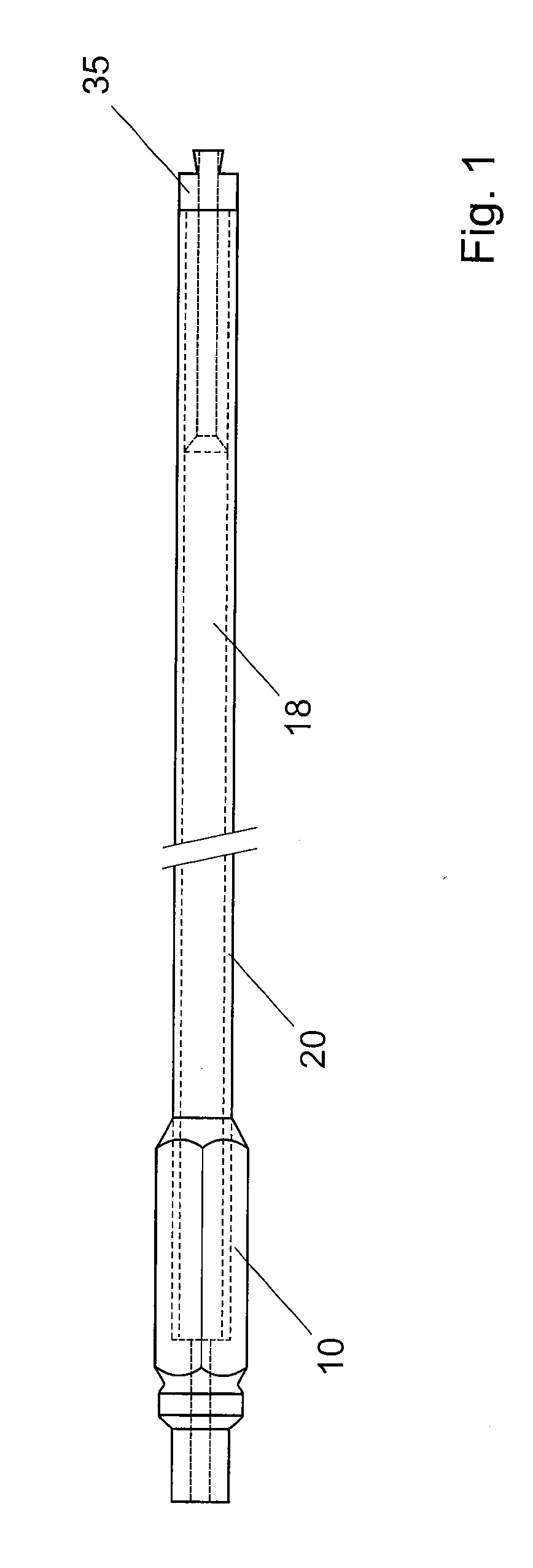
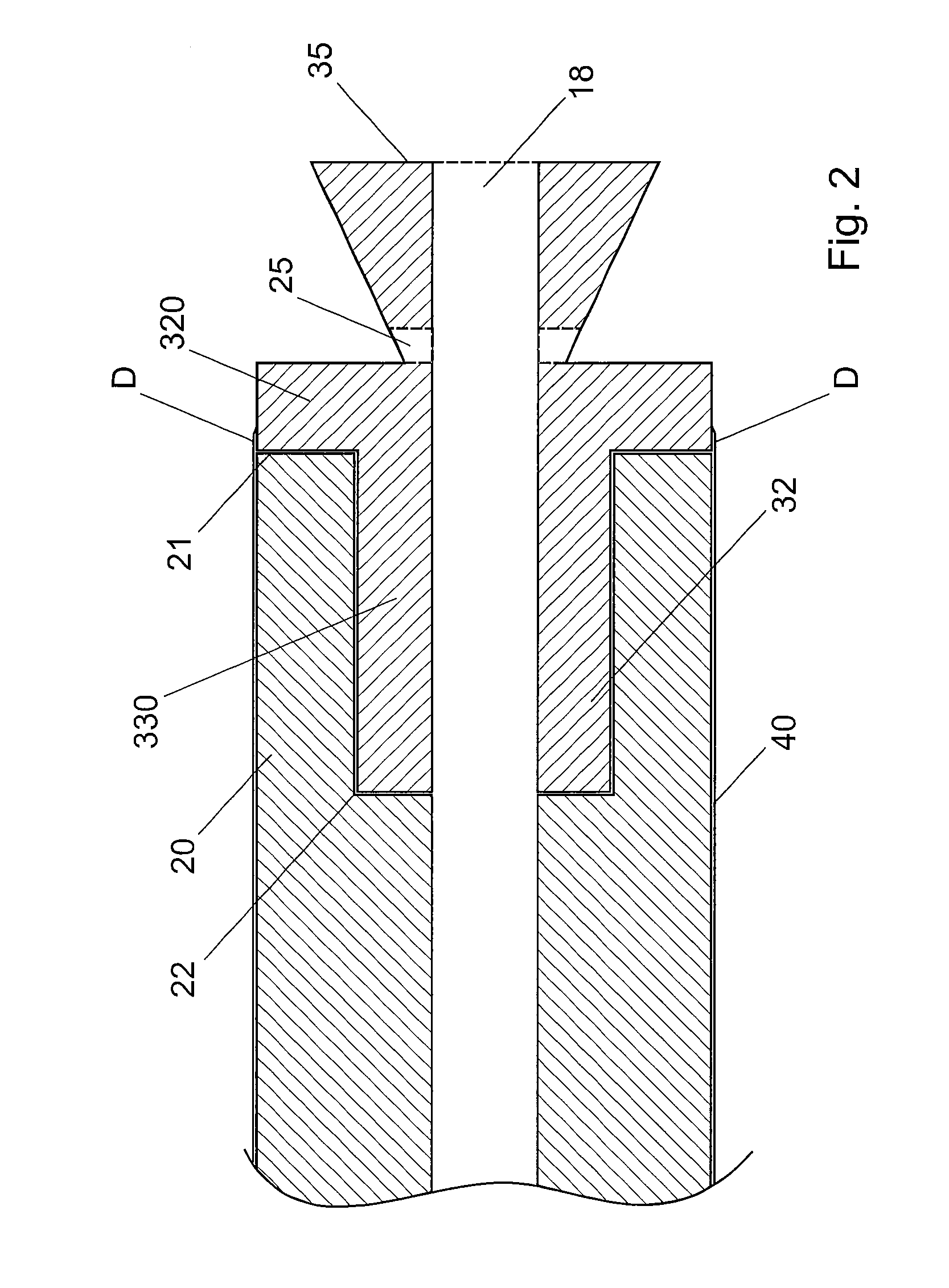
[0019]With reference to FIG. 1, according to one embodiment, the transmission shaft of the invention comprises a flexible rod 20 of composite material, for example with a fiber-reinforced plastic matrix. The length of the rod is adapted to that of the medullary canal of the bone on which one wishes to operate. In a preferred embodiment, this length is greater than 70 cm, for example 1m, which advantageously makes it possible to perform arthrodesis in a single step. Known metallic transmission shafts with a wound coil have a length of approximately 50 cm and they thus do not allow arthrodesis to be performed in a single step. Furthermore, there are difficulties in making a known metallic transmission shaft with a length lower than 1 m, obtained by cutting a shaft of greater length, because of the spring's helix structure.
[0020]In a preferred embodiment, the inventive shaft is manufactured having a length of 1 m. As it is made of composite material, it is possible to cut it into two e...
PUM
| Property | Measurement | Unit |
|---|---|---|
| transverse diameter | aaaaa | aaaaa |
| length | aaaaa | aaaaa |
| length | aaaaa | aaaaa |
Abstract
Description
Claims
Application Information
 Login to View More