
Hetero-Bicyclic Derivatives as HCV Inhibitors
a derivative and heterocyclic technology, applied in the field of heterocyclic derivatives, can solve the problems of high rate of chronic infection, hematologic abnormalities, neuropsychiatric symptoms, and combination therapy with significant side effects,
- Summary
- Abstract
- Description
- Claims
- Application Information
AI Technical Summary
Benefits of technology
Problems solved by technology
Method used
Image

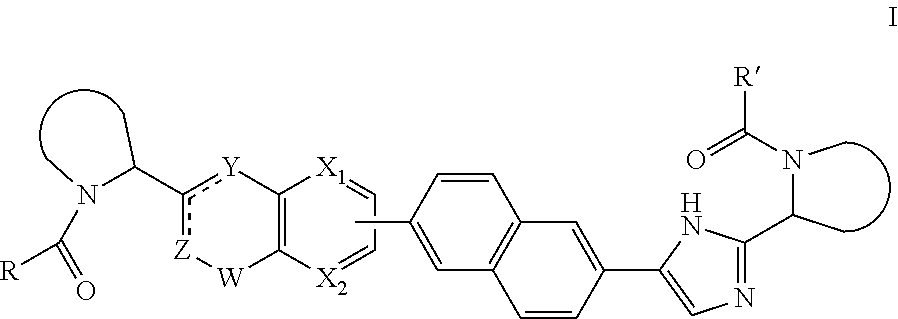
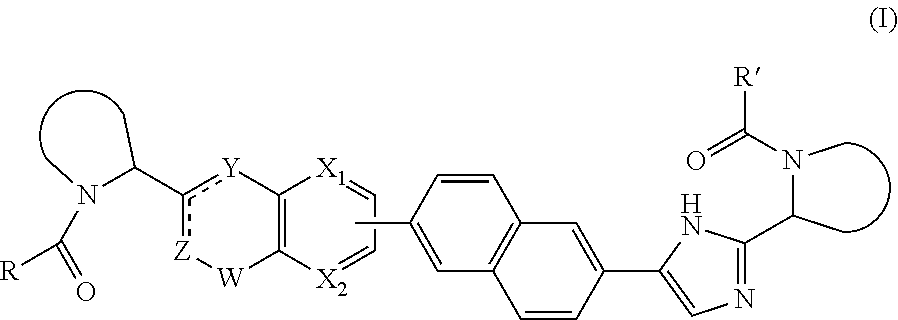
Examples
first embodiment
[0039]In the present invention, each
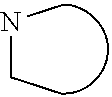
independently is pyrrolidin-2-yl, 2-aza-bicyclo[3.1.0]hexan-3-yl or piperidin-2-yl, wherein each of said heterocycles may optionally be substituted by one or more halogen atoms.
second embodiment
[0040]In the present invention, each
independently is pyrrolidin-2-yl or 2-aza-bicyclo[3.1.0]hexan-3-yl, wherein each of said heterocycles may optionally be substituted by one or more halogen atoms.
third embodiment
[0041]In the present invention ZCY is CH═C—NH.
[0042]In a further embodiment R and R′ are identical.
[0043]In yet a further embodiment R2 is hydroxyl, amino, mono- or di-C1-4alkylamino, C1-4alkyl-carbonylamino, C1-4alkyloxycarbonylamino; in particular, R2 is C1-4alkylcarbonylamino or C1-4alkyloxycarbonylamino, and R3 is hydrogen.
[0044]In a further embodiment R1 is selected from C1-4alkyl; C2-4alkyl substituted with methoxy or hydroxyl; and phenyl optionally substituted with 1 or 2 substituents independently selected from halo and methyl. In particular, R1 is selected from branched C3-4alkyl; C2-3alkyl substituted with methoxy; and phenyl optionally substituted with 1 substituent selected from halo and methyl.
[0045]In a further aspect, the invention provides a compound of formula I or a pharmaceutically acceptable salt, hydrate, or solvate thereof, for use in the treatment or prophylaxis (or the manufacture of a medicament for the treatment or prophylaxis) of HCV infection. Representat...
PUM
| Property | Measurement | Unit |
|---|---|---|
| temperature | aaaaa | aaaaa |
| temperature | aaaaa | aaaaa |
| temperature | aaaaa | aaaaa |
Abstract
Description
Claims
Application Information
 Login to View More