
N1-Cyclic Amine-N5-Substituted Phenyl Biguanide Derivatives, Methods of Preparing the Same and Pharmaceutical Composition Comprising the Same
- Summary
- Abstract
- Description
- Claims
- Application Information
AI Technical Summary
Benefits of technology
Problems solved by technology
Method used
Image

Examples
example 1
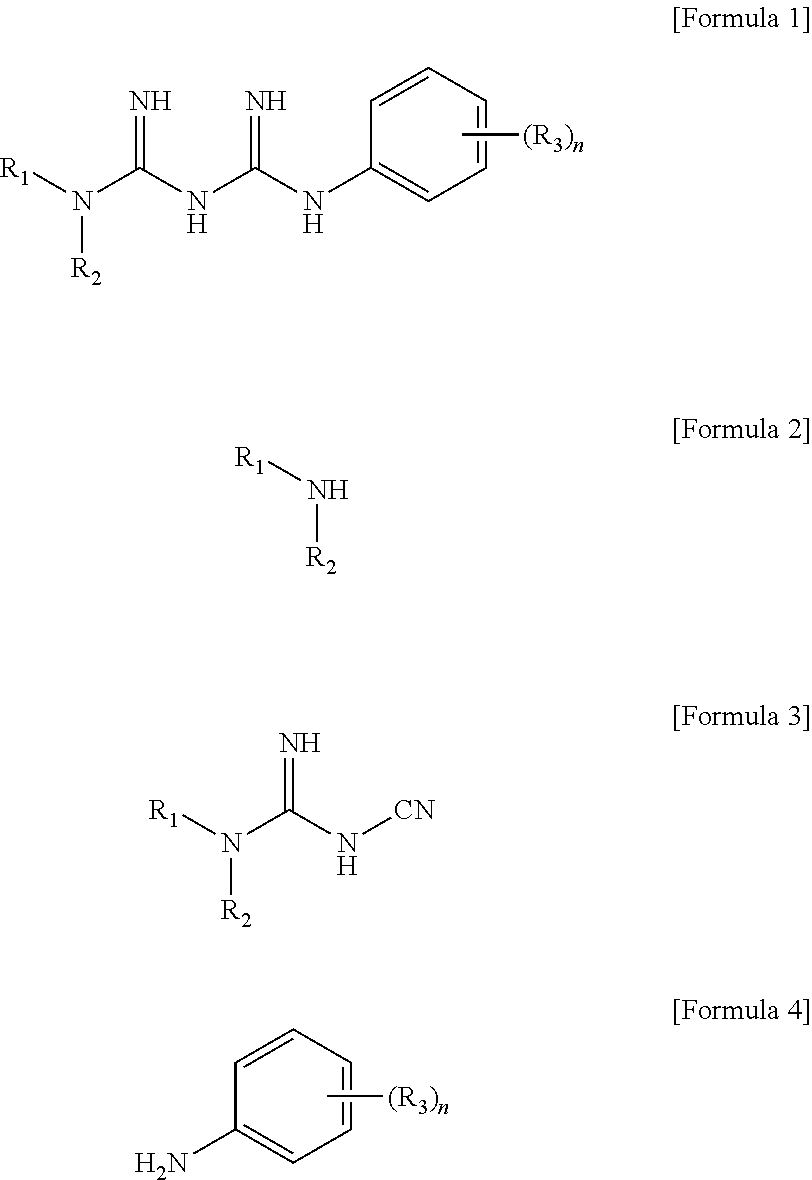
Synthesis of N1-piperidine cyanoguanidine
[0084]Concentrated hydrochloric acid (81.7 ml, 0.940 mol) was added to a solution prepared by dissolving piperidine (92.8 ml, 0.940 mol) in butanol (300 ml) and stirred at 0° C. for 30 minutes. Sodium dicyanamide (92.0 g, 1.03 mol) was added to the mixed solution, and the resulting reaction mixture was stirred for 24 hour under reflux. After the completion of the reaction was confirmed, sodium chloride formed by filtering the reaction mixture was removed, and the filtrate was then concentrated at a reduced pressure. Distilled water (100 ml) was added to the concentrate and stirred at room temperature for 1 hour. The formed solid was filtered, and the filter cake was washed with distilled water (2×20 ml). The filter cake was dried at a reduced pressure to obtain a white solid target compound (93.3 g, 65%).
[0085]1H NMR (600 MHz, DMSO-d6) δ 7.01 (br, s, 2H), 3.39 (m, 4H), 1.54 (m, 2H), 1.42 (m, 4H); LC-MS m / z 153.2 [M+1]+; mp 163-165° C.
example 2
Synthesis of N1-azetidine cyanoguanidine
[0086]
[0087]A white solid target compound (1.13 g, 52%) was prepared in the same manner as in Example 1, except that azetidine was used instead of the piperidine which was used in Example 1.
[0088]1H NMR (600 MHz, DMSO-d6) δ 6.92 (br, s, 2H), 3.91 (t, J=7.8 Hz, 4H), 2.16 (tt, J=7.8, 7.8 Hz, 2H); LC-MS m / z 125.2[M+1]+; mp 188-189° C.
example 3
Synthesis of N1-pyrrolidine cyanoguanidine
[0089]
[0090]A white solid target compound (24.5 g, 63%) was prepared in the same manner as in Example 1, except that pyrrolidine was used instead of the piperidine which was used in Example 1.
[0091]1H NMR (600 MHz, DMSO-d6) δ 6.88 (br, s, 2H), 3.24 (m, 4H), 1.80 (m, 4H); LC-MS m / z 139.2[M+1]+; mp 232-235° C.
PUM
 Login to View More
 Abstract
Description
Claims
Application Information
 Login to View More