Check patentability & draft patents in minutes with Patsnap Eureka AI!

Phosphorus Containing Flame Retardants

Active Publication Date: 2015-01-29
LANXESS SOLUTIONS US INC
View PDF3 Cites 38 Cited by
  • Summary
  • Abstract
  • Description
  • Claims
  • Application Information

AI Technical Summary

Benefits of technology

This patent describes a new flame retardant additive for polymers that is formed by heating certain compounds. This flame retardant has improved properties and can be easily processed into resins without negatively affecting their physical properties. The patent also describes the use of phosphinic acid salts and other synergists that can further enhance the flame retardant properties of the compounds. The technical effects of this patent include improved flame retardant properties of polymers and the ability to easily process the flame retardant without negatively affecting the resin's physical properties.

Problems solved by technology

Some polymers are processed at high temperatures, for example 200° C., 220° C., 250° C. or higher, and many known flame retardants are not suitable under these conditions because they are too volatile, not sufficiently thermally stable, have an adverse effect on processing, etc.
Certain organophosphorus flame retardant compounds, such as some phosphate esters, can also exhibit a plasticizing effect which may adversely affect mechanical properties of the polymers into which they are added.
In addition, compounds such as some phosphates are relatively unstable to hydrolysis, which can result in undesired formation of various phosphoric acid compounds.
However, these materials are not necessarily suitable for use in all polymer systems and may create problems for processing or may lack the flame retardant effectiveness needed for certain polymers.
As disclosed in US 2007 / 0029532, decomposition of such phosphonic acid salts is well known at temperatures encountered during processing of polyesters and polyamides, damaging the polymers in the process.

Method used

the structure of the environmentally friendly knitted fabric provided by the present invention; figure 2 Flow chart of the yarn wrapping machine for environmentally friendly knitted fabrics and storage devices; image 3 Is the parameter map of the yarn covering machine
View more

Image

Smart Image Click on the blue labels to locate them in the text.
Viewing Examples
Smart Image
  • Phosphorus Containing Flame Retardants
  • Phosphorus Containing Flame Retardants
  • Phosphorus Containing Flame Retardants

Examples

Experimental program
Comparison scheme
Effect test

example 1

Flame Retardant from Methylphosphonic Acid Aluminum Salt, FR-INV1

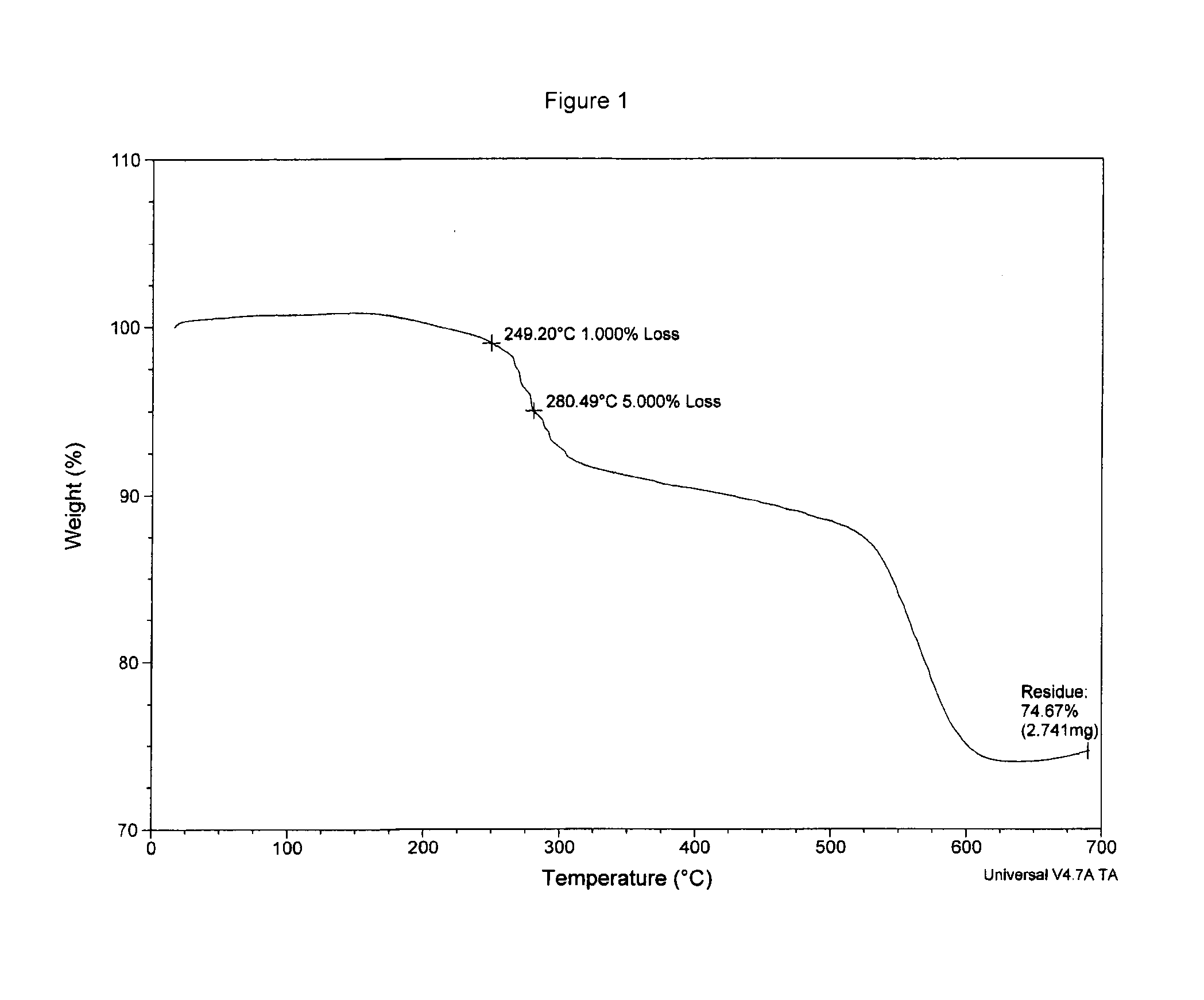
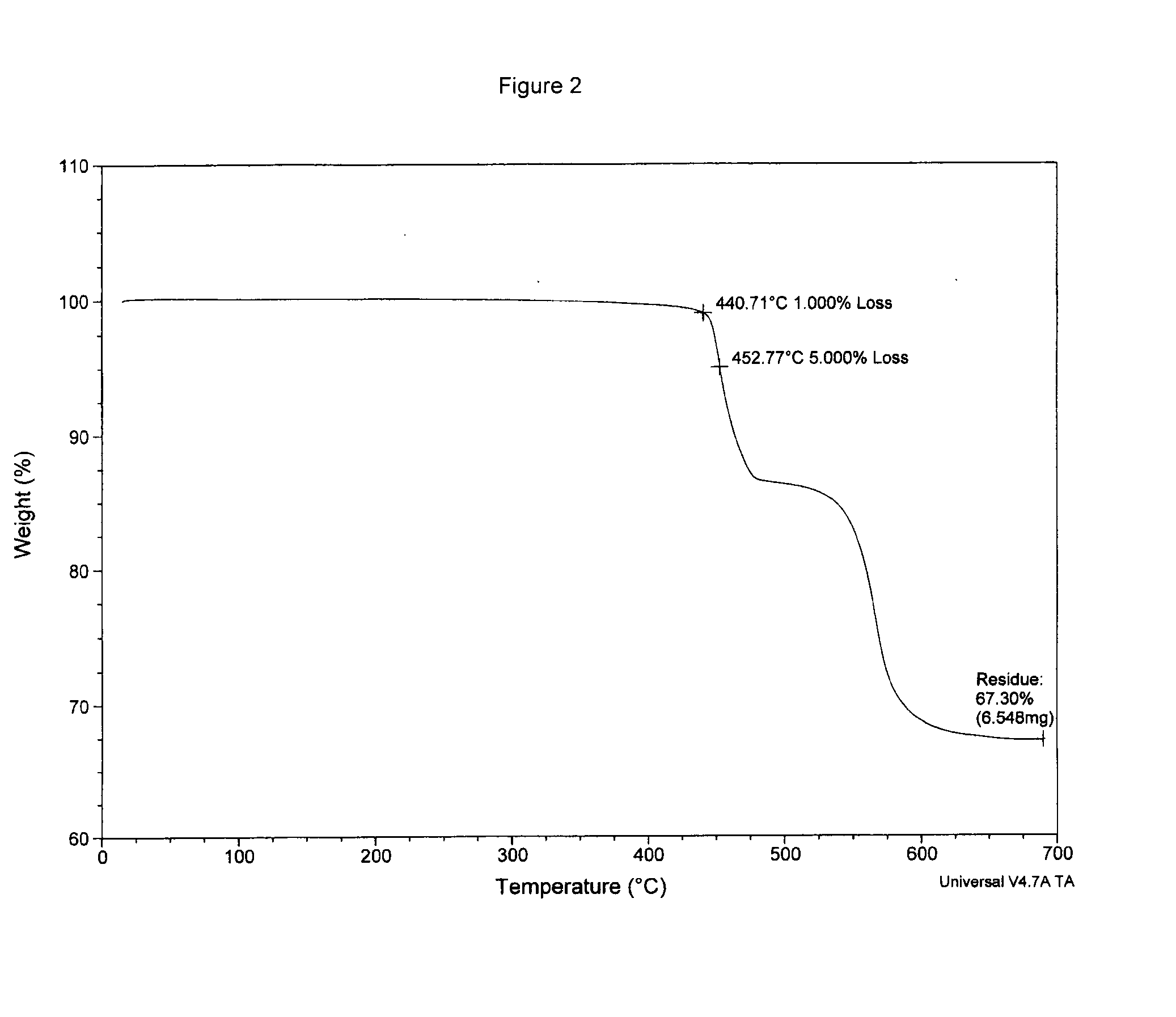
[0078]To a cooled solution of 48.0 g methylphosphonic acid (500 mmol) in 210 ml deionized water is slowly added 27.0 g aluminum ethoxide (167 mmol) under nitrogen. The reaction is then allowed to warm to room temperature and is stirred for 16 h. The solution is subsequently concentrated and dried at 100° C. in vacuo to afford a clear, colorless solid. Thermal analysis as indicated the loss of one mole of water starting at 250° C. The colorless solid was heated for 4 h at 280° C. resulting in an off-white solid that is stable to >400° C., as shown in FIG. 2. Elemental analysis: 31.5% P, 9.0% Al.

example 2

Flame Retardant from Ethylphosphonic Acid Aluminum Salt, FR-INV2

[0081]To a stirred solution of 149.5 g ethylphosphonic acid (1.36 mol) in 500 mL deionized water is added a solution of 109.3 g aluminum chloride hexahydrate (.453 mol) in 250 mL deionized water. The solution is then concentrated and dried at 130° C. in vacuo to remove water and HCl. Thermal analysis indicated the loss of one mole of water starting at 180° C. Heating the dried salt for 3 h at 225° C. affords a white powder that is stable to approximately 400° C. Elemental analysis: 27.3%P, 7.6% Al.

example 3

Flame Retardant from Ethylphosphonic Acid Calcium Salt, FR-INV3

[0082]To a stirred solution of 52.1 g ethylphosphonic acid (473 mmol) in 250 mL deionized water is slowly added 17.5 g calcium hydroxide (236 mmol). The solution is then concentrated and dried at 100° C. in vacuo. Thermal analysis indicated the loss of one mole of water staring at 220° C. Heating the dried salt for 3 h at 290° C. affords a white powder that is stable >400° C. Elemental analysis: 25.3% P, 16.3% Ca.

[0083]Formulations comprising flame retardants from Examples 1, 2 and 3 and various synergists were compounded into polyamide 66 with glass using a Haake Rheocord 90 and molded with a BabyPlast Mini-Molder into 1 / 16″ bars which were subjected to standard UL 94 Vertical Burn Test. Formulations and results are listed in Table 1 below.

TABLE 1FR DataFormulation 123456789101112Nylon 6656.3 4553.857.5 50.75350.351.7 46.353.854.445Glass303030303030303030303030FR-INV113.7 2513.71013.713.7 13.713.713.713.7FR-INV215.6FR-I...

the structure of the environmentally friendly knitted fabric provided by the present invention; figure 2 Flow chart of the yarn wrapping machine for environmentally friendly knitted fabrics and storage devices; image 3 Is the parameter map of the yarn covering machine
Login to View More

PUM

PropertyMeasurementUnit
Temperatureaaaaaaaaaa
Fractionaaaaaaaaaa
Fractionaaaaaaaaaa
Login to View More

Abstract

Certain phosphonic acid salts heated at temperatures over 200° C. generate thermally stable, highly efficient flame retardant materials well suited for use as flame retardant additives in polymers. The flame retardants of the invention can be used as the sole flame retardant in a composition or in combination with other flame retardants, synergists or adjuvants.

Description

[0001]This application claims benefit under 35 USC 119(e) of U.S. Provisional Application No. 61 / 857,741 filed Jul. 24, 2013, the disclosure of which is incorporated herein by reference.BACKGROUND OF THE INVENTION[0002]Polymers, such as polyolefins, polyesters, polycarbonates, polyamides, polyurethanes, epoxy resins, and other thermoplastic or thermoset polymer resins, are frequently made more flame retardant by incorporating therein a phosphorus-containing compound, a halogen-containing compound or a mixture thereof. U.S. Pat. No. 3,689,602, for example, discloses halogenated phosphoric acid esters as flame-retardant additives for plastics.[0003]Some polymers are processed at high temperatures, for example 200° C., 220° C., 250° C. or higher, and many known flame retardants are not suitable under these conditions because they are too volatile, not sufficiently thermally stable, have an adverse effect on processing, etc. Certain organophosphorus flame retardant compounds, such as so...

Claims

the structure of the environmentally friendly knitted fabric provided by the present invention; figure 2 Flow chart of the yarn wrapping machine for environmentally friendly knitted fabrics and storage devices; image 3 Is the parameter map of the yarn covering machine
Login to View More

Application Information

Patent Timeline
no application Login to View More
IPC IPC(8): C08K5/5397C08K3/32C08K5/3492C08K5/5317C08K5/53
CPCC08K5/5397C08K5/5317C08K3/32C08K5/3492C08K5/53C07F9/5329C07F9/5333C07F9/657172C07F9/3808C08K5/34928C07F9/3839C07F9/40C08K5/005C08K5/0066C08K5/5333C08L77/06
Inventor STOCKDALE, ZACHARY D.HANSON, MARK V.TIMBERLAKE, LARRY D.NARAYAN, SUBRAMANIAMFIELDING, WILLIAM R.
Owner LANXESS SOLUTIONS US INC
Features
  • R&D
  • Intellectual Property
  • Life Sciences
  • Materials
  • Tech Scout
Why Patsnap Eureka
  • Unparalleled Data Quality
  • Higher Quality Content
  • 60% Fewer Hallucinations
Social media
Patsnap Eureka Blog
Learn More