Symbiotic reverse osmosis for maximizing desalinated water recovery from saline waters and brines

a technology of desalinated water and saline water, applied in the field of symbiotic reverse osmosis system, can solve the problems of unsuitable performance, unsatisfactory performance, and all these applications that are functionally still limited, and achieve the effect of remixing seawater with desalinated water
US20170080389A1Inactive Publication Date: 2017-03-23KELADA MAHER ISAAC

Patent Information

Authority / Receiving Office
US ยท United States
Current Assignee / Owner
KELADA MAHER ISAAC
Publication Date
2017-03-23
Estimated Expiration
Not applicable ยท inactive patent

Smart Images

  • Figure 1
    Figure 1
  • Figure 2
    Figure 2
  • Figure 3
    Figure 3
Patent Text Reader

Abstract

The present application comprises symbiotic reverse osmosis train system for maximizing desalinated water recovery, meanwhile yielding high salinity brine suitable for osmotic power generation or commercial salt production; trains comprise series of number of cells operating in interrelated sequential pattern within a salinity field. Each cell forms a closed hydraulic brine loop having pumping means, power recovery means and shared semipermeable membranes between adjacent cells, defining the boundaries of flow path within a given cell, using applicant's technology for semipermeable Flat Sheet Membranes [FSM] or Hollow Fiber Membranes [HFM] intended for new and novel development in Hypersalinity processes and applications in desalination and osmotic power generation of brackish, seawater and brines of 15% salinity or more. Charging each cell in the train of plurality of cells with a formulated brine having a specified ionizable inorganic salt concentration and type, without permitting mixing of the given brines among the adjacent cells in the plurality of cells, allowing the train of multiple cells to achieve water recovery exceeding 85% with concentrated rejected brine of 28-30% salt content that is recoverable by evaporation / crystallization for commercial use. Highlighting, the first of its kind, a large scale Seashore Tower of flat Sheet membrane [FSM] for Induced Osmotic Desalination Plant of a capacity 28-56 million cubic meter per year (15 billion gallons per year) at a recovery rate of 85%, and rejected brine salinity of 28-30%, either used for sodium chloride salt recovery of 1-2 million metric tons per year, or to generate Induced Osmotic Power of 25-50 MW.
Need to check novelty before this filing date? Find Prior Art

Description

BACKGROUND

[0001] 1. Field of the Invention

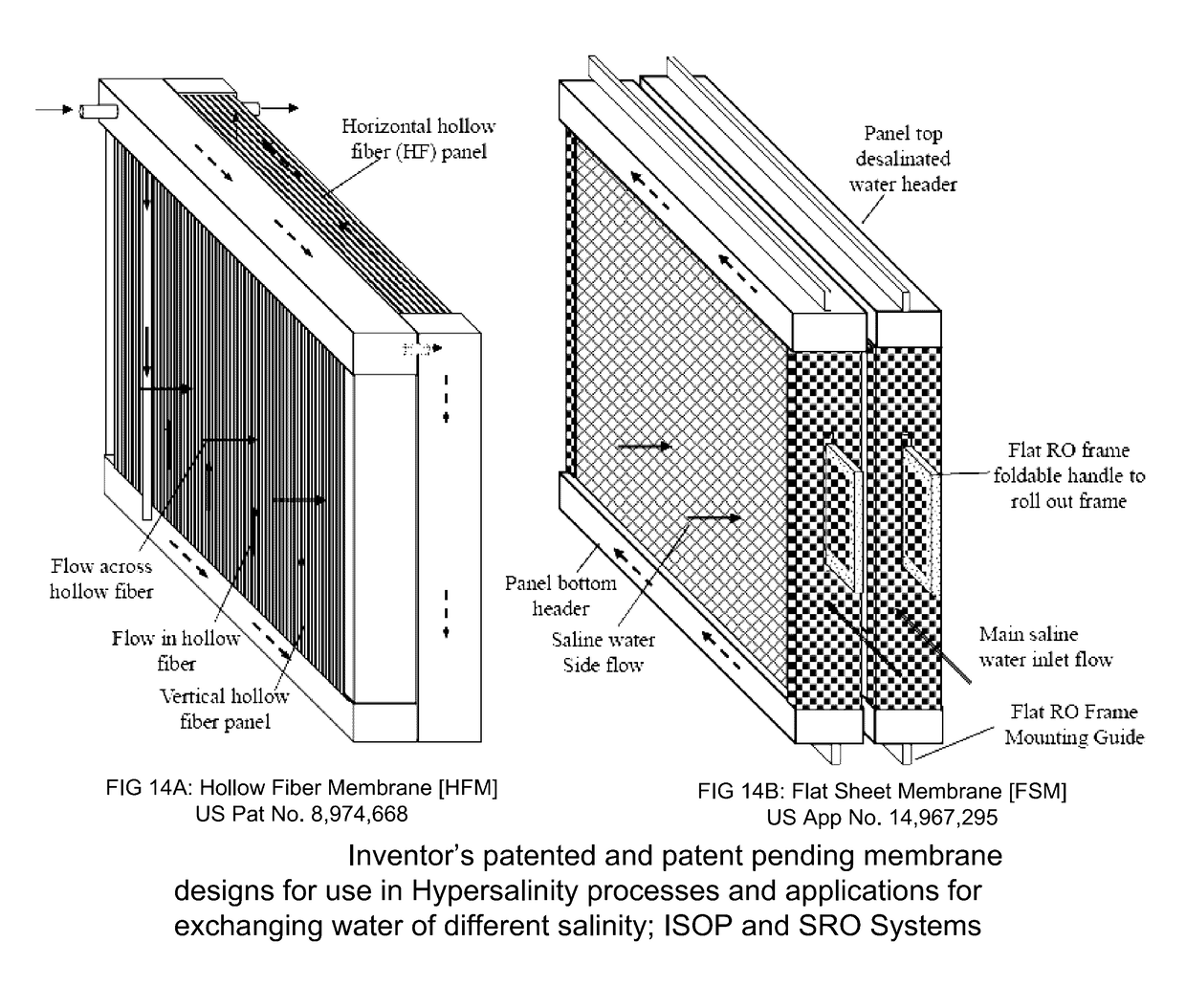
[0002] The present application relates generally to a symbiotic reverse osmosis system using semipermeable flat sheet and hollow fiber membranes panels design.

[0003] 2. Description of Related Art

[0004] In 1959, two researchers at UCLA, Sidney Loeb and Srinivasa Sourirajan succeeded in producing a functional synthetic RO membrane from cellulose acetate polymer and based on this development, the world's first commercial RO plant was built in Coalinga in 1965. Today, reverse osmosis and membrane filtration elements are used for multitude of water treatment processes and applications and many types of membranes are developed and in use worldwide. However, all of these applications are functionally still limited by seawater salinity of 3.5%

[0005] This serious operational limitation has promoted the applicant of this invention to consider rather new approach that allows the use of the technology not only for seawater, but also for brines of different c...

Claims

the structure of the environmentally friendly knitted fabric provided by the present invention; figure 2 Flow chart of the yarn wrapping machine for environmentally friendly knitted fabrics and storage devices; image 3 Is the parameter map of the yarn covering machine
Login to View More