Check patentability & draft patents in minutes with Patsnap Eureka AI!

Tire pressure monitoring sensor enabling fast configuration and software updates

Active Publication Date: 2019-03-28
WEGMANN AUTOMOTIVE GMBH
View PDF0 Cites 5 Cited by
  • Summary
  • Abstract
  • Description
  • Claims
  • Application Information

AI Technical Summary

Benefits of technology

The invention provides a universal TPMS wheel unit that requires less maintenance, is easy to handle, and provides flexibility compared to related art. The process of configuring the wheel unit to operate within a specific TPM system should be fast and error-free to save installation costs. The amount of data transferred to the wheel unit during the process of configuration should be low to minimize the impact on battery lifetime. The wheel unit must provide a means to perform full field updates of its software, the range of which is not limited by the existing software to enable the introduction of new TPM systems support, the modification of the behavior of the existing TPM system implemented within the wheel units, as well as error fixing, optimization and possibly other modifications and / or configurations. The wheel units must not require a withdrawal from the installation facilities in order to implement future updates of the wheel units. The wheel unit should be configurable to a large number of vehicles using different TPM systems.

Problems solved by technology

Using a multitude of single-system wheel unit types is not desirable in practice, as such use requires the wheel unit installers to stock a multitude of wheel units.
This approach results in a high initial investment for the installer and the complex supply chain, and makes the wheel unit selection time consuming.
Furthermore, the intense communication reduces the capacity of the battery built into the wheel unit.
Such a wired interface requires additional hardware such as drivers and electrical contacts, which make the wheel unit susceptible to electrostatic discharge (ESD) damage and corrosion at the electrical contact points.
The handling of a wired interface is also more complex, because a cable has to be connected to the wheel unit prior to programming the wheel unit and disconnected after the programming has been completed.
The drawback of this solution, however, is that a large number of programs have to be stored in the wheel unit, which further requires a large overhead of memory, thereby increasing the wheel unit's costs.
A further disadvantage of this approach is that, due to fact that the programs are pre-stored, no adaption to future requirements is possible.
As initially a large number of encoding procedures has to be stored in memory, a comparatively large memory is required or, otherwise, the memory limitation of commercial micro-controllers forces a large number of wheel units to be stocked, which further increases the costs of the wheel unit.
Finally, adaption of a given wheel unit to new TPM systems is not always possible, unless these new TPM system fit into the existing TPM system.
And in some cases such updates may not be practically possible due to hardware and software limitations, forcing the wheel units to be withdrawn.
This approach is disadvantageous and onerous not only for the installers but also for the entire supply chain as well as the wheel unit producers themselves.
This methodology may also require the introduction of a new version number of the wheel unit for each software update, thus practically affecting all parties involved in the wheel unit after market with extra costs, greater handling complexity, time slips, human errors, and increased return rates.
The disclosure of U.S. Pat. No. 7,518,495 B2 enables full software field updates of a wheel unit, but the loading times may be long, which makes the updates more prone to communication errors, thereby often forcing the installer to repeat the process.
This problem—the problem of repetition and reiteration of unsuccessful updates—is reportedly a major problem for the installers, as it induces extra costs and delays.
Moreover, the intense data transfers may consume extended amount of battery power, thereby limiting the overall wheel unit lifetime.
Accordingly, the full field software update may be considerably more time-consuming than uploading the configuration code.
In vast majority of cases, the process of configuring the wheel unit may require uploading only the configuration code, which in turn may require transferring relatively small amount of data.
Lower data transfers consume less energy, thereby prolonging the operational time of the programming unit after recharging or replacing the battery.
That may imply that the access to the direct access module is not available after the wheel unit housing is sealed.

Method used

the structure of the environmentally friendly knitted fabric provided by the present invention; figure 2 Flow chart of the yarn wrapping machine for environmentally friendly knitted fabrics and storage devices; image 3 Is the parameter map of the yarn covering machine
View more

Image

Smart Image Click on the blue labels to locate them in the text.
Viewing Examples
Smart Image
  • Tire pressure monitoring sensor enabling fast configuration and software updates
  • Tire pressure monitoring sensor enabling fast configuration and software updates
  • Tire pressure monitoring sensor enabling fast configuration and software updates

Examples

Experimental program
Comparison scheme
Effect test

Embodiment Construction

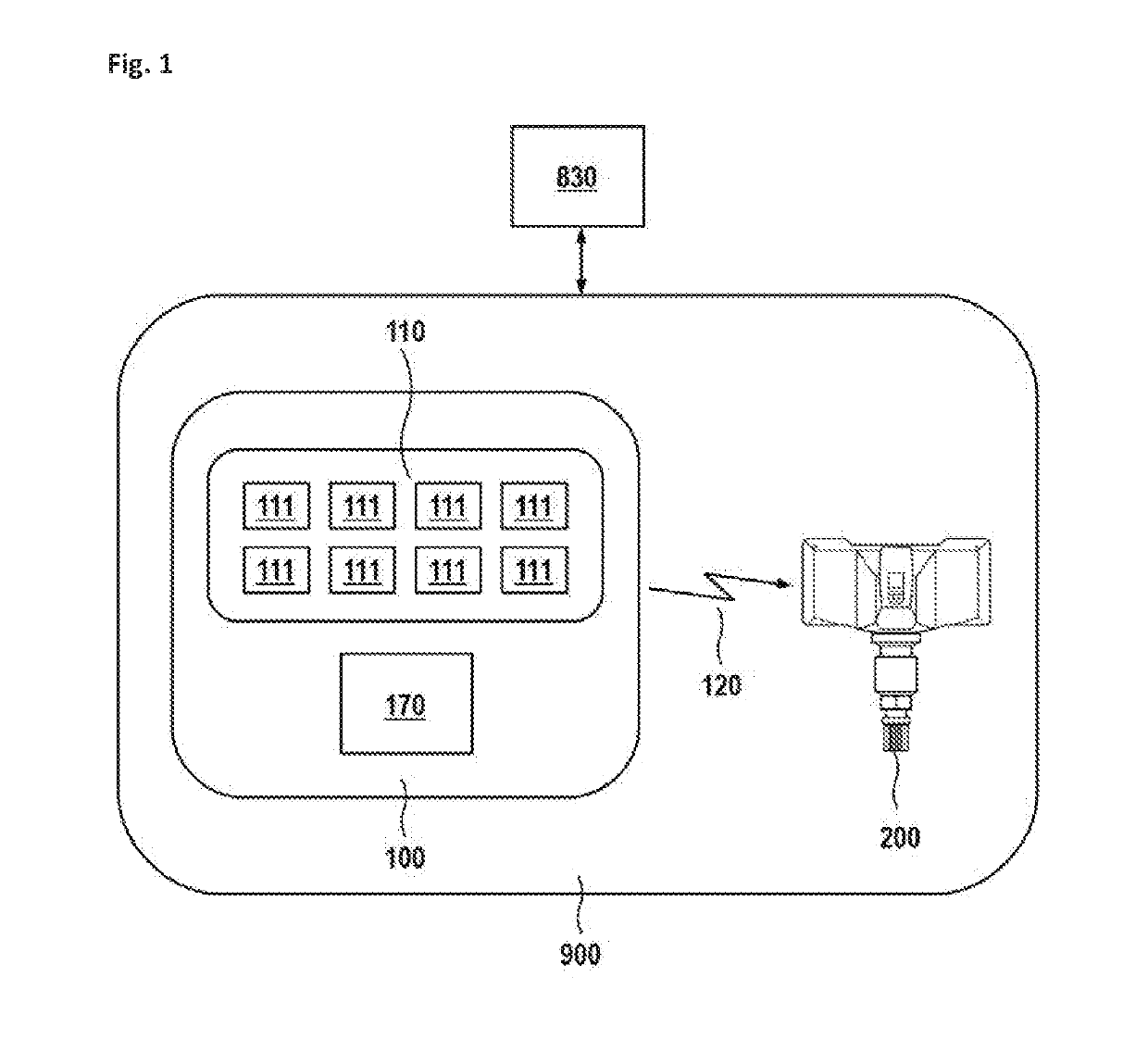
[0052]In FIG. 1 a basic structure and usage of a wheel unit configuration system is shown. A programming unit 100 may have an output device 110, preferably a display or a printer, and an input device 170, preferably a touch screen, a keyboard or a barcode scanner. The output device is configured to provide (present, for example by displaying to) an installer 830 with a plurality of options, for example for selecting a target vehicle within which the wheel unit must operate. The installer may communicate his options selection with the input device. The programming unit will configure the wheel unit, for example via a wireless communication interface 120, to make the wheel unit operate according a specific TPM system used by the vehicle selected by the installer.

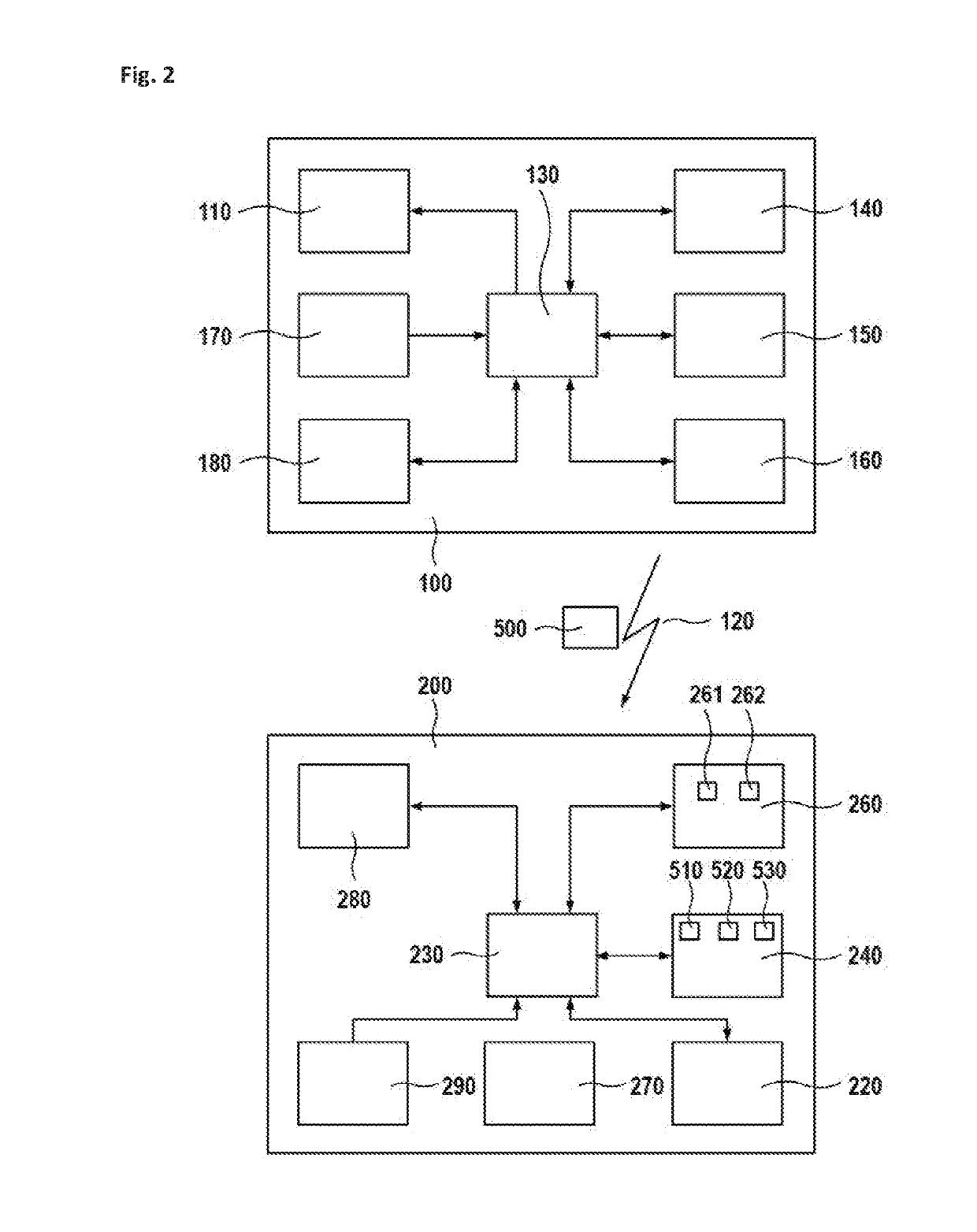
[0053]In FIG. 2, additional details of a wheel unit configuration system are shown. The programming unit 100 preferably has a microcontroller or microprocessor 130 which is further connected to a memory 140 or storage. The mem...

the structure of the environmentally friendly knitted fabric provided by the present invention; figure 2 Flow chart of the yarn wrapping machine for environmentally friendly knitted fabrics and storage devices; image 3 Is the parameter map of the yarn covering machine
Login to View More

PUM

No PUM Login to View More

Abstract

A wheel unit including an environmental pressure sensor, a non-volatile memory for storing a first program and a second program and configuration code, a processing unit for executing the programs, a communication module comprising a wireless transmitter for transmitting at least one parameter indicative of conditions within a tire and a wireless or wired receiver for loading the second program into the non-volatile memory and a battery for powering the wheel unit. The second program may be loaded to the memory by the first program and configured by the configuration code to operate within a specific TPM system.

Description

CROSS-REFERENCE TO RELATED APPLICATIONS[0001]This application is a continuation of the pending International Application No. PCT / EP2017 / 062682 filed on May 24, 2017, which designates the United States and claims priority from the European Application No. 16171701.2 filed on May 27, 2016. The disclosure of each of the above-identified patent applications is incorporated herein by reference.BACKGROUND1. Field of the Invention[0002]The invention relates to tire pressure monitoring sensors (herein referred to, interchangeably, as wheel units) for vehicles and, more particularly, to universal tire pressure monitoring sensors which are configurable to fit a variety of vehicles.2. Description of Relevant Art[0003]A tire-pressure monitoring system (TPMS, or TMP system) is an electronic system for monitoring the air pressure inside a pneumatic tire on various types of vehicles. A TPMS reports in near real-time the tire-pressure information to the vehicle's control system and to the driver. T...

Claims

the structure of the environmentally friendly knitted fabric provided by the present invention; figure 2 Flow chart of the yarn wrapping machine for environmentally friendly knitted fabrics and storage devices; image 3 Is the parameter map of the yarn covering machine
Login to View More

Application Information

Patent Timeline
no application Login to View More
IPC IPC(8): B60C23/04
CPCB60C23/0454B60C23/0455B60C23/0471B60C23/0416B60C23/0462
Inventor WICHER, BARTLOMIEJRIEMANN, ANDREAS
Owner WEGMANN AUTOMOTIVE GMBH
Features
  • R&D
  • Intellectual Property
  • Life Sciences
  • Materials
  • Tech Scout
Why Patsnap Eureka
  • Unparalleled Data Quality
  • Higher Quality Content
  • 60% Fewer Hallucinations
Social media
Patsnap Eureka Blog
Learn More