

Hydrogels for cultivating pancreatic organoids
a pancreatic organ and gel technology, applied in the field of tissue engineering and cell-based therapeutic agents, can solve the problems of tumour-derived matrix not being used in a standard clinical therapy, gel composition and structural variability, and limited cellular therapy for diabetes
- Summary
- Abstract
- Description
- Claims
- Application Information
AI Technical Summary
Benefits of technology
Problems solved by technology
Method used
Image

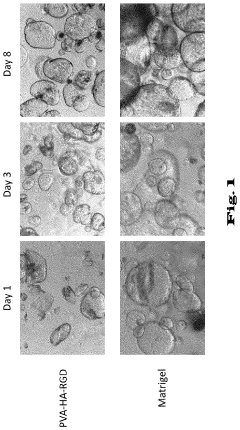
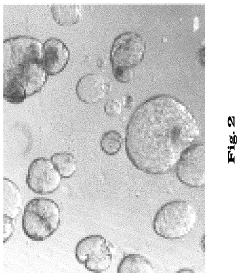
Examples
example 1
creatic Organoid Culture
1. Mouse Pancreatic Growth Medium
[0072]Advanced DMEM / F12 (10 mmol / L HEPES), supplemented with B-27 Supplement (1×), N-Acetylcysteine, R-spondin1 conditioned medium, Nicotinamide, mouse EGF, recombinant FGF10, Noggin, Gastrin (modified after: Boj et al. “Organoid Models of Human and Mouse Ductal Pancreatic Cancer” Cell. 2015; 160 (0): 324-338. doi: 10.1016 / j.cell.2014.12.021)
1. Seeding Mouse Pancreatic Organoids, Previously Grown in Matrigel, into PVA / SH-HA / RGD Hydrogels
1.1 Reagents:
[0073]Mouse pancreatic growth medium: Advanced DMEM / F12 (10 mmol / L HEPES), supplemented with B-27 Supplement (1×), N-Acetylcysteine, R-spondin1 conditioned medium, Nicotinamide, mouse EGF, recombinant FGF10, Noggin, Gastrin (modified after: Boj et al. “Organoid Models of Human and Mouse Ductal Pancreatic Cancer” Cell. 2015; 160 (0): 324-338. doi: 10.1016 / j.cell.2014.12.021)
SG-PVA (Cat. No. M81-3), RGD Peptide (Cat. No. 09-P-001), 10×CB pH 7.2 (Cat. No. B20-3) all obtained from Cell...
example 2
creatic Organoid Culture
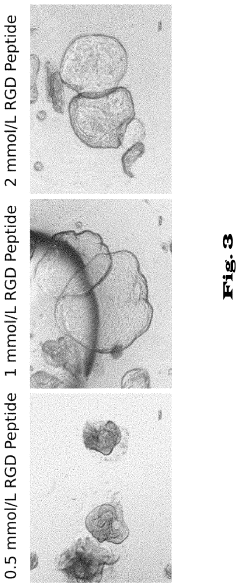
[0100]Human pancreatic organoids were grown in Cultrex BME 2, then transferred into gels with SG-PVA and SH-HA with 1 mmol / L crosslinking and a modification with 0.5 to 2 mmol / L RGD peptide.
1. Seeding Human Pancreatic Organoids, Previously Grown in Cultrex® BME, into PVA / SH-HA / RGD Hydrogels
[0101]Human pancreatic growth medium: Advanced DMEM / F12 (10 mmol / L HEPES), supplemented with B-27 Supplement (1×), N-Acetylcysteine, R-spondin1 conditioned medium, Nicotinamide, mouse EGF, recombinant FGF10, Noggin, Gastrin, and others (modified after: Boj et al. “Organoid Models of Human and Mouse Ductal Pancreatic Cancer” Cell. 2015; 160 (0): 324-338. doi: 10.1016 / j.cell.2014.12.021)
[0102]The procedure of seeding human pancreatic organoids grown in Cultrex BME 2 into PVA / SH-HA / RGD is the same as described for mouse pancreatic organoids. The composition of the hydrogels are given in Table 2 A-C
2. Results
[0103]After two days of culture organoids formed in 1 mmol / L and 2 mmo...
example 3
ulus of Hydrogels
1. Methods:
[0106]The shear moduli G′ of the PVA-PEG-RGD and PVA-HA-RGD hydrogels described in Examples 1 and 2 were determined in a rheometer (Anton Paar MCR 102) at room temperature. The pregel solution was applied to the rheometer and the gel formation was followed by probing with a 25 mm plate at a frequency of 1 Hz and at an angular deflection of 1%.
2. Results:
[0107]After completion of gel formation a shear modulus (G′) of 10 Pa was observed for PVA-HA-RGD gels and of 250 Pa for PVA-PEG-RGD hydrogels.
PUM
 Login to View More
 Abstract
Description
Claims
Application Information
 Login to View More