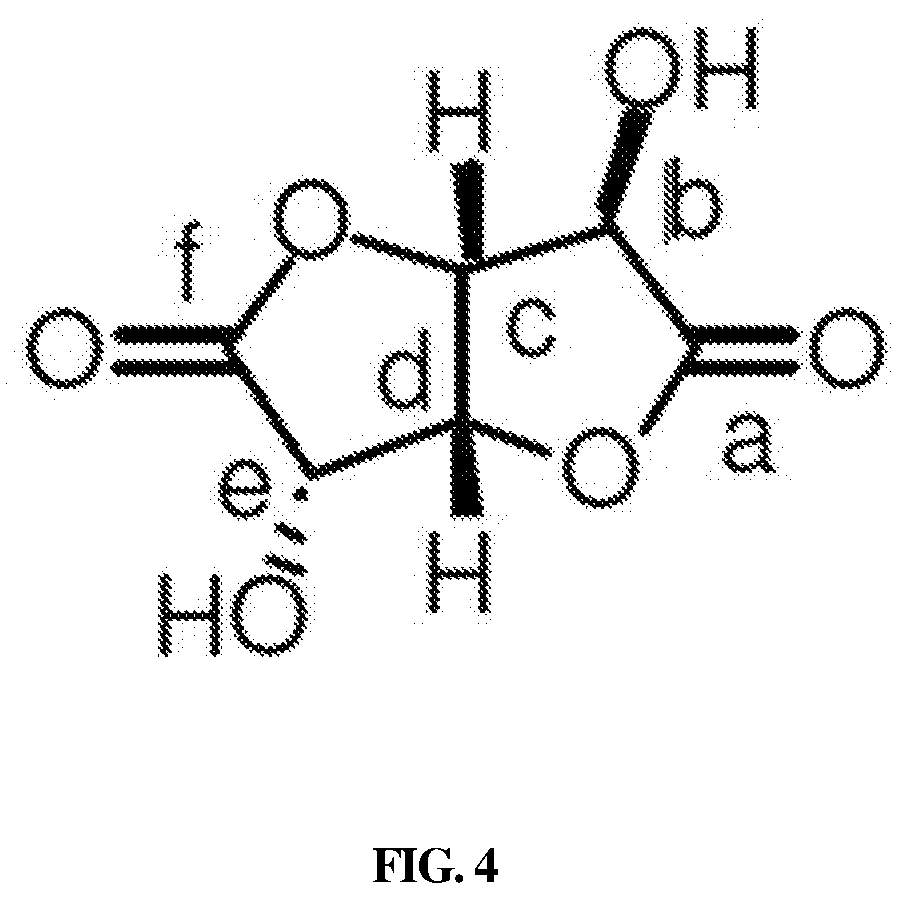
Method of preparing d-glucaro-1,4:6,3-dilactone
- Summary
- Abstract
- Description
- Claims
- Application Information
AI Technical Summary
Benefits of technology
Problems solved by technology
Method used
Image


Examples
preparation example
[0065]Preparation of Potassium Glucarate as Starting Material
[0066]As a starting material, glucose (hydrous glucose, Daesang, Korea) was placed at a concentration of 0.1 g / cc relative to water, serving as a solvent, in a reactor, and potassium hydroxide (Sigma Aldrich, USA) was added in an amount of 0.9 parts by weight based on the amount of glucose. Thereafter, a platinum catalyst (Sigma Aldrich, USA) loaded on activated carbon was added in an amount of 0.3 parts by weight based on the amount of glucose. Thereafter, the reactor temperature was maintained at a temperature of 50° C., and oxygen gas was fed into the reactor such that the pressure was maintained at about 1 bar, and the reaction was allowed to progress for 4 hr. Here, the hydrogen ion concentration was maintained at a pH of 4.
[0067]After completion of the reaction, potassium glucarate, which is an organic acid in a form in which potassium (K+) is bound to the end thereof, was obtained.
[0068]FIG. 3 shows 1H-NMR data of g...
example 1
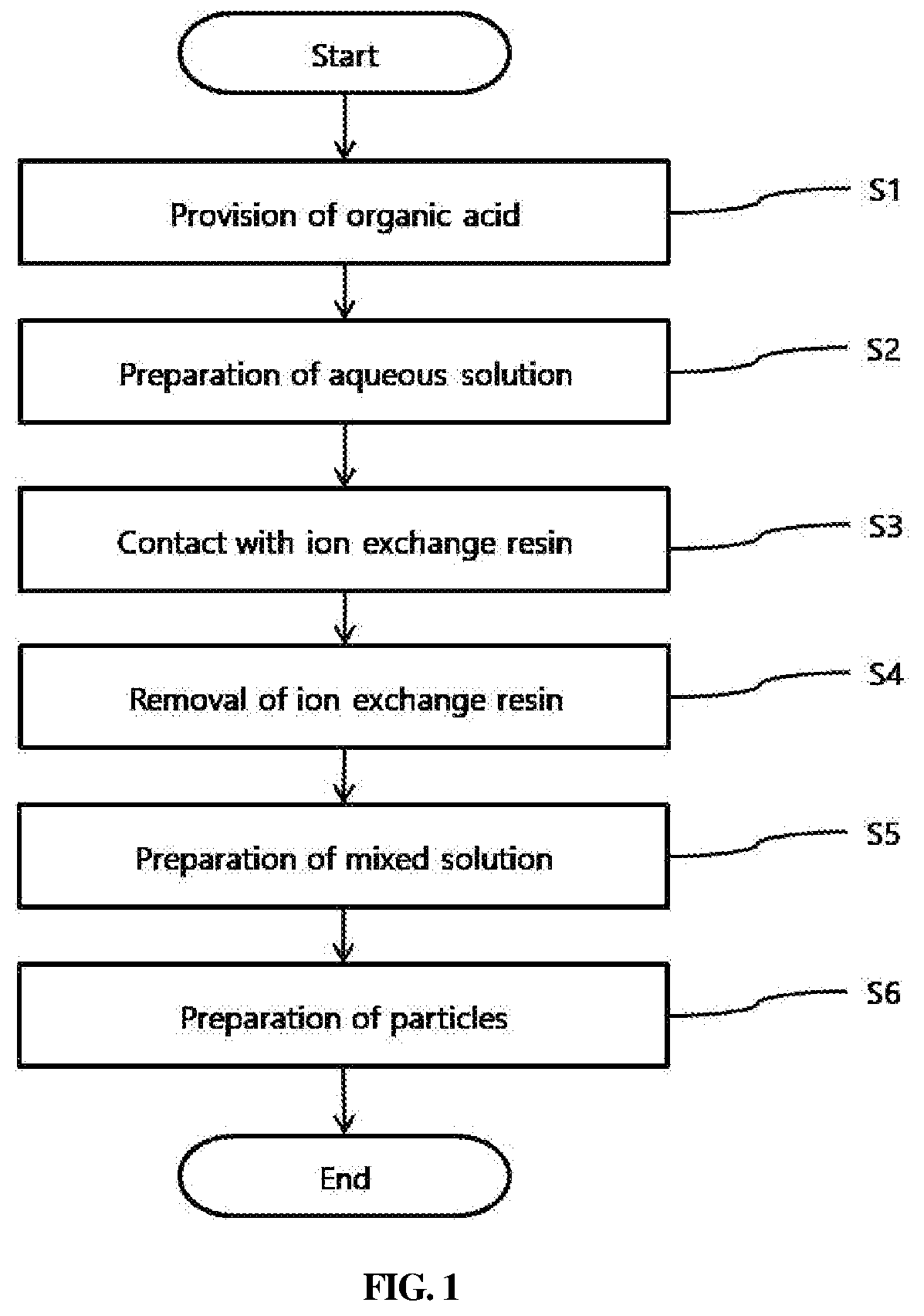
[0069]20 g of potassium glucarate obtained in the above Preparation Example was dissolved in 100 cc of water to give an aqueous solution, after which 40 g of an ion exchange resin (Amberlite® IR120 hydrogen form, Sigma Aldrich) was added to the aqueous solution, followed by contact treatment for 10 hr, and ion exchange resin particles were then removed through filtering using a filter paper.
[0070]The aqueous solution remaining after removal of the ion exchange resin particles was added with 100 cc of 1,4-dioxane (anhydrous, 99.8%, C4H8O2, Sigma Aldrich) and mixed with stirring for 3 hr. After sufficient stirring, the solution was frozen at −70° C. using a cryogenic freezer and then dried for 12 hr using a freeze dryer, after which particles were obtained. The particles thus obtained were subjected to NMR (Nuclear Magnetic Resonance) to analyze the chemical structure of a desired product, from which whether a desired product was obtained was confirmed.
examples 2 to 5
[0071]Particles were prepared in the same manner as in Example 1 under the respective conditions of Examples 2 to 5 shown in Table 1 below. The particles thus obtained were subjected to NMR (Nuclear Magnetic Resonance) to analyze the chemical structure of a desired product, whereby whether a desired product was produced was confirmed.
TABLE 1CompositionExample 2Example 3Example 4Example 5Potassium glucarate (g)22242525Ion exchange resinAmberlite ®45435055(g)IR120 hydrogen formSolvent treatment agent1,4-dioxane105110115120(cm3)Drying typeFreeze drying−70° C.,−70° C.,−70° C.,−70° C.,14 hr16 hr18 hr20 hrSolvent (cm3)Water95105102103
PUM
 Login to View More
 Abstract
Description
Claims
Application Information
 Login to View More
 - R&D
- Intellectual Property
- Life Sciences
- Materials
- Tech Scout
- Unparalleled Data Quality
- Higher Quality Content
- 60% Fewer Hallucinations
Browse by: Latest US Patents, China's latest patents, Technical Efficacy Thesaurus, Application Domain, Technology Topic, Popular Technical Reports.
© 2025 PatSnap. All rights reserved.Legal|Privacy policy|Modern Slavery Act Transparency Statement|Sitemap|About US| Contact US: help@patsnap.com