

Bispecific cytotoxic lymphocyte or macrophage-redirecting autoantibodies, methods for production thereof and methods of treatment
a technology of cytotoxic lymphocytes and macrophages, applied in the direction of peptides, drug compositions, genetically modified cells, etc., can solve the problems of severely suppressing the cytolytic potency of t cell-based therapies, many of the limitations faced by act as a stand alone therapy, and the inability to meet the needs of patients,
- Summary
- Abstract
- Description
- Claims
- Application Information
AI Technical Summary
Benefits of technology
Problems solved by technology
Method used
Image

Examples
example 1
Production of TRAAbs
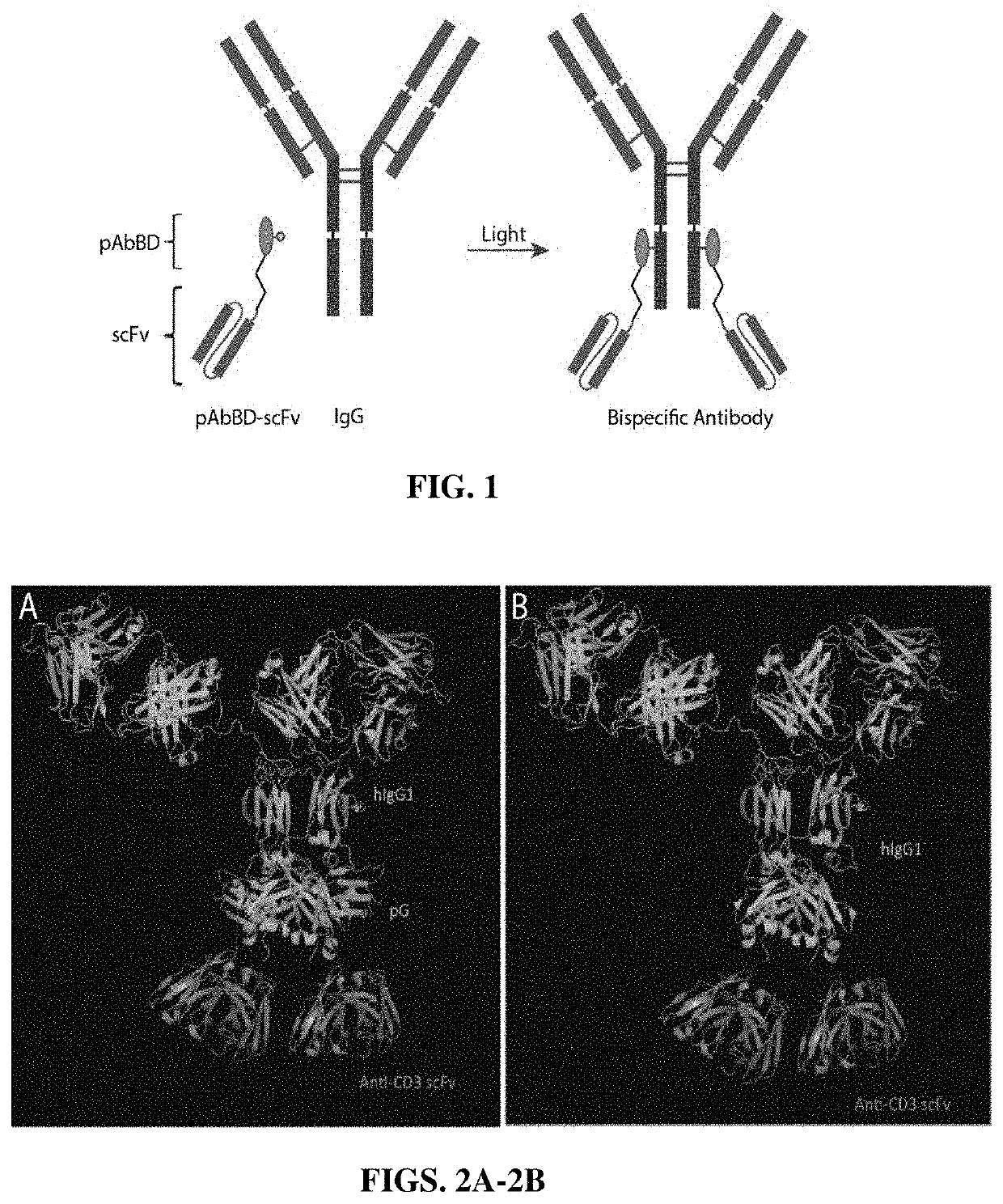
[0060]TRAAbs are generated using a novel, one-step bioconjugation strategy that allows site-specific and covalent attachment of an anti-CD3 single chain variable fragment (scFv) to native human Immunoglobulin G (IgG) (FIG. 1). The TRAAbs production technique relies on a small antibody-binding domain that is engineered to contain a photoreactive unnatural amino acid (benzoyl-phenylalanine, BPA) in its Fc-binding site. The photoreactive antibody-binding domain (pAbBD) is created from a small (˜6.5 kD), thermally stable domain of Protein G (HTB1), as described in Meyer S C, Huerta C, Ghosh I. Single-site mutations in a hyperthermophilic variant of the B1 domain of Protein G result in self-assembled oligomers. Biochemistry. 2005; 44(7):2360-8, and WO2016 / 183387, each of which is incorporated herein by reference in its entirety.
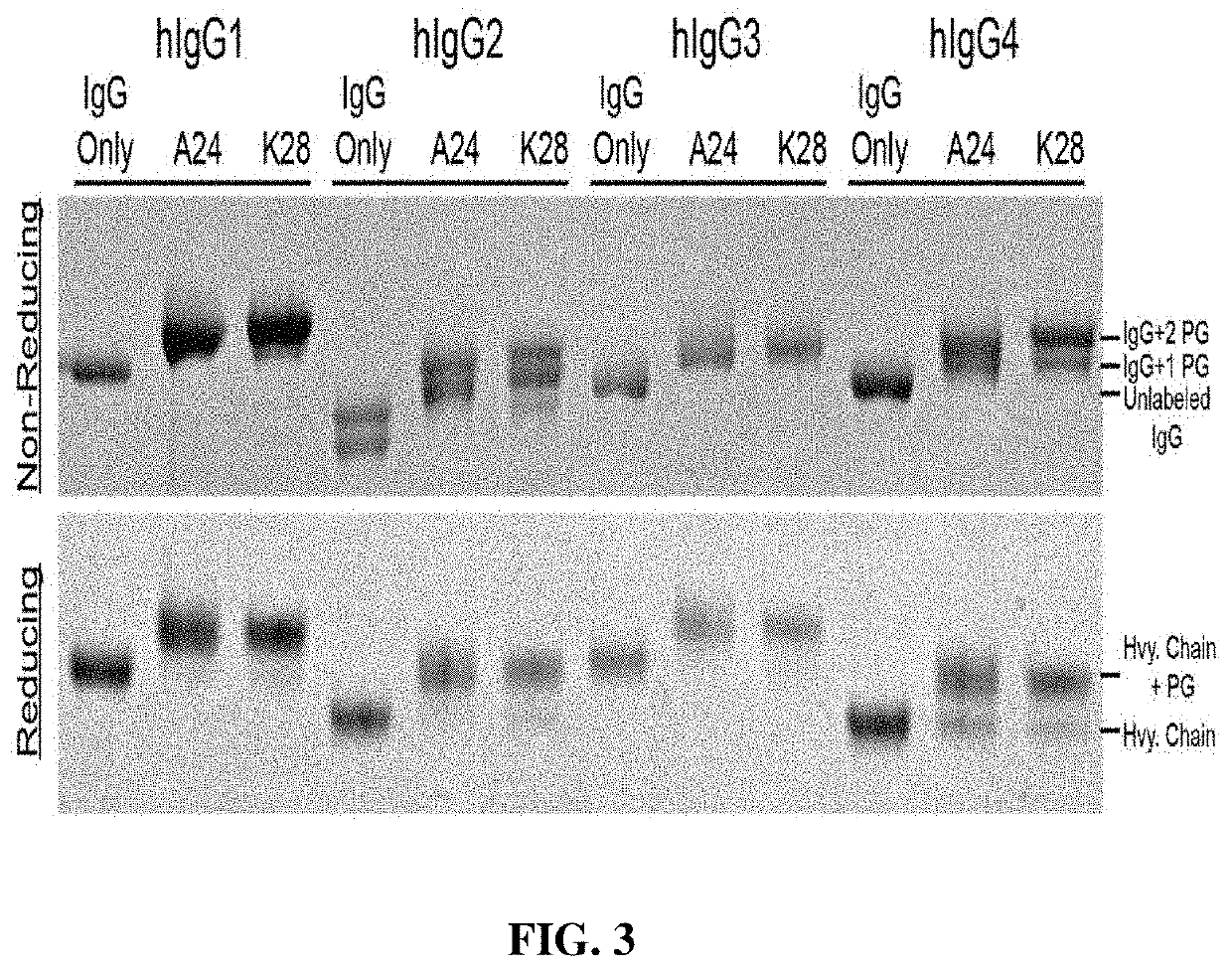
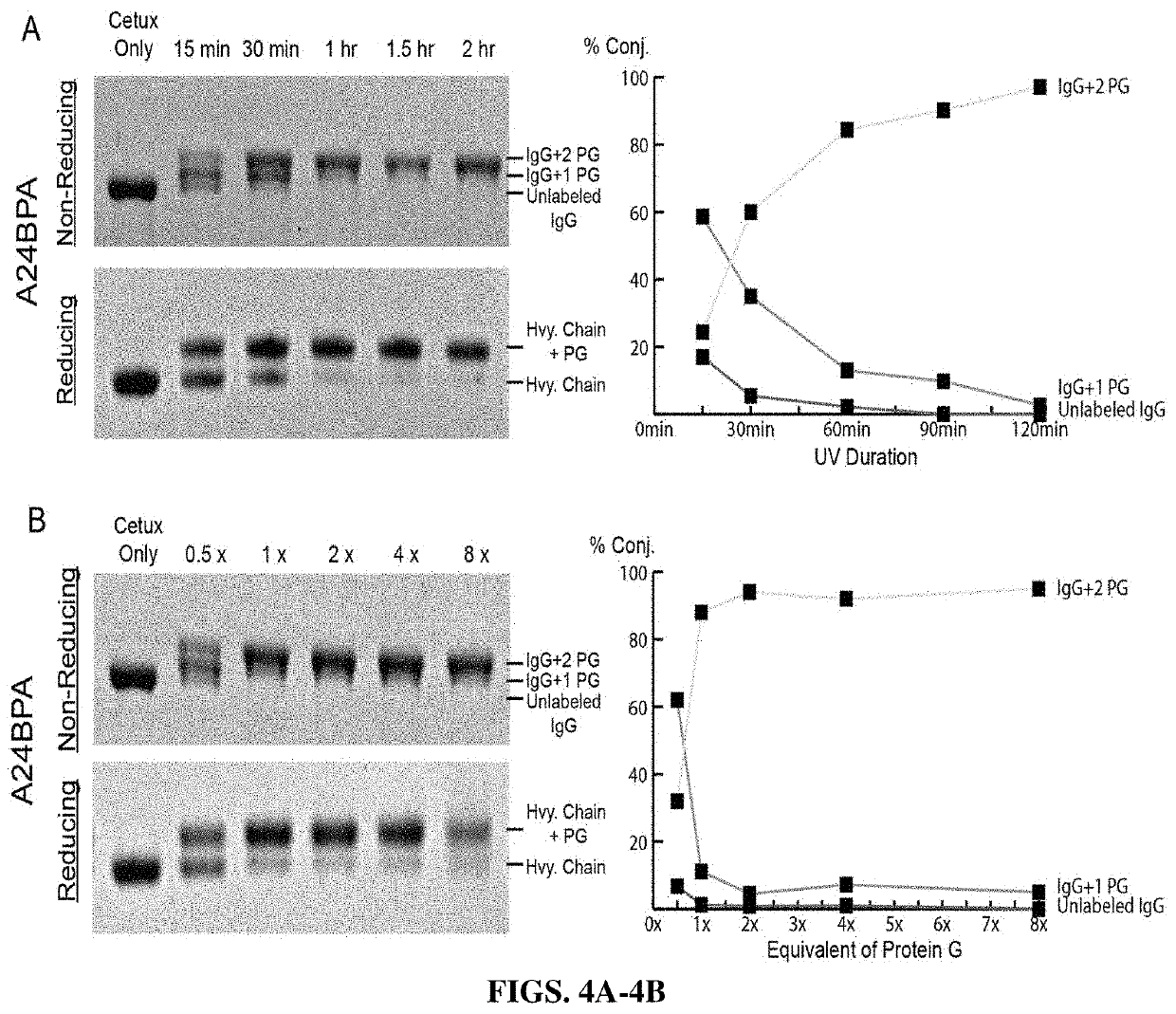
[0061]In WO2016 / 183387, of the nine Protein G variants successfully designed and expressed, two variants, A24BPA and K28BPA, allowed ˜100% of ...
example 2
on of BAbs Using pAbBD-scFv Fusion Proteins, Functionality Chemically-Crosslinked BAbs and TRAAb Therapy in Mouse Model of Breast Cancer
[0063]In Vivo Incorporation of BPA into Protein G HTB1 During Protein Expression:
[0064]To incorporate the unnatural amino acid benzoylphenylalanine (BPA) into the Protein G HTB1 sub-domain during translation, site-directed mutagenesis was used to introduce an amber codon into the IgG binding site of Protein G HTB1. Host E. coli were co-transformed with the plasmids encoding for photoreactive protein G or wild-type protein G and the pEVOL-pBpF plasmid (Addgene), which carries the tRNA / aminoacyl transferase pair, as described by Young T S, et al., An enhanced system for unnatural amino acid mutagenesis in E. coli. J Mol Biol. 2010; 395(2):361-74, which is incorporated herein by reference in its entirety. While wild-type Protein G HTB1 was expressed in the absence of BPA, the mutant containing the amber codon required BPA for expression. There was no d...
example 3
the Composition of Bispecifc T Cell-Redirecting Autoantibodies (TRAAbs)
[0080]Autoantibodies isolated from mice that have been vaccinated with breast cancer cells will be transformed into TRAAbs. Anti-CD3 single-chain variable fragments (scFv) will be used to confer specificity for T cells.
[0081]TRAAbs will be prepared using three different anti-CD3 scFvs (OKT-3, UCHT1, and SP34) and three different linker lengths between the antibody and scFv. In particular, five different anti-CD3 scFv constructs will be studied, three with scFvs against unique CD3 epitopes (OKT-3, UCHT1, and SP34) and two additional OKT-3 scFv constructs with different linker lengths between the scFv and IgG, as shown in Table 1.
TABLE 1Summary of anti-CD3 scFvsscFv OriginLinkerSpecificityOKT3(GGS)2CD3ϵγ and CD3ϵδOKT3(GGS)3CD3ϵγ and CD3ϵδOKT3(GGS)5CD3ϵγ and CD3ϵδUCHT1(GGS)3CD3ϵγ and CD3ϵδ
[0082]The biophysical properties (i.e., solubility, stability, tendency to form aggregates) of each TRAAb will be evaluated and a...
PUM
| Property | Measurement | Unit |
|---|---|---|
| Cell death | aaaaa | aaaaa |
| Cytotoxicity | aaaaa | aaaaa |
| Thermal stability | aaaaa | aaaaa |
Abstract
Description
Claims
Application Information
 Login to View More