This helps you quickly interpret patents by identifying the three key elements:
Problems solved by technology
Method used
Benefits of technology
Benefits of technology
The patent is about a process for making coke by heating a secondary feedstock and allowing it to react in a coking drum for a longer time. This results in a higher quality coke that can be used for various purposes.
Problems solved by technology
The production and supply of anisotropic coke has been limited by availability of potential hydrocarbon feedstock, which is desired to have high aromatic content and low sulfur content.
Method used
the structure of the environmentally friendly knitted fabric provided by the present invention; figure 2 Flow chart of the yarn wrapping machine for environmentally friendly knitted fabrics and storage devices; image 3 Is the parameter map of the yarn covering machine
View more
Image
Smart Image Click on the blue labels to locate them in the text.
Viewing Examples
Smart Image
Click on the blue label to locate the original text in one second.
Reading with bidirectional positioning of images and text.
Smart Image
Examples
Experimental program
Comparison scheme
Effect test
example 1
[0128]Clarified oil with properties provided in Table 1, was taken for batch mode extraction as per procedure explained below.
[0129]100 kg CLO with properties as given in Table 1 was split into two fractions in 9:1 ratio. The 10 kg CLO was subjected to aromatic extraction using NMP as solvent at 45° C. temperature in bench scale batch extractor unit. The remaining 90 kg of CLO was subjected to distillation to remove lighters of ˜6 wt % and the heavier portion was subjected to hydrotreatment at 340° C. temperature and 42 Bar pressure. The final feed blend was prepared by mixing the Desulfurized CLO and Aromatic extract samples and the properties are provided in Table 2.
[0130]One experiment was carried out by using the clarified oil feedstock blend as provided in Table 2 in Batch-Coker unit and the coke generated was calcine...
example 2
[0131]Clarified oil with properties provided in Table 4, was taken for batch mode extraction as per procedure explained below.
[0132]100 kg CLO with properties as given in Table 4 was split into two fractions in 9:1 ratio. The 10 kg CLO was subjected to aromatic extraction using NMP as solvent at 45° C. temperature in bench scale batch extractor unit. The aromatic extract was separated. The remaining 90 kg of CLO was subjected to distillation to remove lighters of ˜6 wt % and the heavier portion was subjected to hydrotreatment at 340° C. temperature and 42 Bar pressure. The final feed blend was prepared by mixing the Desulfurized CLO and Aromatic extract samples and the properties are provided in Table 5.
[0135]100 kg CLO with properties as given in Table 7 was split into two fractions in 9:1 ratio. The 10 kg CLO was subjected to aromatic extraction using NMP as solvent at 45° C. temperature in bench scale batch extractor unit. The aromatic extract was separated.
[0136]The remaining 90 kg of CLO was subjected to distillation to remove lighters of ˜6 wt % and the heavier portion was subjected to hydrotreatment at 340° C. temperature and 42 Bar pressure.
[0137]The final feed blend was prepared by mixing the Desulfurized CLO and Aromatic extract samples and the properties are provided in Table 8.
[0138]One experiment was carried out by using the clarified oil feedstock blend as provided in Tabl...
the structure of the environmentally friendly knitted fabric provided by the present invention; figure 2 Flow chart of the yarn wrapping machine for environmentally friendly knitted fabrics and storage devices; image 3 Is the parameter map of the yarn covering machine
Login to View More
PUM
Login to View More
Abstract
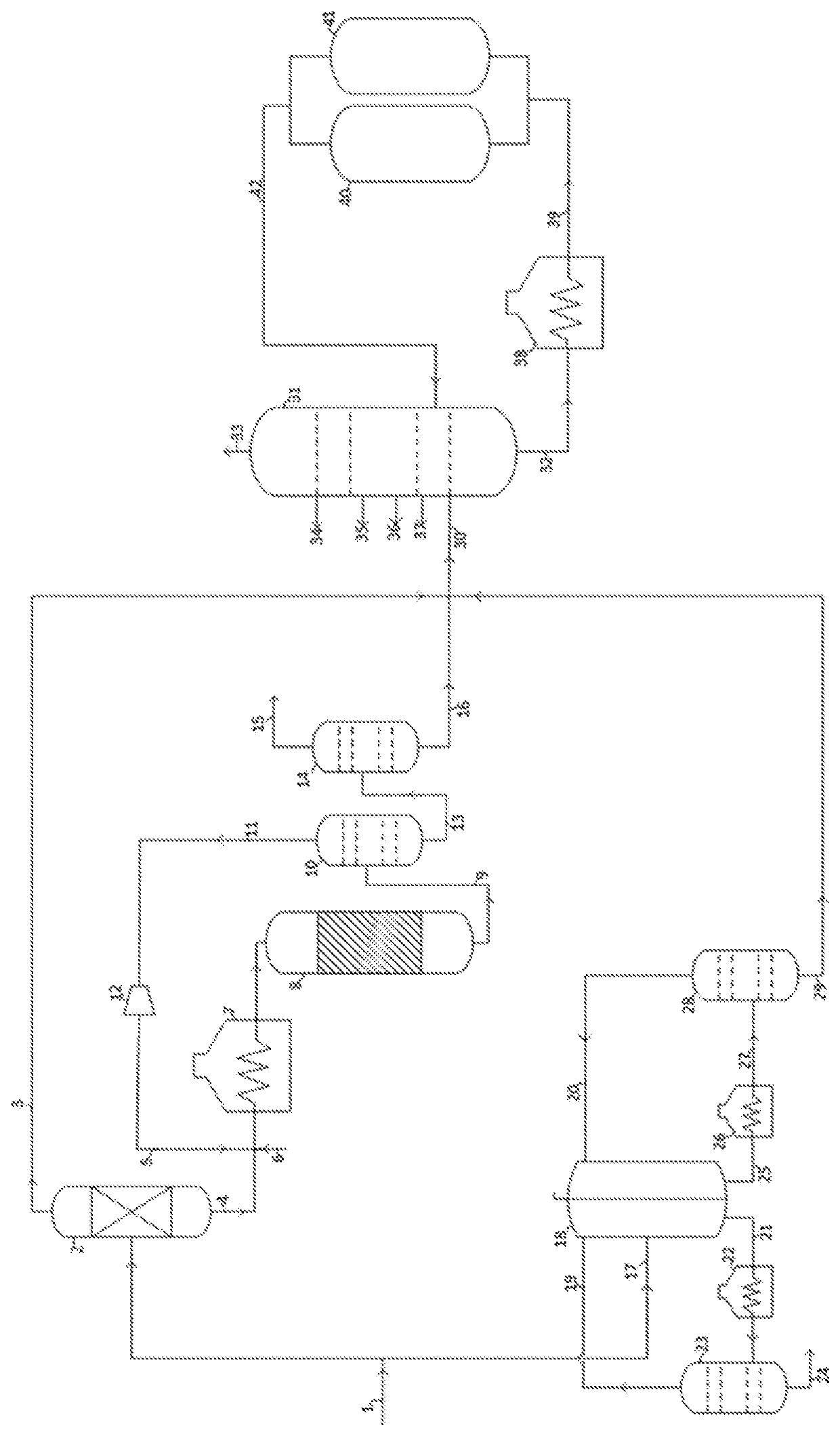
The present invention relates to a process for production of anisotropic coke from a hydrocarbon feedstock and a system for producing the same. More particularly, the present invention relates to a thermal cracking of heavy petroleum residue producing petroleumcoke and lighter hydrocarbon products. The invented process utilizes a novel scheme for production of a premium quality coke from primarily, a clarified oil feedstock. Clarified oil from fluid catalytic cracking unit is routed through a process scheme comprising a separator column, hydro-treatment section and an aromatic extraction section to create an ad-mix of effluents which form the feedstock to a thermal cracking unit. Premium quality anisotropic coke is produced in the thermal cracker reactor drums under tailor made process conditions employing the said feedstock.
Description
FIELD OF THE INVENTION[0001]The present invention relates to a process for production of anisotropic coke from a hydrocarbon feedstock and system for producing the same. More particularly, the present invention covers a thermal cracking process, used to crack heavy hydrocarbon molecules, thus converting it into gaseous and liquid product streams and leaving behind solid, carbonaceous petroleum coke. The invention in particular relates to a process for production of anisotropic coke suitable for manufacturing graphite electrodes, which can be used in electric arc furnace for production of steel and in batteries for electric vehicles.BACKGROUND OF THE INVENTION[0002]Delayed Coking process is a severe thermal cracking process for converting low value heavy residual hydrocarbon feedstock into lighter hydrocarbon products and solid coke. Based on the characteristics of the feedstock and operating conditions, different qualities of coke namely, Fuel grade, Anode grade and Needle grade / Ani...
Claims
the structure of the environmentally friendly knitted fabric provided by the present invention; figure 2 Flow chart of the yarn wrapping machine for environmentally friendly knitted fabrics and storage devices; image 3 Is the parameter map of the yarn covering machine
Login to View More
Application Information
Patent Timeline
Application Date:The date an application was filed.
Publication Date:The date a patent or application was officially published.
First Publication Date:The earliest publication date of a patent with the same application number.
Issue Date:Publication date of the patent grant document.
PCT Entry Date:The Entry date of PCT National Phase.
Estimated Expiry Date:The statutory expiry date of a patent right according to the Patent Law, and it is the longest term of protection that the patent right can achieve without the termination of the patent right due to other reasons(Term extension factor has been taken into account ).
Invalid Date:Actual expiry date is based on effective date or publication date of legal transaction data of invalid patent.


 Login to View More
  Login to View More