

Regenerable battery electrode
a battery electrode and battery technology, applied in the field of rechargeable battery electrodes, can solve the problems of irreversible capacity loss, long electrode cycle lifetime of libs, significant cathode degradation factor, etc., and achieve the effect of restoring capacity to the electrode and increasing capacity
- Summary
- Abstract
- Description
- Claims
- Application Information
AI Technical Summary
Benefits of technology
Problems solved by technology
Method used
Image

Examples
example 1
Characterization
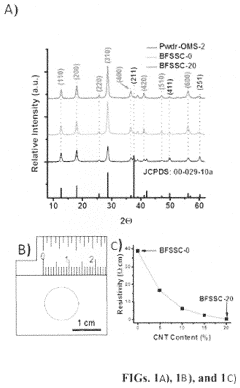
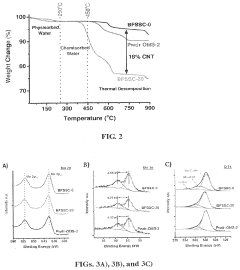
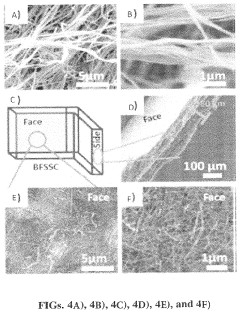
[0057]Potassium containing cryptomelane type OMS (OMS-2) fibers were synthesized by the redox reaction between Mn2+ and S2O82− under hydrothermal conditions. Binder-free self-supporting cathode (BFSSC) materials were prepared by dispersing the fibers with varying amounts of multiwall carbon nanotube (CNT) in NMP and filtering through a glass membrane. For comparison, as made OMS-2 fibers were grounded to fine powder and labeled as Pwdr-OMS-2. FIG. 1A shows the X-ray diffraction (XRD) patterns of BFSSC with 0 and 20% w.t CNT and pwdr-OMS-2. Diffractions lines of both BFSSC and pwdr-OMS-2 are in agreement with the tetragonal cryptomelane phase (JCPDS file number 29-1020) with substantially no detected impurities. One difference between BFSSCs and pwdr-OMS-2 (and the standard pattern) may be the higher relative intensities of (hk0) diffraction lines compared to (001) lines. The (hk0) crystallographic planes may be parallel to the 2×2 tunnels. Therefore, higher intensiti...
example 2
emical Characterization of BFSSCs
[0066]Electrochemical performance of BFSSCs as cathodes in lithium ion batteries was investigated via galvanostatic charge-discharge tests. For the tests, experimental coin cells were assembled using BFFSCs directly. For comparison, a prior art composite coating on aluminum foil was prepared from pwdr-OMS-2 sample. The cells were charged / discharged in a voltage range of 2.0-3.9 V and at two different current densities; 0.09 mA / cm2 (FIG. 5) and 0.45 mA / cm2. FIG. 5A shows the cycling performance of pwdr-OMS-2, BFSSC-0, and BFSSC-20 over 100 cycles. In the figure, the capacity of pwdr-OMS-2 was calculated both 30 per gram of cathode (solid triangle) and per gram of active material (open triangle) and capacities of BFSSCs were calculated per gram of cathode. The discharge capacities of BFSSC-20, BFSSC-0, and pwdr-OMS-2 are 107, 62, and 35 mAh / g at initial discharge and 53, 20, and 10 mAh / g at 100th cycle, respectively. BFSSC-20 showed the highest gravime...
example 3
[0069]The regeneration of electrodes was conducted in order to restore the behavior of the cell. The electrodes were removed from the cells after the capacity had decreased from the initial cell capacity after cycling. The electrodes were heat treated at 200, 300 or 350° C. under air. The same electrodes were reinserted into active electrochemical cells and cell testing was resumed, FIG. 8.
[0070]Prior to regeneration, the delivered capacities from the cells were below 60 mAh / g. After heat treatment the cell capacities were above 100 mAh / g. In particular, as the cells resumed cycle testing under constant current, the capacity of the regenerated electrodes remained at a high level. The control cell had a delivered capacity of ˜30 mAh / g while the regenerated cells had delivered capacities of ˜60-70 mAh / g, 2× that of the control cell.
[0071]Thus, the regeneration process may be able to restore capacity to the electrode. The capacity increase as a result of regeneration ma...
PUM
| Property | Measurement | Unit |
|---|---|---|
| charge | aaaaa | aaaaa |
| weight ratio | aaaaa | aaaaa |
| temperature | aaaaa | aaaaa |
Abstract
Description
Claims
Application Information
 Login to View More