Although scanning
electron microscopic (SEM) images of such structures clearly show that small lengths of wire are self supporting, longer lengths of wire are not self-supporting.
So, longer lengths of unsupported wire are susceptible to shorting.
This approach reduces, but does not eliminate shorting in an air dielectric IC structure.
The above examples of the prior art incur a substantial wiring density penalty because the support pillars extend through several wiring levels, all the way up from an underlying substrate.
However, any dielectric must be removed after the planar layer is formed by complex venting and filling steps or the dielectric is trapped under the permanent planar layer.
Unfortunately, Aitken stud opening diameters must be significantly wider (twice the thickness of the
dielectric tube) than the studs themselves, which must be significantly larger than the minimum
process dimension.
Further,
circuit design is more complicated because the wiring and the support pedestals must be accounted for on each wiring level.
Materials used in prior art methods are exotic and, so, are expensive to develop and difficult to remove.
Parylene has a low
decomposition temperature, which severely restricts the materials that can be used for the freestanding structures.
Furthermore, typical prior art methods use aqueous chemicals to etch the removable material.
It is uncertain whether these aqueous chemicals can penetrate the convoluted paths to regions buried deep within the wiring that must be cleared of removable dielectric.
In particular, when dielectric removal is deferred until the end, or, for structures with vented planar layers such as U.S. Pat. No. 5,324,683 to Fitch et al. entitled "Method of Forming a
Semiconductor Structure having an Air Region" (which is even more complex than Kaanta), these aqueous chemicals penetrate vent holes with considerable difficulty.
Further, after reaction and
drying, the reaction products may not be removed completely from the nearly enclosed air dielectric compartments.
These small openings make it difficult for reactants to diffuse in, or for waste products to diffuse out, when the cavities are filled with a liquid.
Additional problems arise when aqueous HF is used to remove oxides from the exposed
metal lines.
Electrochemical potentials further contribute to
corrosion of one
metal of the composite.
Such an
attack can result in open electrical circuits, higher line resistivity, and the metal lines separating from their supports.
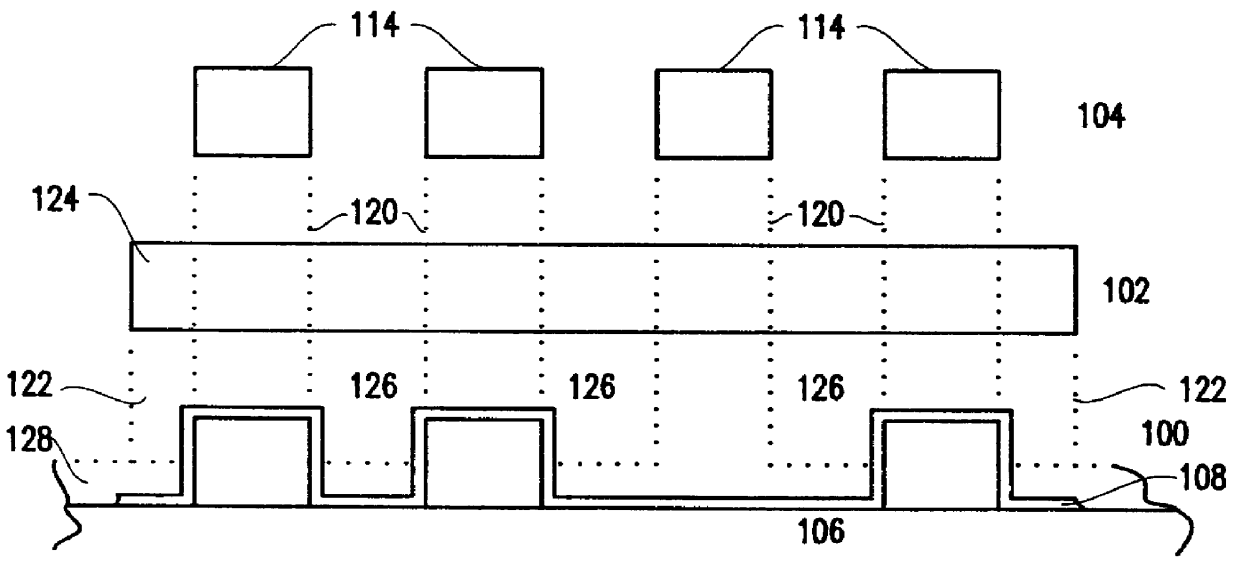
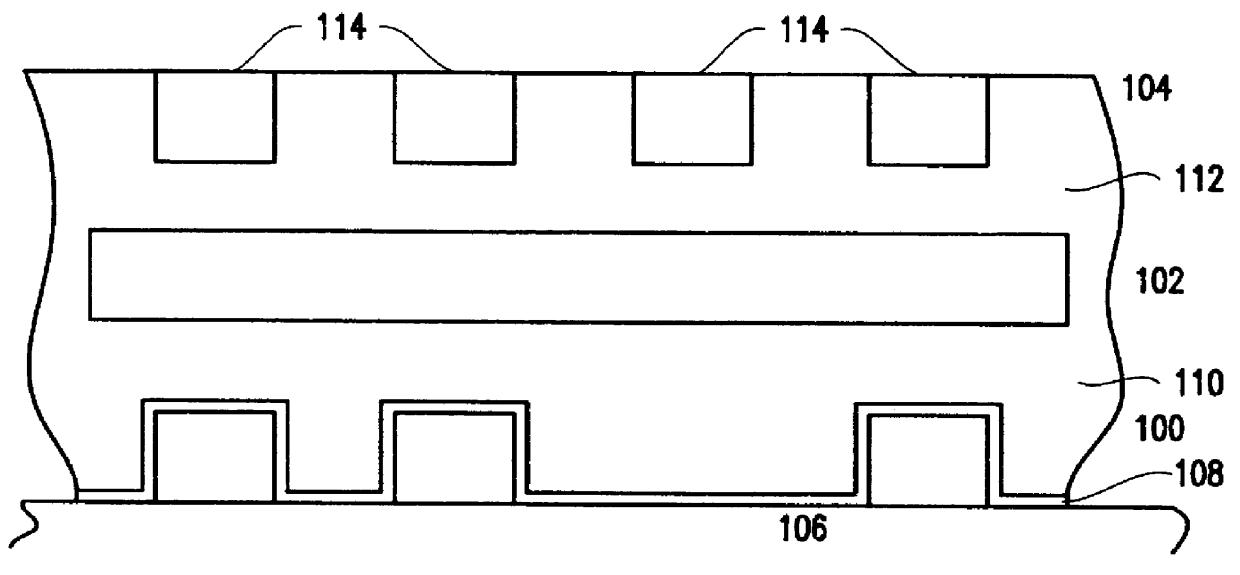
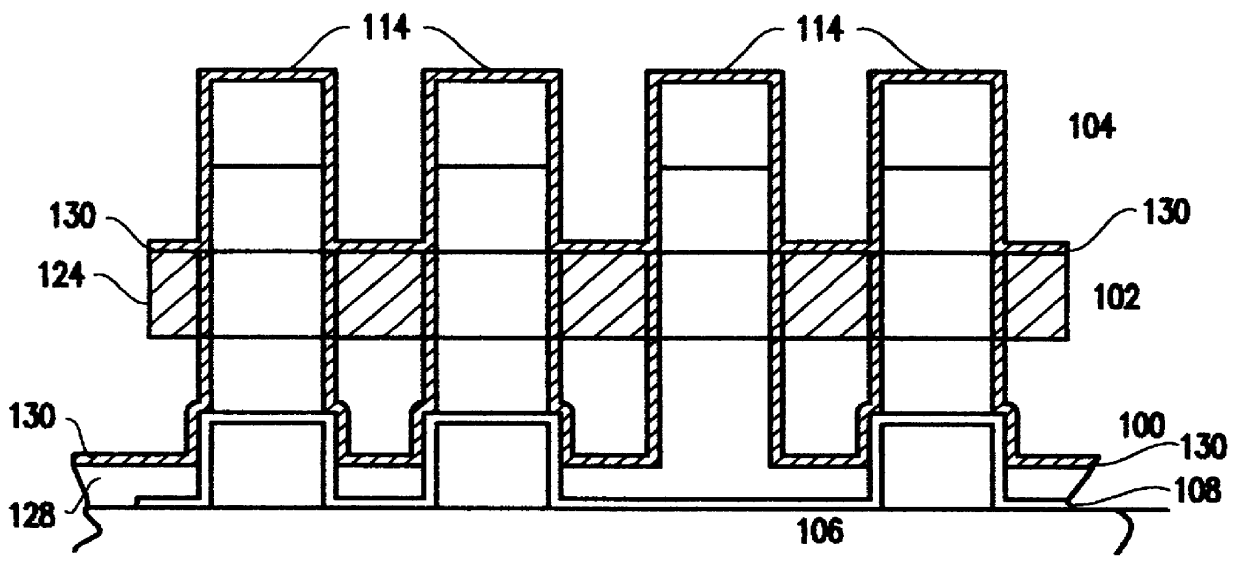
Because sidewalls are formed after wiring, with the wiring at each level providing support definition, complex support alignment is unnecessary.


 Login to View More
  Login to View More