However, a body energy absorber which consists of an Al alloy extruded hollow shape with a virtually rectangular sectional profile has the following problem: if it is used for rear bumper reinforcement, its bending strength may be insufficient with respect to the virtually
horizontal force (of vehicle collision) applied to the body energy absorber when the body collides against a pole.
However, if the strength of the Al alloy shape is increased, it might be more difficult to make shapes by
extrusion or bending and such shapes might be more likely to crack, resulting in less collision
energy absorption.
Also, an increase in the thickness of the Al alloy shape or the width of the bumper reinforcement will lead to an increase in weight, which means that the
lightness of Al alloy is traded off for increased strength.
If the thickness of the Al alloy shape should be simply increased, the maximum load (force) of a collapsing bumper reinforcement might be larger than the permissible maximum load for side members, and it would be very likely to damage body members such as front side members.
Yet still, because the weight of the hollow shape reinforcement with a closed sectional profile is added, the problem of weight increase remains in comparison with the case of absence of an auxiliary reinforcement.
However, the auxiliary reinforcement has a hollow structure with a closed sectional profile and uses inner ribs (props) to reinforce it, so the collapse strength of the auxiliary reinforcement is rather high.
Therefore, if the wall thickness of the bumper reinforcement main body is decreased as stated above, upon collision against a pole or in a similar situation, the bumper reinforcement main body might collapse earlier than the auxiliary reinforcement.
Further, because the auxiliary reinforcement is a hollow shape with a closed sectional profile, it is virtually impossible to join it to the bumper reinforcement main body mechanically or using bolts or the like or by
welding.
Consequently, the fixing method which uses glue as described in the gazette is unavoidable.
However, gluing is much more unreliable as a method for fixing a vehicle structural member than a mechanical fixing method or
welding.
Even when the contact surfaces of both are matched, there still remains another problem: how they should be joined and fixed.
However, these conventional joining / fixing methods have drawbacks.
First of all, they are impractical and sometimes even ineffective.
In the above-said conventional methods, it is practically difficult to put a bolt into the inside of the bumper reinforcement and stay which are both hollow and have a closed sectional profile.
It is even more difficult for a bumper reinforcement with a curved portion at each end.
It is also practically difficult to let the bolt's top and bottom stay in the hollows with the bolt passed through them as suggested by the conventional methods.
Further, it is unrealistic to join and fix the stay to the front of the side member according to the prior art for the following reasons.
One reason is that it is difficult to position the above-said hollow attachment on the side member in the car body widthwise direction.
Besides, even if the hollow attachment is once positioned on and engaged with the side member, it is difficult to let the bolt's top or bottom stay in the hollow of the side member or stay attachment with the bolt passed through them horizontally from the side of the car body.
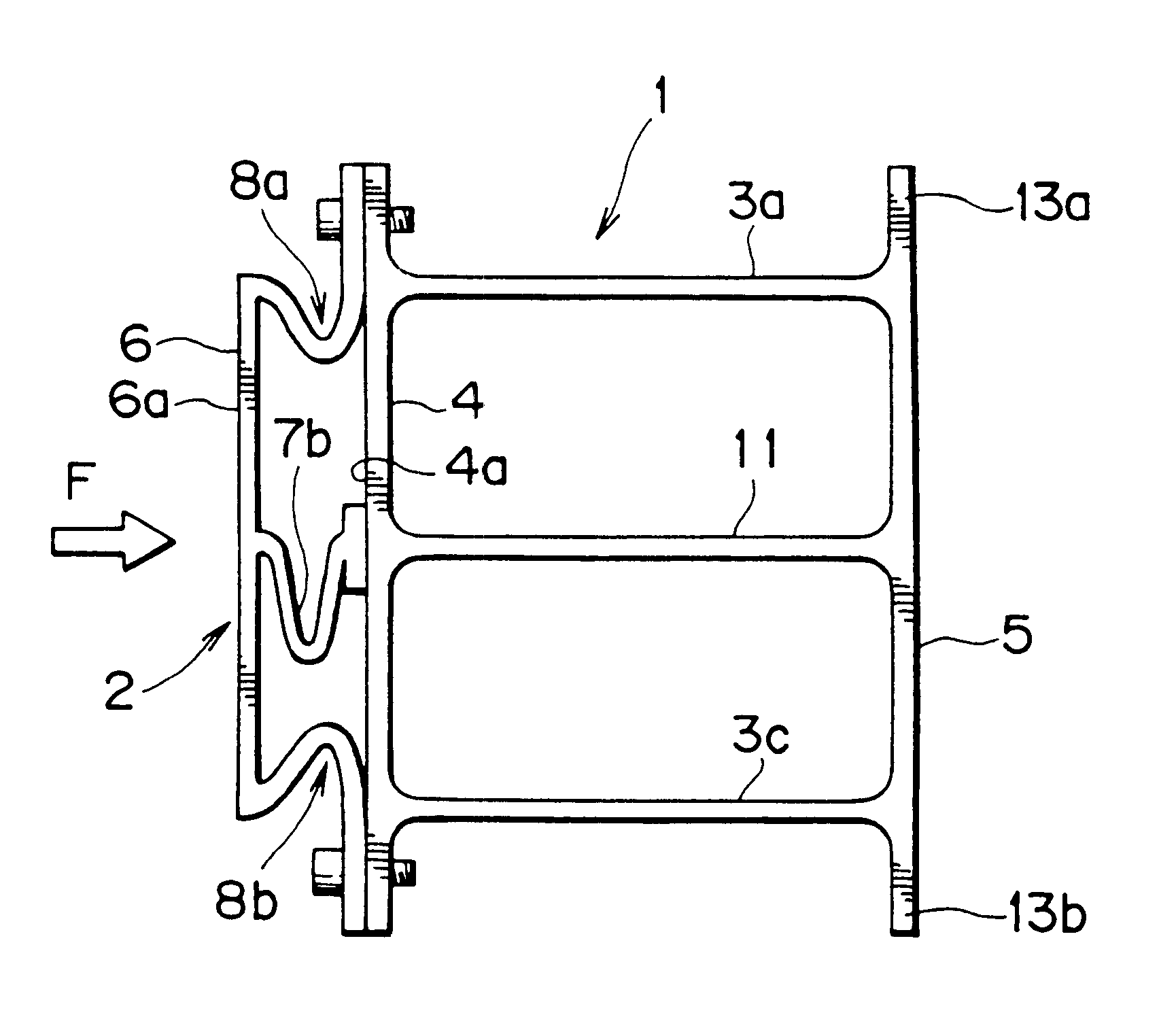
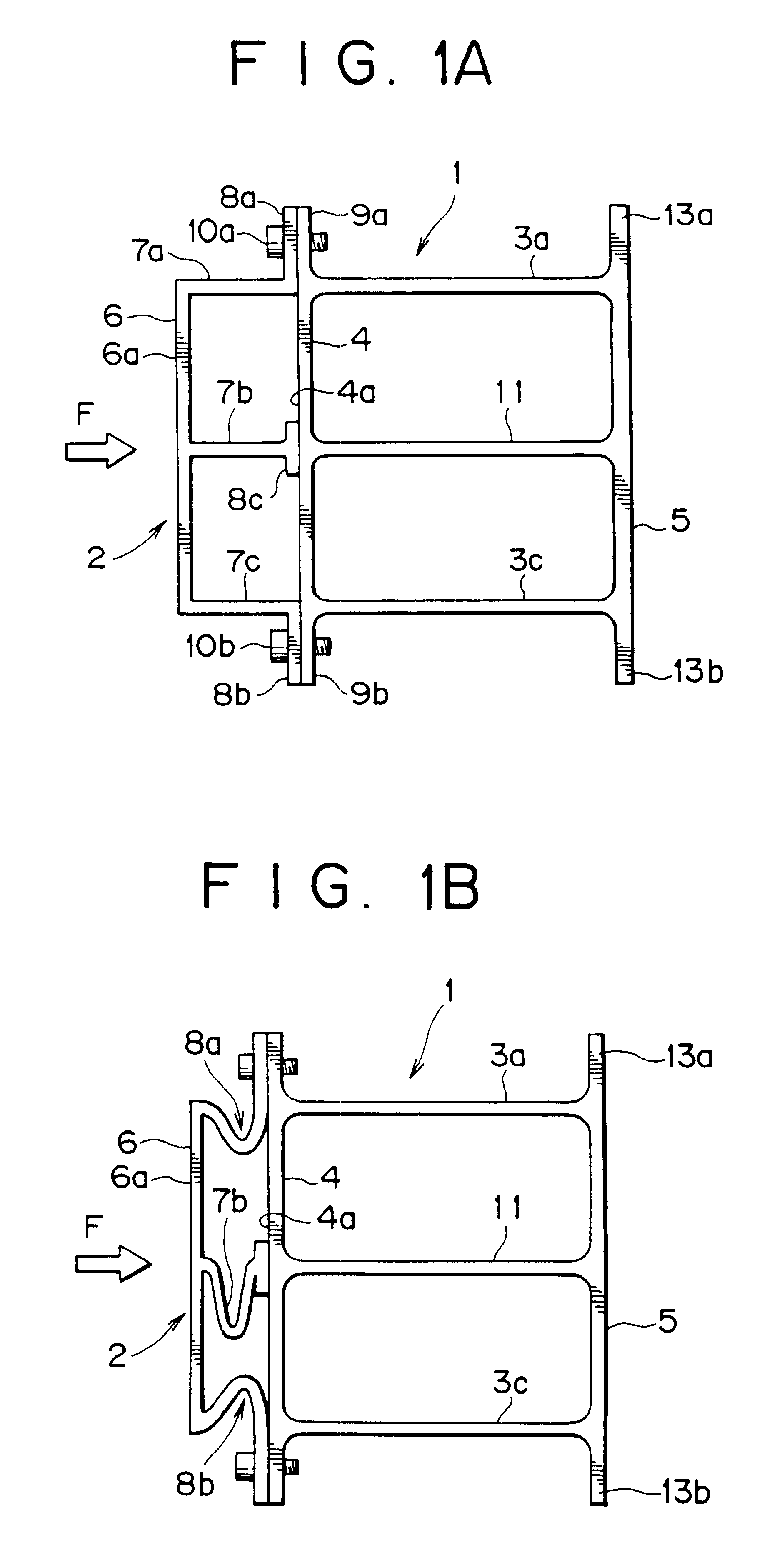
Firstly, since the hollow shape and the reinforcing shape are aluminum alloy extruded shapes, the overall weight of the absorber is smaller and the weight increase due to the addition of the reinforcing shape is also relatively small.
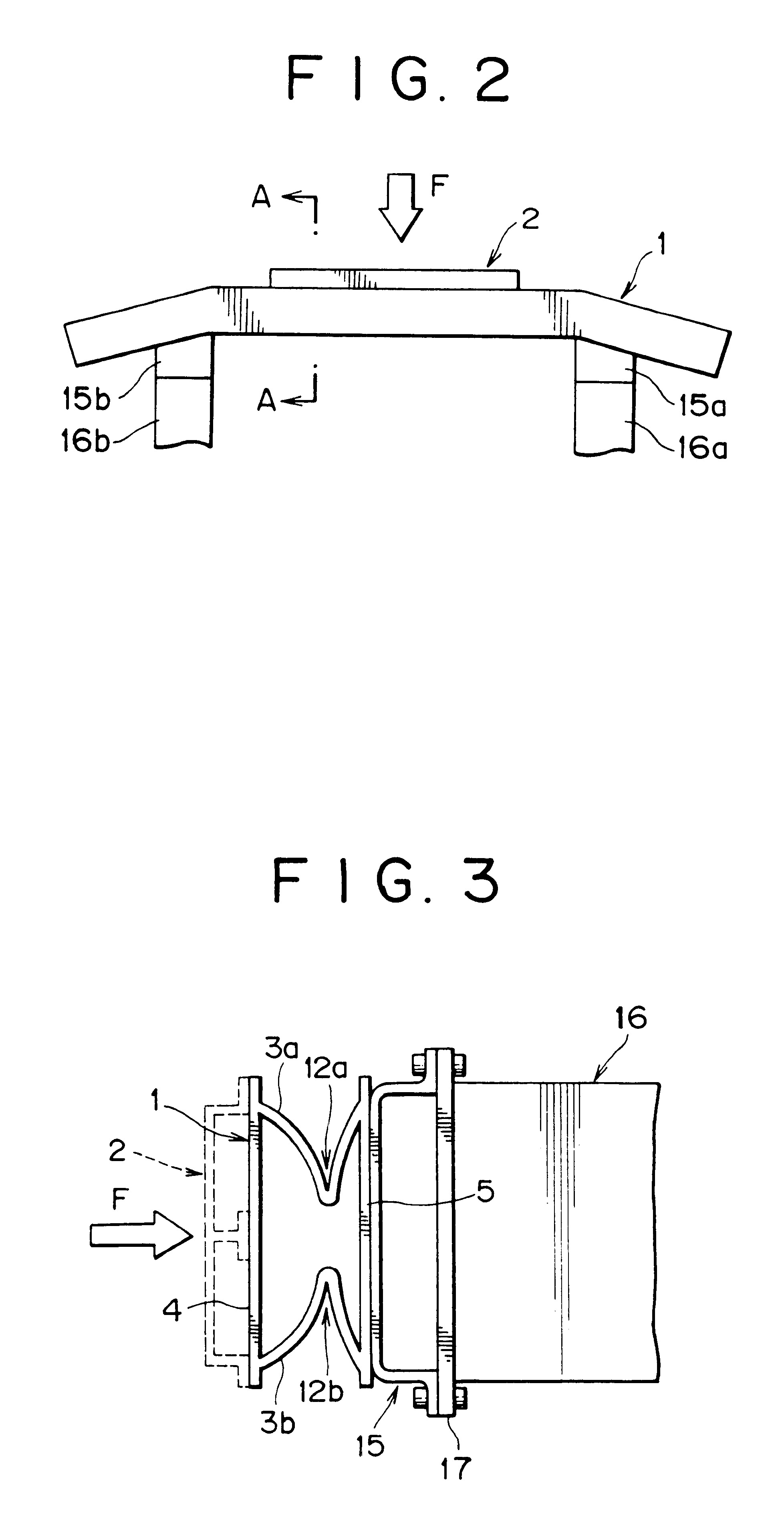
However, if the stay has a hollow, closed sectional profile, it would be difficult to attach it to the side member.
However, this method makes attachment of the reinforcing shape 2 to it and its attachment to the car body as mentioned later complicated.
Thus, in order to join them by a simpler method, it would be necessary to rely on glue as in the method (described earlier) disclosed by J-P-A-No. 286536 / 1994, which would make the connection less reliable.


 Login to View More