Check patentability & draft patents in minutes with Patsnap Eureka AI!

Watermarking of digital images using wavelet and discrete cosine transforms

Inactive Publication Date: 2005-12-13
MARKANY
View PDF9 Cites 36 Cited by
  • Summary
  • Abstract
  • Description
  • Claims
  • Application Information

AI Technical Summary

Benefits of technology

[0013]It is another object of the present invention to provide an improved watermarking method and system which makes it very difficult to erase or remove the watermarks.
[0014]It is yet another object of the present invention to provide a watermarking method which preserves and maintains the integrity of the watermark as it undergoes the image processing, such as image compression or cropping, dithering, color requantization or scaling compression and expansion, and the like.
[0016]It is still another object of the present invention to provide a method of digital watermarking which is robust against data, compression and filtering.
[0017]It is a further object of the present invention to provide improved watermarking method and system in color images.
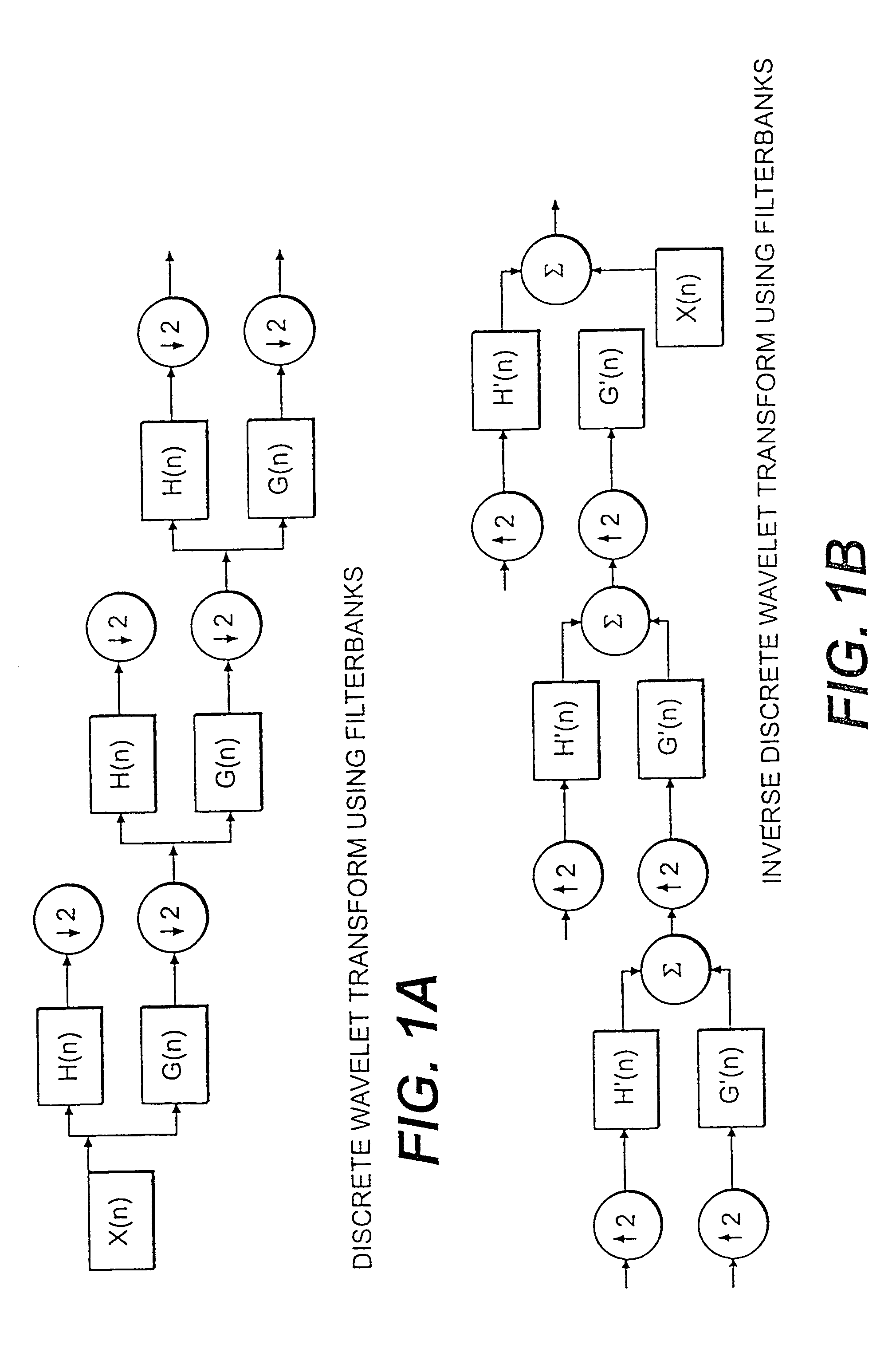
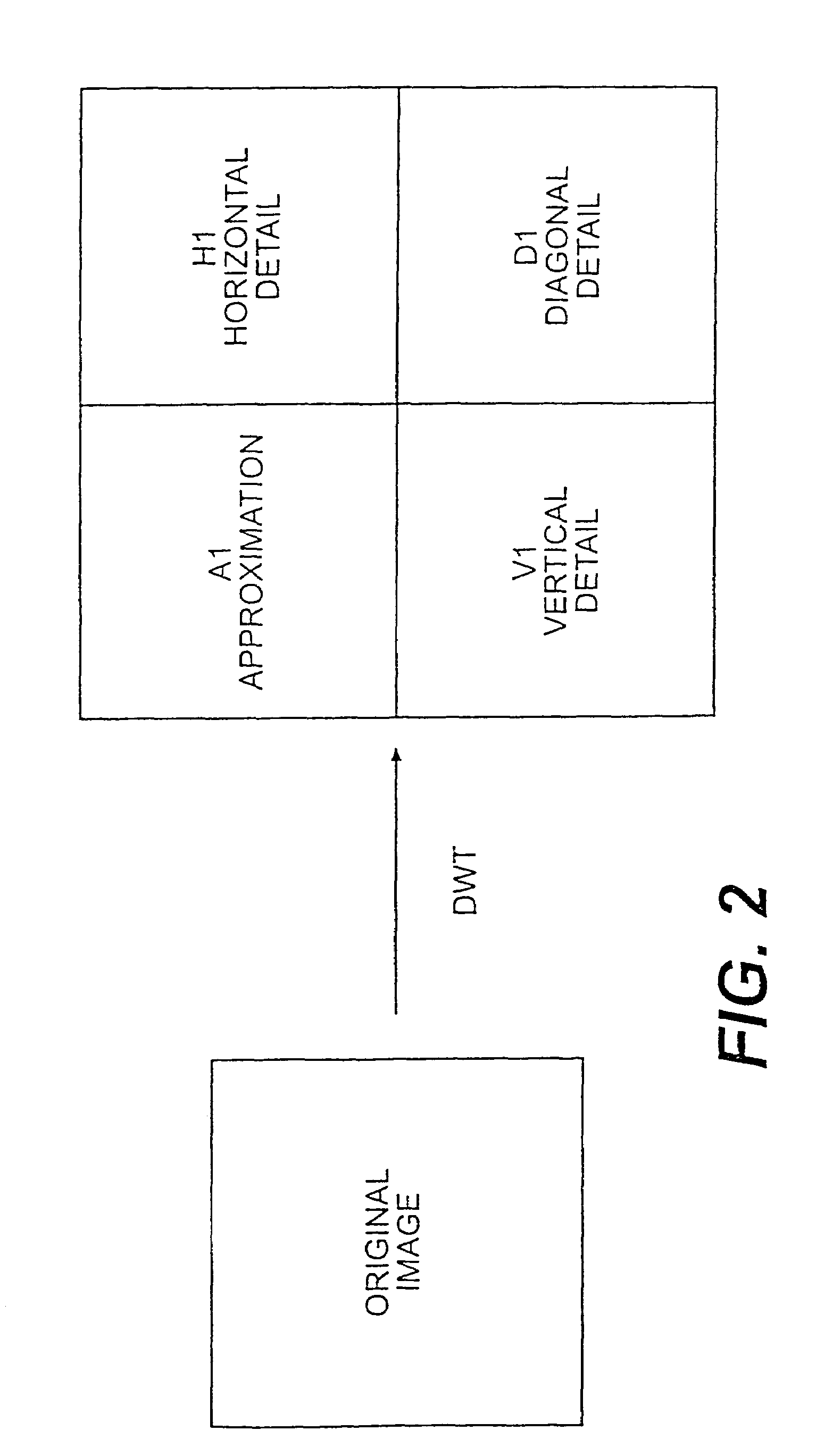
[0019]The foregoing and other objects of the present invention are achieved by the present invention based on the use of a unique combination of two algorithms, namely, a wavelet transform (WT) and a discrete cosine transform (DCT). In accordance with the present invention, a watermark is embedded into a digital image by using wavelet transform and discrete cosine transform. The present inventive method is found to be effective against impairment of the watermark that would otherwise be caused by the image processing operations, such as compression, filtering and cropping.

Problems solved by technology

However, there are problems associated with the rapid distribution and dissemination of the information.
One of the problems are the proliferation of the unauthorized copying and illegal distribution of copyrighted digital material.
This problem is compounded by the fact that the multimedia digital information of text, image, video, and sound can be easily mass-duplicated in exact copies.
It is illegal to remove the notice and illegal to copy without the author's permission.
But preservation of the copyright notice and prevention against illegal copying is very difficult against infringement and illegal copying.
But there is a problem of image distortion in the information produced by the conventionally available watermarking processes according to the known prior art.
The spatial method has the advantage that the watermark can be added easily, but has the disadvantage in that the image or information being watermarked and the image itself is susceptible to distortion as it is subjected to lossy compression and filtering.
Although the watermark created by the frequency domain method is difficult to erase because it is distributed over the entire data, there is the problem of image distortion depending on the values of the coefficients.
But this method causes the watermark to suffer in the data compression stage, that is, the watermark is considerably impaired in the data compression stage.

Method used

the structure of the environmentally friendly knitted fabric provided by the present invention; figure 2 Flow chart of the yarn wrapping machine for environmentally friendly knitted fabrics and storage devices; image 3 Is the parameter map of the yarn covering machine
View more

Image

Smart Image Click on the blue labels to locate them in the text.
Viewing Examples
Smart Image
  • Watermarking of digital images using wavelet and discrete cosine transforms
  • Watermarking of digital images using wavelet and discrete cosine transforms
  • Watermarking of digital images using wavelet and discrete cosine transforms

Examples

Experimental program
Comparison scheme
Effect test

example 1

Evaluation of Watermark Preservation After Lossy Compression of Images

[0057]In general, images are compressed before being transmitted because uncompressed files such as a BMP file could be huge in size. Image compressions may be classified into lossy compressions and lossless compressions. Lossy compressions are widely used due to its high compression ratio despite minor degradation of the original image. JPEG is a representative example of a lossy compression. As mentioned above, since watermarks should be preserved after image processing, a watermarking method is commercially usable if no problem occurs after a lossy compression.

[0058]Accordingly, an experiment was conducted to test the preservation strength of watermarks by changing the Q factor of JPEG to 50%, 30%, 20%, and 10%. As a result, the watermark after 20% JPEG compression was clearly identified. The watermark after 10% JPEG compression was somewhat blurred, but was still visually identifiable.

example 2

Effect on Watermarks After Filtering of Images

[0059]Since images typically go through filtering to eliminate the noise, an experiment was conducted to find out the effect on watermarks after a low-pass filter and a median filter images. The test confirmed that the watermarks could be successfully extracted. The correlation of watermarks extracted is shown in Table 1.

[0060]

TABLE IFilter TypeLow Pass FilterMedian FilterCorrelation26.83%57.84%

[0061]The result shows that the watermarks were not affected by filtering through the low-pass and median filter.

example 3

Effect on a Watermark After Resampling

[0062]An experiment was conducted to test a watermark generated according to the algorithm of the present invention after resampling, where resampling extinct the entire pixel values of an image. The correlation of an extracted watermark after losses of 3 bits, 4 bits, and 5 bits is shown in Table 2.

[0063]

TABLE 2Loss of bits3 bits4 bits5 bitsCorrelation18.81%37.62%72.99%

[0064]The test shows that the extracted watermark could be clearly recognized after resampling.

the structure of the environmentally friendly knitted fabric provided by the present invention; figure 2 Flow chart of the yarn wrapping machine for environmentally friendly knitted fabrics and storage devices; image 3 Is the parameter map of the yarn covering machine
Login to View More

PUM

No PUM Login to View More

Abstract

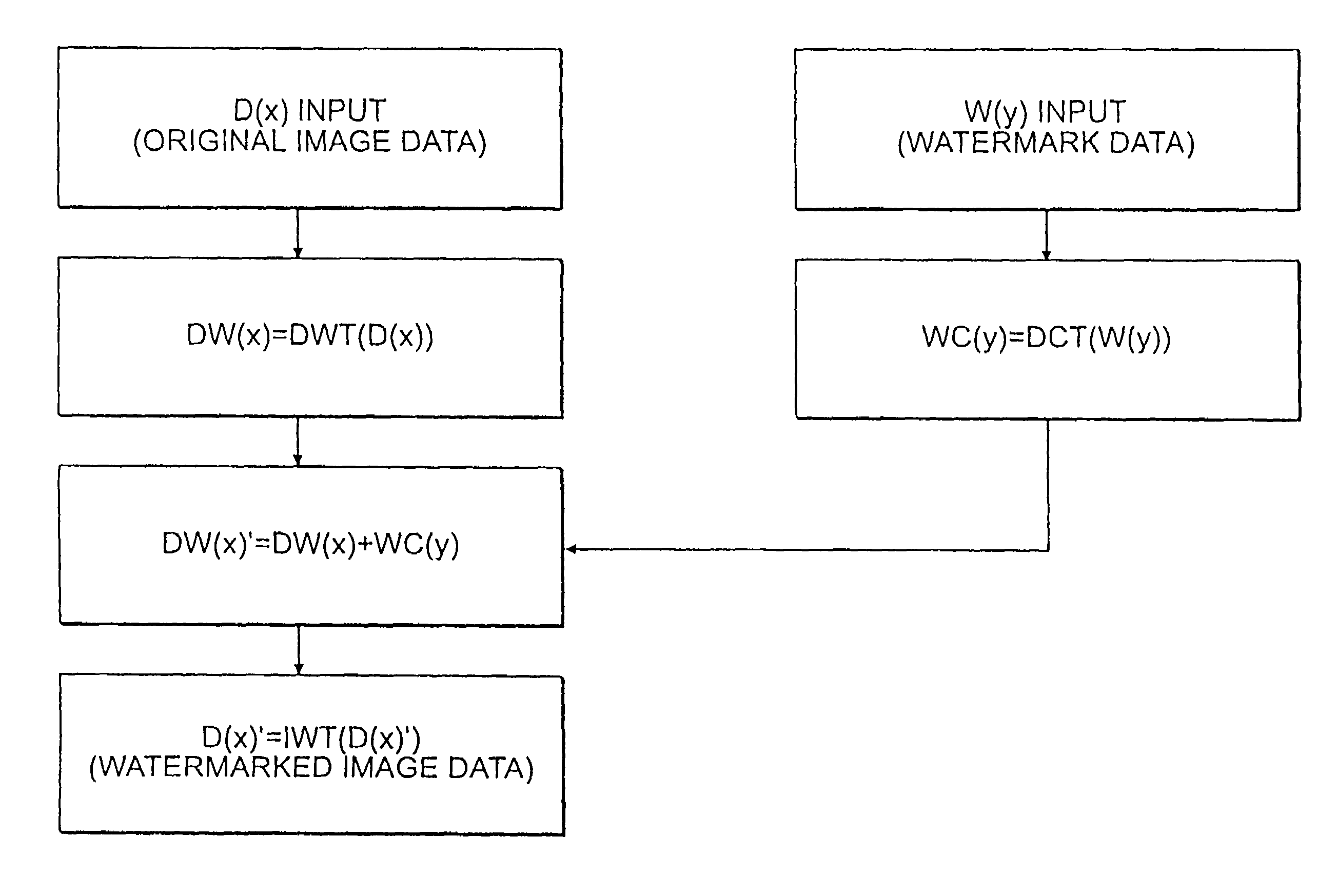
The present invention relates to a method for embedding a watermark into a black and white or color digital image [D(x)]. Basically the inventive method comprises the steps of transforming the digital image using a wavelet transform [WC(y)], transforming a watermark using discrete cosine transform (DCT), integrating the wavelet-transformed digital image with the DCT-transformed watermark [DW(x)+WC(y)] to insert the watermark into the image, and generating the watermarked image using inverse wavelet transform [D(x)′]. For color images, RGB mode is converted into YIQ mode using a conversion matrix and the wavelet transform is applied to the Y-, I-, Q-values. This inventive digital watermarking of a color image is found to be highly robust against lossy compression and other image processing operations, compared to conventionally known methods which are known to be unsuitable for watermarking color images.

Description

[0001]This application is based on two Korean Patent applications, both filed on Sep. 10, 1998 at the Korean Intellectual Property Offices by the same inventors, wherein one of the two applications is entitled, A Watermarking Process of Digital Image Using Wavelet Transform and Discrete Cosine Transform, with a Korean Patent Application Serial Number 37273 (issued as Korean Patent No. 289365 on Feb. 19, 2001) and the other of the two applications is entitled, A Digital Watermarking Process of a Color Image Using Wavelet Transform and Discrete Cosine Transform with a Korean Patent Application Serial Number 37274 (issued as Korean Patent No. 285077 on Dec. 28, 2000).TECHNICAL FIELD[0002]The present invention relates to a method of watermarking of digital images in general, and in particular, to a method of embedding watermarks into digital images by using wavelet transform (WT) and discrete cosine transform (DCT) so that the impairment of the watermark during image processing operatio...

Claims

the structure of the environmentally friendly knitted fabric provided by the present invention; figure 2 Flow chart of the yarn wrapping machine for environmentally friendly knitted fabrics and storage devices; image 3 Is the parameter map of the yarn covering machine
Login to View More

Application Information

Patent Timeline
no application Login to View More
IPC IPC(8): G06K9/00
CPCH04N1/32144H04N1/32165H04N1/3217
Inventor CHOI, JONG UKKIM, JONG WONCHO, JUNG SUCKLEE, HAN HO
Owner MARKANY
Features
  • R&D
  • Intellectual Property
  • Life Sciences
  • Materials
  • Tech Scout
Why Patsnap Eureka
  • Unparalleled Data Quality
  • Higher Quality Content
  • 60% Fewer Hallucinations
Social media
Patsnap Eureka Blog
Learn More