[0007]It is, therefore, an object of the present invention to provide a razor that provides
improved performance relative to existing razors, and one that is more comfortable to use than existing razors.
[0009]The four or more razor blades of the present invention cartridge and razor
assembly provide several advantages over currently available razor cartridges and razor assemblies. Most modern safety razors include one to three razor blades disposed between a guard and a cap. The
cutting edge of each
razor blade is positioned adjacent a plane (i.e., the “
contact plane”) that tangentially intersects the contact surfaces of the guard and the cap. The
contact plane represents the theoretical position of the surface being shaved. The position of a razor blade's cutting edge relative to the
contact plane is described in terms of the “
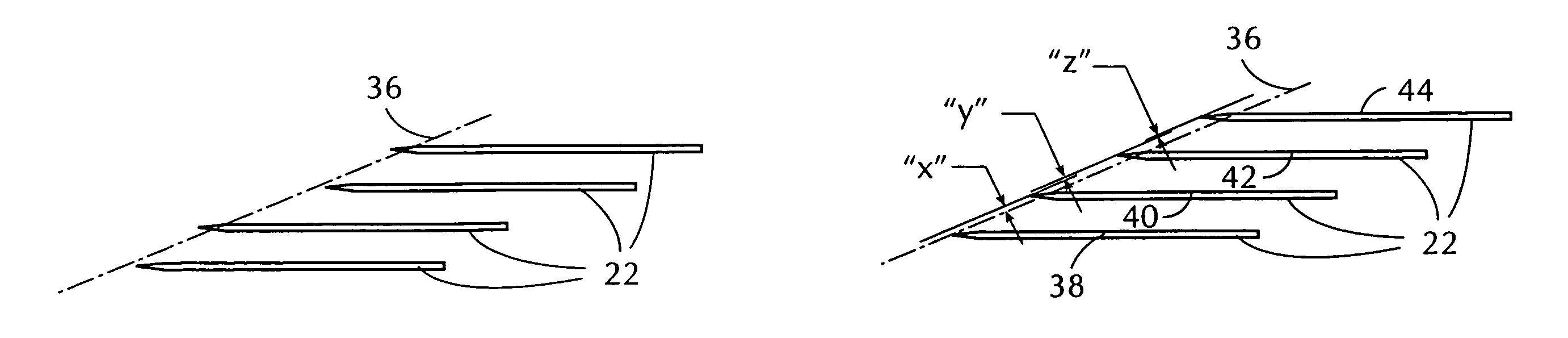
exposure” of the cutting edge. A cutting edge with “positive exposure” is one where the blade and its cutting edge extend through the plane and into the area normally occupied by the object being shaved. A cutting edge with “negative exposure” is one where the cutting edge of the blade is positioned below the plane and therefore does not intersect the contact plane. A blade with “neutral exposure” is one where the cutting edge of the blade is contiguous with the contact plane. In a single blade razor, the single blade must
cut each hair at the prescribed height in
one pass, or
cut sections of each hair in multiple passes until the prescribed height of each of those hairs is reached. If the single blade razor is designed to cut at the prescribed height in a
single pass, it is likely to have a substantial positive exposure. A problem with positioning a blade at a substantial positive exposure is that it increases the chance of
skin irritation. On the other hand, if the single blade razor is positioned to have a slight positive, neutral, or negative exposure, the likelihood of irritation in
one pass is diminished. However, the closeness of the shave possible with a single pass is also diminished, making it necessary to pass the razor over the same surface multiple times, which also increases the chance of
skin irritation.
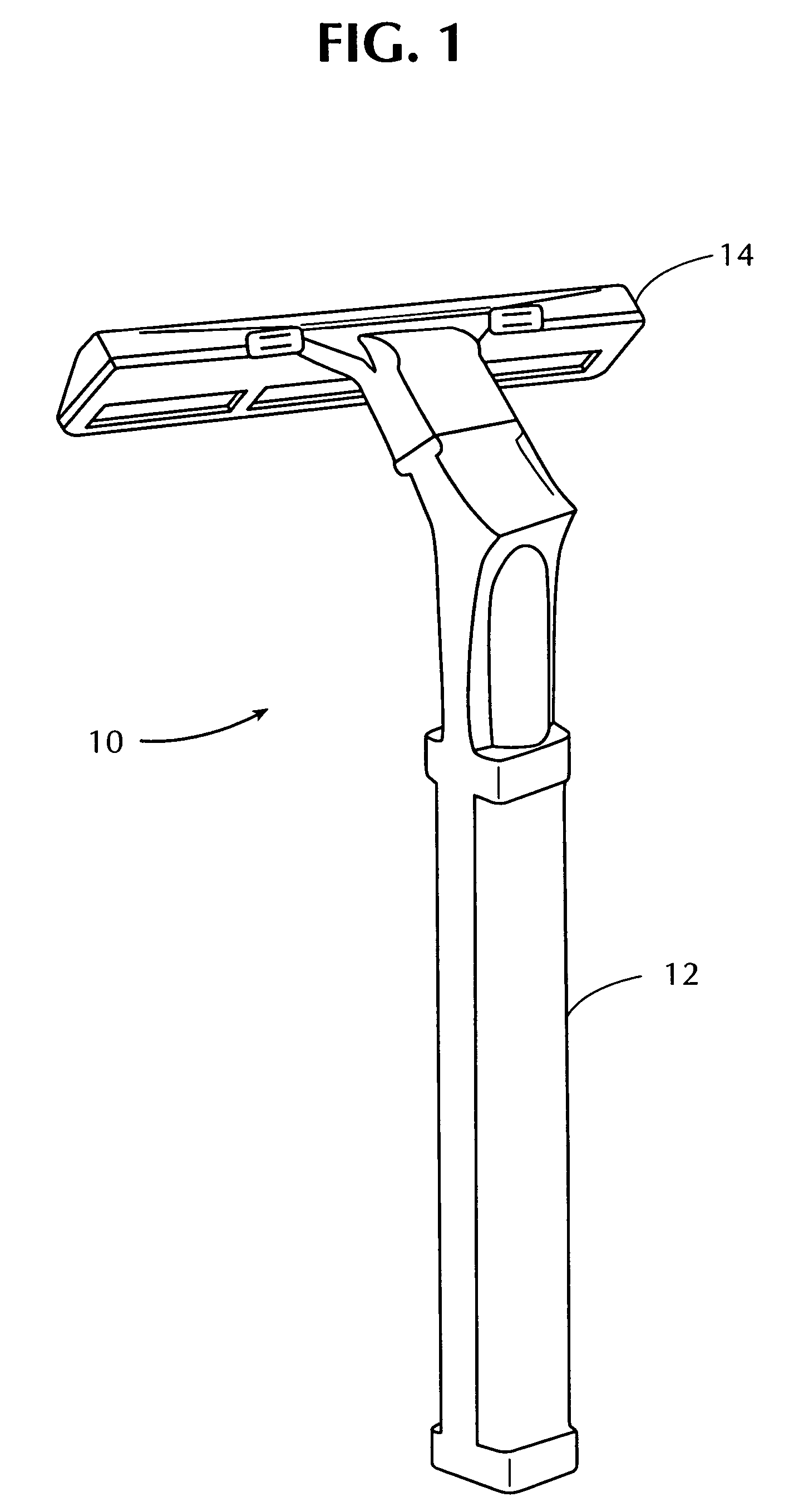
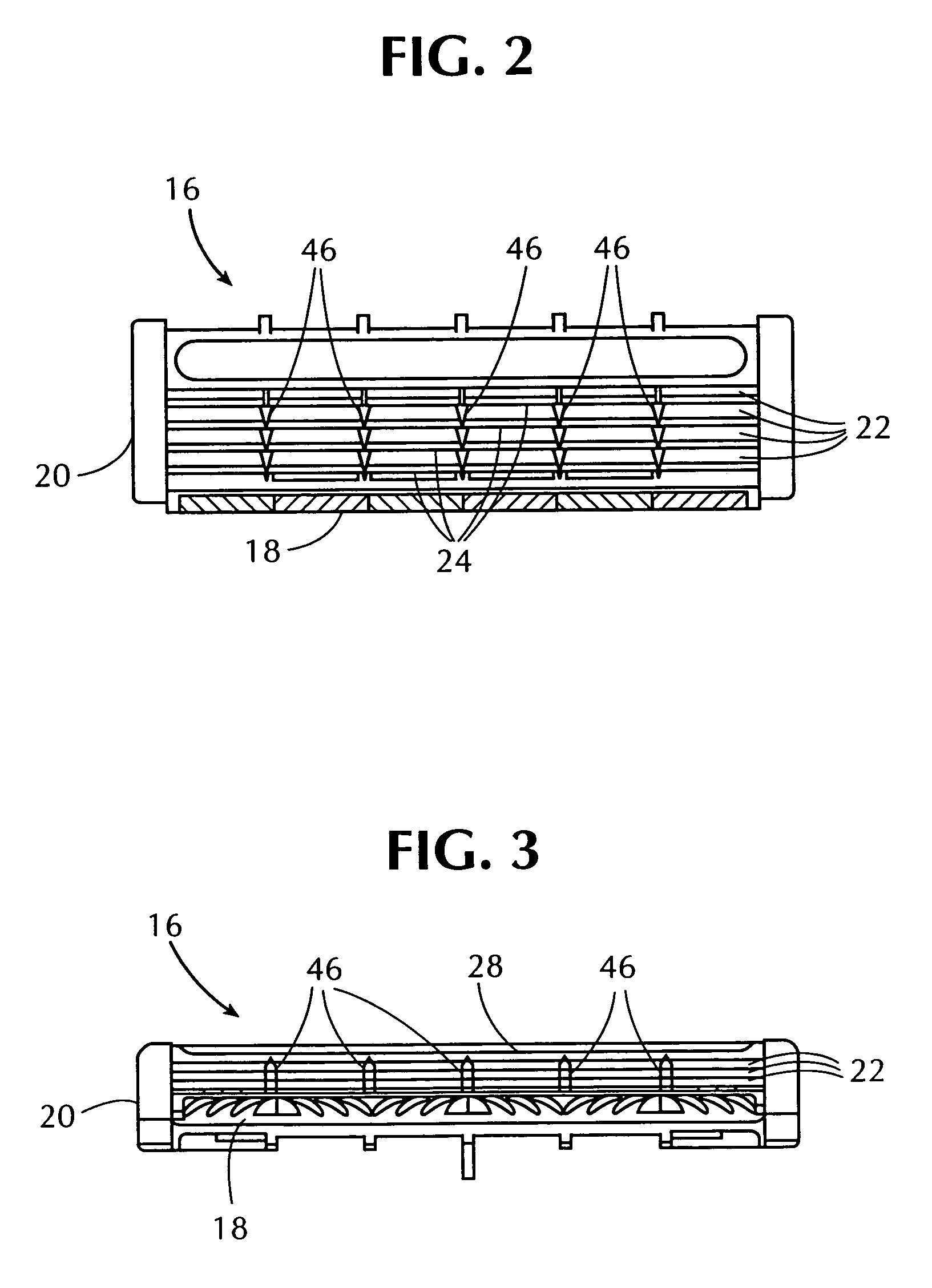
[0010]The present invention, in contrast, exposes the surface to be shaved to at least four razor blades in succession. The blades can be positioned in a variety of different exposure configurations to provide different “feels” or to tune the razor for different applications. In all cases, the work of cutting the hairs is distributed among the four or more razor blades. Each razor cuts a portion of the hairs and collectively the desired closeness of shave is provided in a single pass. The chance of irritation is consequently reduced.
[0011]The four or more blades of the present invention and the different blade exposure configurations possible therewith provide a multitude of options not possible with the one to three blade razors presently available. As stated above, there is a relationship between the exposure of the blade(s) and the chance of irritation, and a relationship between the number of razor passes and the chance of irritation. The present invention makes it possible to decrease the exposure of the blade(s) and the necessity to make multiple passes over the same
skin surface. As a result, the chance of irritation is greatly reduced and the comfort and performance of the shaving device is improved.
[0012]In addition, the four or more blades of the present invention make it possible to provide a range of blade exposures not practically possible with two or three bladed razors. If, for example, the maximum amount of acceptable exposure change between adjacent blades is 0.2 mm, then a three bladed razor cartridge has a maximum collective blade exposure of 0.6 mm. Under the present invention, in contrast, the same maximum collective blade exposure would be 0.8 mm or greater. This increased range makes it possible, for example, to position the forward-most blade at a substantial negative exposure and the aft-most blade at a substantial positive exposure.
[0013]Another configuration possible with the present razor cartridge is one in which the range of razor blade exposure is similar to that found in presently available two or three bladed razors, but the amount of exposure change between adjacent blades is reduced. In this configuration, increased comfort and performance are provided because the amount of hair removed per blade is reduced.


 Login to View More
  Login to View More