
Chemical process for the production of 1,3-diglyceride oils
Inactive Publication Date: 2006-07-25
KAO CORP
View PDF11 Cites 19 Cited by
- Summary
- Abstract
- Description
- Claims
- Application Information
AI Technical Summary
Benefits of technology
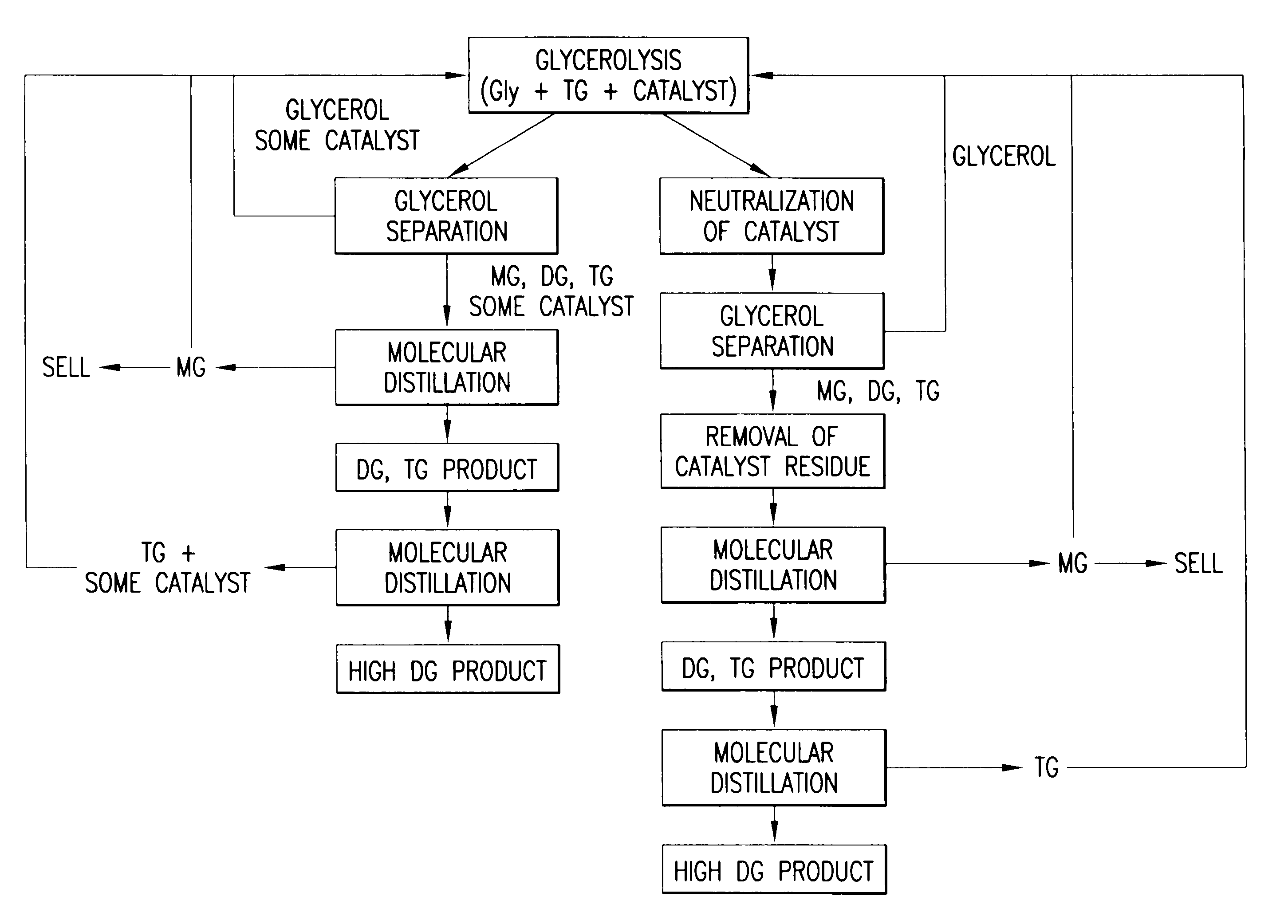
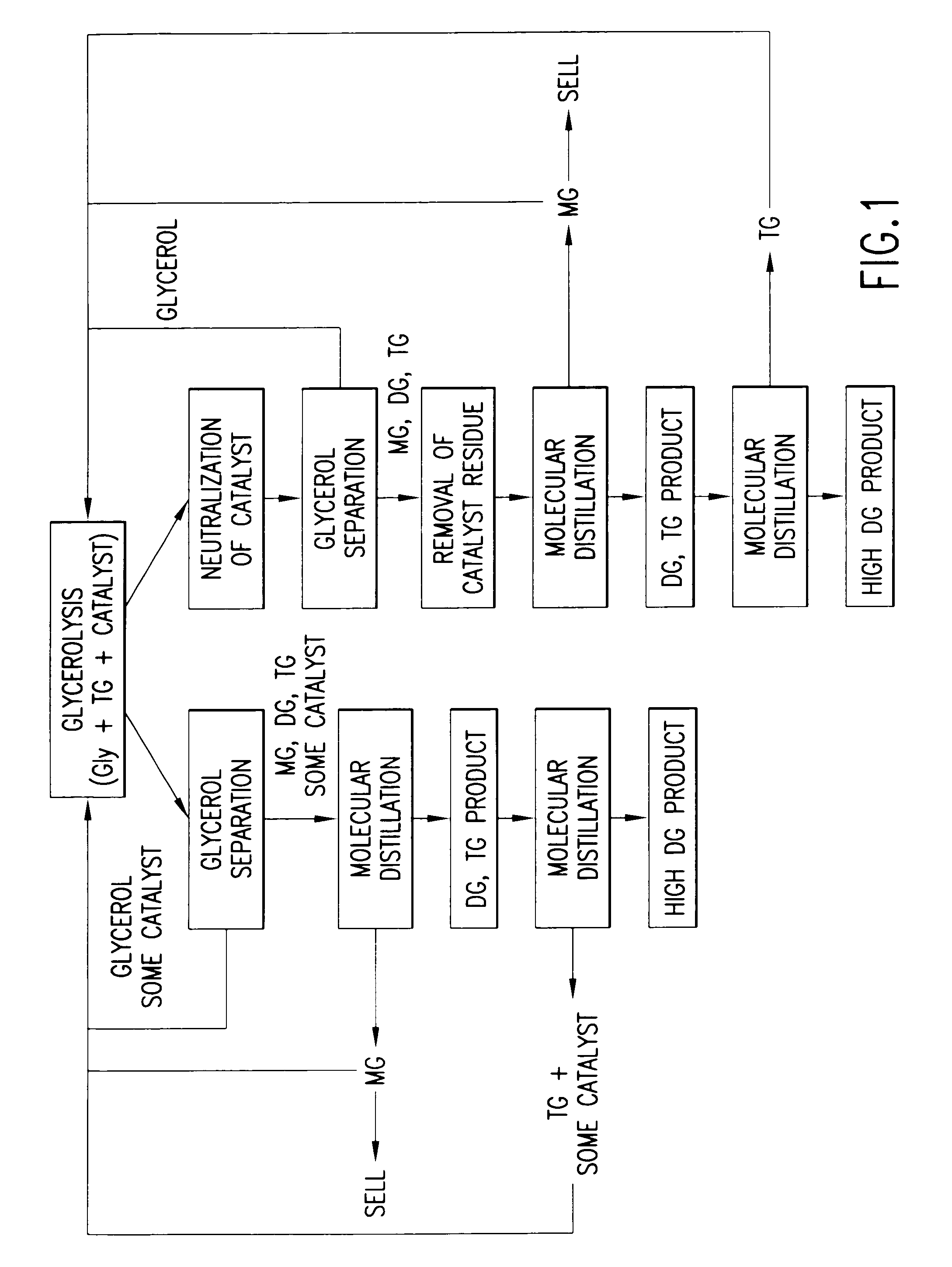
[0009]In an effort to produce DG oils rich in 1,3-diglycerides in a simpler and more economical manner, it has been determined that DG oil compositions can be prepared chemically. Chemical preparation of DG oils avoids the fat splitting, fatty acid separation, clean-up and selective enzymatic esterification steps required in the method disclosed in WO 99 / 09119. When diglyceride oil was prepared chemically, as described in the following examples, the ratio of 1,3- to 1,2-diglycerides was essentially the same as the commercially available DG oil product.
[0011]Another advantage of the present chemical process over the enzymatic process disclosed in WO 99 / 09119 is that a large variety of DG oil products having different physical properties can be produced for various applications such as shortenings, margarines, frying fats, and the like. The products that can be made by enzymatic esterification are limited due to the enzyme's thermal stability and the acyl migration that occurs during enzymatic esterification at higher temperatures. In the WO 99 / 09119 document, the esterification was done at 40° C. in order to maintain enzyme stability and viability, and to minimize acyl migration, which can increase the formation of TG and change the ratio of positional isomers. Due to the high-melting characteristics of many fats, it is not practical to prepare these forms of DG products by the enzymatic process. There is no such limitation, however, for the instant chemical process. The present chemical method opens up the opportunity to manufacture a variety of DG oil products, which could not be made enzymatically.
Problems solved by technology
The products that can be made by enzymatic esterification are limited due to the enzyme's thermal stability and the acyl migration that occurs during enzymatic esterification at higher temperatures.
Due to the high-melting characteristics of many fats, it is not practical to prepare these forms of DG products by the enzymatic process.
Method used
the structure of the environmentally friendly knitted fabric provided by the present invention; figure 2 Flow chart of the yarn wrapping machine for environmentally friendly knitted fabrics and storage devices; image 3 Is the parameter map of the yarn covering machine
View moreImage
Smart Image Click on the blue labels to locate them in the text.
Smart ImageViewing Examples

Examples
Experimental program
Comparison scheme
Effect test
example 1
[0023]Nusun oil (400 g) was placed in a 1-L round bottom flask and dried by heating the oil to 90° C. under vacuum for 30 minutes. Glycerol (80 g) and NaOH (1 g) were added with vigorous agitation to the dried oil. After a 3-hour reaction at 145° C., the reaction mixture was cooled before it was centrifuged to separate oil phase from residual glycerine for color measurement. The color of the oil phase was 12.5 Red and 70 Yellow. The original Nusun oil had color of 0. 8R and 4.1Y.
example 2
[0024]The same procedure as in Example 1 was used, except the reaction time was 4 hours.
example 3
[0025]The same procedure as in Example 1 was used, except the reaction time and temperature was 170° C. and 1 hour, respectively.
the structure of the environmentally friendly knitted fabric provided by the present invention; figure 2 Flow chart of the yarn wrapping machine for environmentally friendly knitted fabrics and storage devices; image 3 Is the parameter map of the yarn covering machine
Login to View More PUM
| Property | Measurement | Unit |
|---|---|---|
| Temperature | aaaaa | aaaaa |
| Temperature | aaaaa | aaaaa |
| Temperature | aaaaa | aaaaa |
Login to View More
Abstract
A method for producing 1,3-diglyceride oils from triglyceride containing oils is disclosed. The method uses alkali metal salts or alkali earth metal salts of mono-carboxylic or di-carboxylic acids to drive glycerolysis under conditions such that commercial, food-quality 1,3-diglyceride oils are produced.
Description
CROSS-REFERENCE TO RELATED APPLICATIONS[0001]This application claims the benefit of U.S. Provisional Application No. 60 / 327,762, filed Oct. 3, 2001, the contents of which are fully incorporated by reference herein.FIELD OF THE INVENTION[0002]The present invention relates to a method for producing 1,3-diglyceride oils from triglyceride containing oils. More specifically, the invention uses alkali metal salts or alkali earth metal salts of mono-carboxylic or di-carboxylic acids to drive glycerolysis under conditions such that commercial, food-quality 1,3-diglyceride oils are produced.BACKGROUND OF THE INVENTION[0003]With obesity on the rise in the industrialized countries, the incidence of degenerative diseases such as cardiovascular disease, hypertension and diabetes is also rising at alarming rates. While obesity can be due to a combination of genetic, psychological, socioeconomic and cultural factors, a more straightforward, bottom-line explanation is that obesity is “caused” by an...
Claims
the structure of the environmentally friendly knitted fabric provided by the present invention; figure 2 Flow chart of the yarn wrapping machine for environmentally friendly knitted fabrics and storage devices; image 3 Is the parameter map of the yarn covering machine
Login to View More Application Information
Patent Timeline
 Login to View More
 IPC IPC(8): C11C1/00B01J31/04C11B7/00C11C3/06
CPCC11C3/06C11B7/0008
InventorJACOBS, LEWISLEE, IMMOKPOPPE, GEORGE
OwnerKAO CORP